Sermon for 11.9.14

Lessons for today are here.

$(KGrHqJHJD!E8fYS9T9MBPLq31Wjhg~~60_35You’ve probably seen the bumper stickers: “Jesus is coming. Look busy.” Or: “In Case of Rapture, Car will be without Driver.” Or my personal favorite: “After the rapture, can I have your car?”

There’s lots of talk out there about the Rapture, the Second Coming of Christ. For instance, there’s the “Left Behind” series – 12 books based on a particular interpretation of Christian end-times prophecies. The series has sold millions of copies, and has recently spawned a high-budget movie starring Nicolas Cage. I will admit that I am not an authority on these books – I got about two chapters into the first one and found it so disturbing I had to stop reading. But from what I gathered, these books begin with the Rapture: people are caught up into heavens to meet returning Jesus – which is one interpretation of the Thessalonians reading this morning. All the good people vanish, leaving piles of clothes and personal effects behind. Planes crash, driverless cars cause chaos, the world is in flames. Only “saved” Christians are taken; sinners and people who are the wrong kind of Christians (such as many Roman Catholics, and I’m sure, many Episcopalians) are Left Behind.

left_behind_nicolas_cageThe rest of the series involves the tribulation, as a few people belatedly realize their mistake in not being saved before, and valiantly fight against the anti-Christ and his minions. Eventually, around the tenth book or so, Christ will return to earth and will start an absolute blood-bath of blowing up his enemies. One commentator calls this blood-bath the return of the “Christ-inator” (similar to the Terminator) and wonders how Christ went to heaven and got a complete personality transplant. I mean, is this the same Jesus who said we need to love God and love our neighbors? The Jesus who forgave his enemies from the cross?

But there it is: it’s one interpretation of what Christ’s return will look like, very popular among a certain set of American Christians (not a well-known interpretation outside the US). It is based on a particular interpretation of the end-times that is distinctly modern – it was not even thought up till the 19th century, and it is certainly not traditional Christian theology.

What is so disturbing about it all is the absolute gleefulness that Christians feel as they read about (or watch in movies) people who aren’t Christians – or who are different kind of Christians than they are – meeting death and destruction. And question becomes: would Jesus really do this to people he came to save?

parable-of-the-ten-bridesmaidsThe unfortunate thing is, if you read today’s gospel a certain way, it seems he might. In the parable we read today, ten bridesmaids are waiting for the bridegroom; five are wise and have plenty of oil, but the other five are foolish and, right when the bridegroom arrives, they discover they’ve run out of oil and have to go run off to find some. The bridegroom lets the wise ones in, and locks the door against the foolish ones. And when they come and pitifully start banging on the door, he refuses to let them in – I don’t know you, he says. Devastating.

If you’re of a “Left Behind” frame of mind, this story is really easy to fit into your scenario – the five wise ones have already been saved, the five foolish ones didn’t prepare by repenting and being saved, and oops! They’re left behind. It’s pretty cut and dried, rule-based, theology based on who’s in and who’s out. Problem is, Jesus really didn’t seem to operate like that. Jesus included everyone, especially the foolish ones, the ones no one expected God to like, the prostitutes and tax collectors. No one was left behind or left out by Jesus. Furthermore, Jesus says over and over that we are supposed to share what we have with others, not hoard it as these “wise” bridesmaids hoard their oil, refusing to share because there won’t be enough left for themselves. How is this a Christian way to act?

Preacher Anna Carter Florence did a small rewrite of parts of the Sermon on the Mount in light of this parable, that goes like this: (Matthew 6:19ff) “Do not store up for yourselves treasures on earth, where moth and rust consume and where thieves break in and steal; but store up for yourselves treasures in heaven, although to get there, you will need large oil reserves, so forget the first part of what I said; store up for yourselves oil on earth, so that you will have treasure in heaven.”

Or (Matthew 6:25ff) “Therefore I tell you, do not worry about your life, what you will eat or what you will drink, or about your body what you will wear. Worry about your oil; that’s the main thing. Worry about whether you have enough for you, and forget about everyone else; they are not your problem.”

Or (Matthew 7:7ff) “Ask, and it will be given you; seek, and you will find; knock, and the door will be opened for you, unless of course you’re late and the bridegroom answers, in which case, you might as well forget it.”

And so on. The point is, this is a very curious parable – it the light of the rest of the gospel, it makes no sense. This bridegroom who won’t let in a few foolish bridesmaids – is this the same person as the Jesus who said he was the Good Shepherd, who would leave 99 well-behaved sheep just to chase after one lost sheep? This bridegroom seems never to have heard of that Jesus. This story seems to be just about punishment for small missteps – like in “Left Behind.” Punishment that glories in the misfortunes of the ones who are left out of the party.

But I don’t think Jesus was the “Christ-inator” – the one who comes to punish his enemies. I think Christ was the Savior – the one who came not to condemn, but save world. (It says so in the first chapter of the Gospel of John). So let’s look a little more closely at the parable.

All ten bridesmaids were invited to the feast; all ten accepted the invitation. But the bridegroom was late in arriving, and all ten fell asleep. At this point, we need to note that Matthew’s gospel was written around 80 AD – 50 years after Jesus died – at a time when Christians were very concerned that the Second Coming of Christ hadn’t happened yet. The bridegroom being delayed would be a matter of high anxiety for them, especially in light of what was going on in their world. The Temple in Jerusalem had been destroyed, both Jews and Christians were driven into exile, both were being persecuted, and they were both trying to figure out if they were one religion or two, and were busy separating themselves from each other and excluding each other. These Christians of Matthew’s time, surrounded by all this anxiety, would have to be wondering how to act until Christ appears.

Back to the parable: then someone catches sight of the bridegroom, all ten bridesmaids wake up, but five of them get all anxious about a trivial detail – their lamps – and run off before he arrives, while he is only steps away. In essence, the bridegroom in in sight right there, but they decide that there is something more important than him to concentrate on. That’s why they are shut out – not by his choice, but by theirs – because when the bridegroom arrives, you need to be ready to greet him with joy. The arrival of the bridegroom – Jesus – needs to be the most important thing there is. Nothing else takes precedence.

Which leads me to ask: how are we preparing for the bridegroom’s coming? If the people of Matthew’s time were concerned because Jesus had been gone for 50 years, well, for us, he’s been gone for 2,000 years – and it sure is easy to get distracted and begin to believe that trivial details of our lives are more important than he is.

So how do we prepare for the fact that Christ is real, and that someday we will meet him? I’m not talking about something as simple as whether we’ve been saved, whether we consider ourselves Christian, whether we think there is such a thing as the Rapture, whether in case of rapture our car will be driverless! I want to know, is our spiritual health, is our love of God and our neighbor the most important thing in our lives? Are our lamps lit, are our eyes open to see Christ in action and join him wherever he is?

If not, what has become more important? What distracts us from God? What takes our attention off the things that really matter and redirects it to things that don’t? Like foolish bridesmaids who run off to take care of one last detail when the bridegroom is in sight and the wedding is about to begin?

This world has many distractions – busy schedules and worries about money, and family quarrels, and work that absorbs all our time and energy, and politics and entertainment and the internet – and it’s easy to neglect our spiritual lives. We have so many choices that it’s hard to put them in order. Should I pray, or do Facebook? Should I go to church, or clean my house? Should I take my kids to Sunday school, or should they go to soccer? Should I give money for God’s mission, or should I let someone else take care of it? Should I do an act of service for someone, or should I go to work?

We have so many priorities in our lives, yet all of them, potentially, are distractions from the bridegroom. Like the five foolish bridesmaids, we are in danger of spending way more time on anxiety over details than on concentrating on things of ultimate importance. While the things of ultimate importance are neglected, like daily prayer, like worship, like asking God for guidance, like doing intentional acts of service. Like opening our eyes to the God of the universe who loves us and wants to remake us into the glorious people we were created to be.

So many of us have settled for way too little in life, when God wants to give us everything. The cares of this world have deceived us and beckoned us. So we pour ourselves into them, we stress ourselves out, we forget to nourish ourselves spiritually, we don’t keep our lamps lit, we close our eyes and miss the presence of Christ, the bridegroom, right here. We forget who we are.

Who we are is children of God, made in the image of God, created to be in communion with God through Christ. And Christ is coming. Christ is always coming.

Christ is coming to this church, in this holy communion. He will be here any minute now. Indeed, he is already here, where two or three are gathered.

Jesus says to wait, with eyes wide open.

To wait with longing for the thing that is most important.

The bridegroom is coming, and indeed, he is almost here. Alleluia.

Sermon Notes for 10.5.14

The scriptures for today are here.  I am preaching on Philippians 3:4b-14.

Years ago, when we lived in Texas, long before we had children, my husband Tom and I used to take a vacation each year, right after Christmas, to Big Bend National Park. The park is on the far southwestern edge of Texas, where the border with Mexico makes an elbow shape. That border is formed by the Rio Grande River, which is deep and wide there.

santa-elena-canyon-big-bendOne day we took a hike right along the banks of the Rio Grande. At this place the river carves a deep channel through a mountain, so you can hike along the US side next to the river and walk deeper and deeper into a canyon formed by the mountain walls rising on both sides of the river. To get to the canyon, you walk across a tiny little stream, three feet wide, just deep enough to splash water two inches high on your hiking boots, that runs from way high up in the mountains down into the Rio Grande half a mile away.

We walked across the little stream, into the canyon, and deeper and deeper into the wild, beautiful channel cut by the river over thousands of years. As we were walking we heard a little thunder, way far off, but it was sunny where we were, so we paid it no attention. Then, as late afternoon came, we finally turned and headed back.

And then we came to little stream. Only, there was no little stream any more. That thunder we had heard way far off was rain, up in the mountains. And the rain had turned that tiny little stream into a giant rushing river. We stood at the edge of it, watched the dirty, churning, turbulent water rushing by, thought about camping out for the night – but we had no food, no blankets, no flashlights, no shelter, no one knew where we were. So we thought – hey, we’re young, we’re 25 years old, what could happen to us? And we waded into the river. Which was a very big, very dumb mistake.

As we walked in, the river quickly rose up to our chests – and it was moving fast. You couldn’t keep your footing in water like that. Water, I had never been afraid of – I had been a swimmer all my life. I knew how to control myself in water. But this water was something new and frightening. This water was a power I had never felt before – a power that was far stronger than my willpower or my training. It swept me off my feet more than once – I couldn’t grab for Tom, he was having just as much trouble as I was, hauling himself across the river.

This is the time when, no matter your personal beliefs, you need to pray. I discovered the best I could do was “God, help!” And somehow, God helped. For a few minutes, as I struggled across that rushing water, I was truly afraid that one or both of us wouldn’t make it. But step by step, with the water pushing us steadily downstream toward the Rio Grande, we hauled ourselves across the water and pulled ourselves, soaking wet, out on the other side. And we looked at each other, astonished and shaken, with new respect fort a force of nature seeming so benign and friendly, like water, yet so strong that it could sweep us out of control.

Sometimes I wonder if that’s exactly how the apostle Paul felt when he met Jesus. Paul had plenty of experience with God, with religion, with knowing how to act as God commanded in the Ten Commandments and other 603 laws. He tells us about it in the reading from Philippians today. The context of this reading is, there are teachers who have come to the Christians in Philippi and tried to convince them that in order to be true followers of Christ, they must live as true Jews: circumcised and following all 613 commandments of Jewish law. Paul is very clear that living as Jews is a good and right thing for Jews, but not for Christians, especially Christians who were born as Gentiles. For Christians, Paul says that marking our bodies as members of God’s people and following intricate rules that set us apart is not what is required, because these things rely on our own personal skills in being holy.

If personal holiness were enough, Paul says, he would have been a champion at holiness (Paul is never particularly humble). “If anyone else has reason to be confident in the flesh,” he writes, “I have more: circumcised on the eighth day, a member of the people of Israel, of the tribe of Benjamin, a Hebrew born of Hebrews; as to the law, a Pharisee; as to zeal, a persecutor of the church; as to righteousness under the law, blameless.”

In other words, Paul had a PhD in holiness: he studied at the feet of one of the most famous rabbis of his era, Gamaliel, a rabbi so famous that he is still studied and revered today. Paul had plenty of training in how to be holy: he had all the credentials; he had developed his religious muscles through years of careful obedience to the law. But he discovered that personal religious training was not enough, because learning the skills of religious holiness means relying on personal power. And he discovered that personal power was nothing compared to the awe-inspiring, irresistible power of God.

One day, as he traveled to Damascus to find and persecute members of the upstart sect of Christ-followers who insisted Jesus was raised from the dead, the divine force of God overtook him and swept him away; he was confronted face to face by the living Christ; he was struck blind by power of Spirit and was led, groping and shaken, to Damascus, where a loving group of Christians nursed him back to health and taught him the truth of the living God. He was blind, but he learned to see. And his whole life changed by the amazing grace of God.

All that training, all that background, all that personal skill in holiness he had developed over a lifetime of exercising careful religious muscles, he learned to count as nothing, as rubbish, as he says today. He learned that his own righteousness wasn’t what mattered: what mattered was Christ. He yearns, “I want to know Christ and the power of his resurrection and the sharing of his sufferings by becoming like him in his death, if somehow I may attain the resurrection from the dead.” In thanksgiving for gift of God’s holiness, he presses on; he travels around the known world, risking his life and his health and his possessions to tell others the good news of salvation and lead others into relationship with living God.

To Paul, the awe-inspiring, uncontrollable, overwhelming power of the living Christ required him to give up everything he had learned on his own, to let go of personal power, and give himself up to the rushing river of God’s holiness. And it is probably because of Paul and the transcendent gift of salvation he received, and his determination to press on, that you and I have heard of Christ and have the chance to stand in awe of that same holiness today.

And oh, how we need that gift of holiness that comes to us from the living Christ. We live in a culture that glorifies personal achievement: that pushes all of us to work more, try harder, push ourselves beyond our limits, be the best. And while I’m all in favor of learning and working and achieving, there are times when all of us find that our whole identity gets caught up in what we can do under our own power – and we forget about who we actually are. Who we are is children of God, members of the living Christ, people who regularly, through no fault and no deserving of our own, stand in the presence of the awe-inspiring God of all creation.

“I want to know Christ and the power of his resurrection,” says Paul, “not that I have already achieved this goal, but I press on to make it my own, because Christ Jesus has made me his own.”   In Christ Jesus, God has made all of us God’s own; in Christ Jesus, God has reached out to us and grabbed onto us for dear life- for our own dear lives. And in Christ Jesus, we stand regularly in the rushing river of God’s holiness, whether we let ourselves get swept up in it or not.

If we’re lucky, sometimes, just sometimes, if we open up our hearts, we can detect the presence of that holiness. I spent most of my life relying on my own power, until the signs of God’s presence and overwhelming power and holiness in my life became unmistakable. It has happened at odd moments: at the altar rail, on a hard day, when a priest stopped in the middle of handing out the Bread of Life in order to give me a blessing, because she saw I needed it. At the baptism of a child, when all of us there suddenly, separately became aware that we were standing in the presence of saints and angels. In an ordinary worship service, when for just a moment, everything around me changed and I saw the people around me glowing with heavenly light.

The truth is that we stand right here in the presence of divine holiness today. It’s easy to ignore, to simply keep our minds on the small streams of own thoughts. But occasionally, if we open our hearts, we can be swept away by the power of God’s presence. The Eastern Orthodox say that the divine liturgy, the celebration of holy communion, goes on at all times and all places, with all the angels of heaven eternally singing with joy: Holy, holy, holy. And when we come here to church, celebrate communion, we simply join in. We sing that same song too, in the middle of the Eucharistic prayer, to our own tune, but when we sing it we join in with saints and angels who are singing that song to all the tunes that have ever been composed by the universe.

For brief moments of our lives, as we worship, we can open our minds to the deeper reality of holiness that we usually ignore, a deeper reality that surrounds us all the time. That deeper reality is the reality of Christ’s resurrection, the truth that God has raised him from the dead and therefore we are raised to eternal life. And that means that we have entered resurrection life already: the living Christ is here with us; and every now and then, if we open our hearts, we can let that overwhelming power and beauty and transcendence sweep us away. Living not under our own power, not according to our own achievements, but in the secure knowledge that we are borne on the rising tide of God’s love. Safely held, for all time, by the power of Christ’s resurrection – the prize we have already gained as our own, through our baptism into Jesus Christ our Lord.

Sermon for 9.7.14

Scriptures for today are Here.

It’s great to see you all again! I’ve missed you this summer but I had a wonderful sabbatical! I traveled a bit with family, relaxed, read novels, wrote most of a book, and in my spare time, I went to see movies, which I don’t do very often. Sadly, if you’re not into superheroes or horror or thrillers, your movie choices are limited this year. Because of various friends who wanted to see it, I ended up seeing “The Hundred Foot Journey” three times. I also saw The Giver, based on a classic YA novel I read when my children did, when they were in middle school. The story is set in a dystopian future in which the authorities have done away with all conflict and pain: but in doing away with conflict and pain, they have also eliminated kindness, joy, compassion, and love from the world – even color. In this world, everything is in black and white, every day is the same, and every action is predictable.

Things come to a head for the young hero when he realizes that this society maintains its sameness and colorlessness at a cost: it secretly kills people it doesn’t think will be productive, including babies who are too fussy – and a baby he has come to secretly love as a younger brother is on the list to be “released to elsewhere” – so the hero rebels. He goes on an adventure that will bring the full range of human experience back into the world. It turns out that releasing love, kindness, and compassion back into the world will also mean bringing back pain and conflict – some of it unbearably sad. So the movie leaves you with a question: would you rather live in a literally colorless world, where every day is the same as the one before, all things are predictable, and authorities carefully control your thoughts and emotions and decide when it’s time for you to die because you’re no longer useful? Or would you rather live in a world where people experience the full human world: the heartbreak of suffering and the joy of heartfelt love? The movie leaves no doubt about what it thinks is the right answer: it is better to live in a world where humans experience the full range of emotions, the complete human experience, in all its joy and pain.

For us, in our world, there is no question of preference: we don’t have a choice – we do live in this world of love and suffering – but what I realized on the way home was, we don’t have a choice, but Jesus did. And it turns out that Jesus did not choose to enter, or to leave behind, a perfect, painless world. He chose this world and these people to live among and to love. And because Jesus was intimately familiar with the joys and sufferings of this world, because he knew the human predicament inside and out, because he knew the ordinary human beings who were going to fill this earth after he was gone, he left behind him a church.

The Book of Common Prayer (Catechism, p. 855) says “the mission of the church is to restore all people to unity with God and each other in Christ.” Or as Paul puts it in today’s Romans reading, “Owe no one anything, except to love one another, for the one who loves another has fulfilled the law.” Paul goes on to say, “Besides this, you know what time it is, how it is now the moment for you to wake from sleep. For salvation is nearer to us now than when we became believers; the night is far gone, the day is near.”

In other words, the church’s mission of love & reconciliation – restoring all people to unity with one another and God in Christ – this mission is urgent – there is no time to lose. We have to get to work on loving each other, and teaching the world to love, now.

Well, surely if there’s a world that needs to learn how to love, it’s this one. This summer has been full of disturbing conflicts, from Israel and Gaza to Iraq and Syria to Ferguson, Missouri. It’s a world full of people who divide ourselves into “us” and “them” and create sharp lines of conflict between the two sides.

In this world of conflict, the church has a clear vocation – to love, to reconcile, to restore people to unity – yet we have our own trouble, loving. Jesus knew this would be the case: even during his lifetime, long before there was a church, Jesus knew that there would be a church, and that the church would be composed of ordinary human beings, and that those human beings would sometimes disagree.

There’s an old cartoon: a man who has been stranded on a desert island for years is finally rescued. He stands on the deck of the ship that rescued him with the ship captain, and the captain looks at the shore of the desert island and asks about all the buildings the stranded man has built during his years there. Oh, says the man, there’s my house, there’s my recreation center, and there’s my church. Okay, says the ship captain, Well, what about that building over there? Oh, says the man, that’s where I used to go to church.

Yes, sometimes people in church disagree. The church is a human institution like any other – Jesus knows people will disagree – and note, this doesn’t just happen in church, it happens in families, workplaces, friendship, anywhere there are human beings in relationship with each other. Because conflict is part of life, Jesus outlines a model for reconciliation in our gospel today.

This model is important for any of us to pay attention to, because the Christian life is a life of learning to love, to deal with conflict constructively. The fact is that most of the time, when we are in conflict with someone, there are two important viewpoints, and if we can take the best from both, we will end up with a much better solution than either of us could alone. That’s not always true – it’s not true in Iraq and Syria, where there is a clear wrong side – and it’s not true in cases of abuse or crime. But most of the time, where there are two people with two different viewpoints, each has something important to offer the other.

So Jesus outlines a process for how to deal with disagreement. The process is to first go to the person and talk to them directly. You don’t talk to everyone else around you about your disagreement – that’s just gossip. You talk instead to the person you disagree with, one on one. This is hard work because you have to express yourself with kindness and generosity, when we’d sometimes rather keep our hurts hidden – but Jesus says relationships between people are important enough to try to reconcile.

It’s also hard work to talk directly because you can’t just talk – you have to listen too. And not listen so you can figure out the next point you’re going to make to prove that they’re wrong and you’re right. Listen so you can really understand what they are trying to say, and learn from them. You do this because the goal is reconciliation: as Jesus says, if it works, you have regained that person, you have restored your relationship, you have offered forgiveness. This is a requirement of Christian community, a requirement of loving our neighbors – we respect them and we try to understand them, and we learn from them so that the solution we come up with together is better than either of us could have come up with alone.

Well, this is a hard thing to do. Years ago, before I started working in the church, when I was working in the business world, there was a woman in my office who drove me crazy. Every single day she would do something that made me angry, till I didn’t even want to go to work any more. But Lent was coming that year, so I decided to make a special Lenten discipline: to pray for her every day. Now this is hard to do, to pray for someone you don’t like and are furious at – it’s hard to come up with words that are acceptable to you AND to God, if you know what I mean. But I did it – and I am not kidding, only three days after I began praying for her, a miracle happened – we were reconciled, and not only that, we began a friendship that lasted a long time. This, to me, was a miracle, one that wouldn’t have happened if it had been up to me, with my stubbornness and belief that I was always right. It took God, and it took me being willing to approach the conflict in a Christian way, to allow this miracle to happen.

So this first step Jesus gives us makes perfect sense. But I will be honest with you: I have a problem with Jesus’ 2nd and 3rd steps. The second: take 1 or 2 other people with you; third, if they still won’t listen to you, take the whole church, last, if they still won’t listen, treat them as Gentile and tax collector. The process Jesus outlines seems to assume one side is clearly right, one wrong. And I would agree that this process works if that is the case – in cases of abuse or crime, for instance. But our side is not always clearly right. We certainly prefer to assume so, believe that we are entirely in the right.

But I think when reading the Bible, what we have to be careful of is our tendency to seize on one passage at a time and forget the rest of what the Bible says. I don’t think you can read this passage in Matthew 18 without also reading an important passage in Matthew 5: “If you are offering your gift at the altar, and then remember that your brother or sister has something against you, first go be reconciled with your brother/sister, then come and offer your gift.” In other words, being able to worship with a clean heart means asking for forgiveness when you have wronged someone else.

Christian life means not just being vigilant to point out the sins of others, much as we enjoy doing this! We love to look at the speck in other people’s eyes while ignoring the log in our own, as Matthew 5 says. Christian life also means being even more vigilant of our own sins, and being ready to ask forgiveness, from God and from other people. As Christians, we both seek forgiveness and offer forgiveness. When these two attitudes of the heart are combined, people can reconcile, true Christian community can flourish, people can understand and learn from each other, people can truly learn to love even those they disagree with.

And when Jesus says, if you can’t reconcile with someone, treat them as a Gentile and a tax collector – well, let’s just remember how Jesus and the earliest church treated gentiles and tax collectors. By the time Matthew’s gospel was written, there were many, many Gentiles in the church – thank God, because most of us here are Gentiles too. The discipline that Jesus gave the church was not to expel people, but to reach out, to keep loving them, to keep inviting them in. And Matthew himself, the author of this gospel, was a tax collector. Jesus called him to leave it all behind follow him. No one is beyond the love of God.

Which highlights what Jesus was all about, in his life and in his death. It wasn’t some conflict-free, colorless world Jesus chose to love and to save. It was THIS world Jesus chose to come into, THIS world that Jesus chose to experience, THIS world of color and love and heartbreak that Jesus immersed himself in, THIS world that subjected Jesus to the ultimate suffering, and THIS world that allowed him to pour out the ultimate love, God’s love for us. And it is THIS world that Jesus still loves today, because right here, where two or three are gathered in his name, he is here in the midst of us – this blessed Christian community.


Sermon for 3.30.14

This sermon was preached at St. Philip’s in the Hills, Tucson, on March 30, 2014.  The scriptures for this Sunday are here.

In the 20th century, when it became possible for surgeons to do surgery to correct cataracts, ophthalmologists began doing a lot of it. Cataract surgery is very successful for a huge percentage of people.  But surgeons began realizing that it wasn’t nearly as successful for one group of people – people who been born blind with cataracts.  Though the surgery healed their eyes, and though measurements showed that their retinas were detecting light perfectly, there was still something missing.

Annie Dillard describes it in her essay “Seeing,” from her book, Pilgrim at Tinker Creek: 

“The vast majority of patients had no idea of space whatsoever. Form, distance, and size were so many meaningless syllables…. Before the operation a doctor would give a blind patient a cube and a sphere; the patient would tongue it or feel it with his hands, and name it correctly. After the operation the doctor would show the same objects to the patient without letting him touch them; now he had no clue whatsoever what he was seeing.”

They couldn’t recognize faces of loved ones without running their fingers over them.  They didn’t know that patterns of light and dark indicated shadows and depth; they didn’t realize that a larger object, like a chair, might visually hide a smaller object, like a dog, that was sitting behind it.  They couldn’t comprehend notions of height & distance by using their sight. In order to walk up and down stairs safely, they would have to close their dangerous eyes so they wouldn’t be confused by the shadows and trip and fall.   Eventually, some of them simply gave up on using their sight, bought the darkest glasses they could find, and returned to living lives of blind persons.

It turned out that what doctors didn’t understand was that seeing is more than a matter of how well your eyes receive light; what is even more important is perceiving: how well your brain interprets the light your eyes bring in. Those first few months of a baby’s life, as her eyes struggle to focus on her mother’s face, she is learning one of the most complex tasks her brain will ever undertake: how to see. And more than how to see: how to perceive. Without that essential work of the first few months of life, the human brain begins to lose its capacity to understand what it is seeing.  Seeing, it turns out, is something that happens in our brains, not our eyes.

John, our gospel writer for today, understands this perfectly.  When he tells us the story of Jesus healing the man who was blind from birth, he understands that this is not a miracle of healing or a demonstration of great power: it’s miracle of perception.  Yes, the man was physically healed, and yes, his brain somehow also receives the gift of being able to perceive what he sees, but John is far more interested in the deeper perception, the emotional and spiritual healing that goes along with it.

In fact, in John’s gospel, we are not told about many of Jesus’ healings at all. Instead, what John tells us about is signs: strange acts like turning water into wine, or healing a man blind from birth.  These are signs because we are not supposed to look at them, but at the greater reality that they point to.  That’s what signs do: they point to things.

In the case of today’s story, this sign is continuing to unfold a theme that John began way back in the opening to his gospel:  in Jesus, the light of God was coming into the world. The light of Jesus throws everything around him into sharp relief; the shadows stand out starkly against the glowing light of Christ, and it takes the mind of Christ to understand the meaning of the lights and shadows.

In the shadows in today’s story, we see the formerly blind man’s neighbors, whose perception is so dim that they don’t recognize him after he is healed. They have fallen into the common trap of looking at a person with a disability and identifying him as the disability alone, not a whole person, so that without the disability they can’t even be sure he is the same man.  This is one kind of blindness that the light of Christ exposes.

The man’s parents, in a part of the story we didn’t read today, are afraid to admit that their son has been healed because of their ear of the religious authorities. Their fear of speaking the truth because they might lose their personal position is another kind of common human blindness the light exposes.

The religious authorities are fearful of the kind of power that the healing of the blind man represents, and they drive him out of community of faith: a third kind of blindness, willful blindness that causes the misuse of power.  All this blindness is a failure of perception far greater than eyes that don’t see.

At the same time we hear about all these kinds of blindness, though, we also hear about the gift of perception, the light standing out against the shadows. The blind man who receives his sight receives a far greater gift than physical eyesight – he receives the gift of understanding who Jesus is.  To the skeptical authorities, the now-not-blind, but perceiving man says, If this man were not from God, he could do nothing.  And to Jesus, he says simply, Lord, I believe, and he worships him.

Out of this gift of perception, many changes come into his life, good and bad: he is no longer a beggar; his dysfunctional and fearful family renounces him; he is driven out of his community of faith; he begins to follow Jesus; he receives a new family and a new community of faith.  Jesus, the light of the world, has transformed this man’s entire life; Jesus has thrown the shadows and darknesses of dysfunction that surround him into sharp relief; and Jesus has called him into a whole new way of living.

The question Jesus poses for us today is, how are our powers of perception? Can we see, hear, perceive the truth? Can we detect the working of God in our world?  Do we have our eyes open to see the world in the light of Christ, do we have our ears tuned to the music of God’s kingdom, do we have our hearts open to the gifts of God?

Of course most of us can see, hear, perceive the physical world.  But what happens if we can’t imagine a reality that runs under the surface of all things?  What happens if we believe that the mundane everyday world is all that exists or can exist?  Maybe we can’t see a deeper reality even if it’s there.

Some reporters at Washington Post decided to test people’s perception in 2007.  They set up a hidden camera in L’Enfant Plaza subway station in Washington DC. A young man in jeans, a Washington Nationals baseball cap and a T-shirt walked into the station, set down a violin case, took out a violin, put a few dollars and coins in the case to seed the pot, and began to play.  For the next 43 minutes, he played as 1,097 people passed by.  Each person had a choice: rush on by, stop to listen, put a little money in the case?

He played classical pieces, and he played the best-known religious song n world–Ave Maria.  As the Post said, the violin sang, it sobbed, it shivered.  What the commuters didn’t know was that the young man was Joshua Bell, one of the finest classical musicians in the world, playing his multi-million dollar Stradivarius.  Three days before he had sold out Boston’s Symphony Hall, with tickets costing $100 and up.

What happened in the subway? In that 43 minutes, seven people stopped to listen for a while; a few put in money; only one person actually recognized him. Many people interviewed later didn’t even remember there was a musician.  Many of those had iPods in their ears, their music already pre-programmed. Interestingly, every single child who walked by stopped, pulled his parent toward the violinist, wanting to listen, and every single parent hurried their child away.

The Post’s question was this: “His performance was arranged by The Washington Post as an experiment in context, perception and priorities — In a banal setting at an inconvenient time, would beauty transcend?”  The answer, apparently, was no – we expect to hear beauty in a symphony hall. In a subway station, we can’t imagine deeper reality, we can’t perceive it – so we just don’t hear it.

It turns out that the light that shone through Jesus’ ministry was so unimaginable, so imperceivable to most people, they ended up putting him to death: Most people missed it altogether.

We worship Jesus, we grieve over his suffering and rejoice in his resurrection.  Yet do we truly believe he is alive and still calling us to transformation? Do we perceive God’s truth?  Could God be in action all around us and we might even miss perceiving it altogether? Could the Holy Spirit be weaving beautiful music all around us, the most beautiful music we’ve ever heard, the music of the Kingdom – and we can’t hear it because we can’t imagine it?

Maybe we can only imagine Jesus at work in church, not the other 167 hours a week of our lives.  Maybe we don’t see the shadows and dysfunctions we are confronted with, maybe we don’t hear Christ’s command to be healed.

Healed of our addictions, to substances and money and power.  Healed of our blindness to the suffering of others.  Healed of our failure to be transformed.

Maybe we’re the blind and the deaf who need to be healed, maybe we’re the lame who need to be taught how to walk, maybe we’re the dead who need to learn to live.

This is the Lenten challenge we receive from Jesus each year.  Are we able to open our lives to the light of Christ, can we allow that light to throw our own shadows into the open, can we let ourselves be transformed?

If we could only imagine the transformations that God wants us to experience; if we could only recognize God’s work in the world all around us ; if we could open our eyes and ears and see signs of Christ working here and now – all of life might be infused with the sweetness of his presence, and our eyes opened to recognize the light of Christ’s presence in our world.

Sermon for March 2, 2014

Scriptures for this Sunday are Here

Listen to this sermon here:

On March 18, 1958, the Trappist monk Thomas Merton, one of the great writers on Christian spirituality in the 20th century, was walking down an ordinary street in the shopping district of Louisville, Kentucky, as crowds went about their business, when something happened: he looked around and saw something.  He wrote about it in his journal the next day:  “Yesterday, in Louisville, at the corner of Fourth and Walnut, in the center of the shopping district, I was suddenly overwhelmed with the realization that I loved all those people, that they were mine and I theirs, that we could not be alien to one another even though we were total strangers.  It was like waking from a dream.”

Years later, he wrote about the experience:  “It is a glorious destiny to be a member of the human race, though it is a race dedicated to many absurdities and one which makes many terrible mistakes: yet, with all that, God Himself gloried in becoming a member of the human race. As if the sorrows and stupidities of the human condition could overwhelm me, now that I realize what we all are. And if only everybody could realize this! But it cannot be explained. There is no way of telling people that they are all walking around shining like the sun.”

Walking around shining like the sun? That may be true for spiritual giants like Merton, we might say; for Jesus, the Son of God – but surely it cannot be true for us.

After all, we got up this morning, didn’t we?  We brushed our teeth, we ate breakfast, we rushed to get into the car in time, we got ourselves and our children here to church, we settled into our chairs and tried to figure out the tune to the opening hymn, we are ordinary people who every now and then get a glimpse of what God might want for us.  But surely we are not shining like the sun.  Shining like the sun is what Jesus did, on the mountaintop, in the Transfiguration story we read today.

Today is the last Sunday of Epiphany.  And Epiphany is the season of light: it begins with a bright star shining in the Western sky, bringing wise men from the East to find a child in Bethlehem.  And Epiphany ends with that child full-grown, shining in transfigured glory on a mountaintop, dazzling his disciples with uncreated light.  In the meantime, during Epiphany, we see how Jesus is light to the world, and we hear him tell us that we are also the light of the world.

Today’s story provides a clear bookend with the story we hear in the first Sunday after the Epiphany, when Jesus emerges from the waters of baptism to hear the words, “You are my Son, the Beloved, with you I am well pleased.”  Today we hear the same words, as a voice from the clouds interrupts Peter:  This is my Son, the Beloved; with him I am well pleased; listen to him!

Dazzling light, shining clouds, Moses and Elijah, a mysterious voice!  It is transcendent glory we hear about today.  It is glory that looks backward to the baptism that began Jesus’ ministry, and it is glory that looks forward at the long Lenten journey to the cross that awaits Jesus when he comes down from the mountain.  It is glory that looks even further than the cross, as Jesus commands the disciples to tell no one about their experience until after he has been raised from the dead.  Apparently there is something about this experience that cannot be understood except in the light of Easter, glorious resurrection light.  And it looks forward beyond Easter, to the moment when the risen Jesus leads disciples out to a new mountaintop and promises to be with them always.

The Transfiguration story is the centerpiece of Matthew’s gospel.  Yet we could be forgiven for hearing this story and simply scratching our heads and asking: what could the Transfiguration possibly mean to us?

I have put a lot of thought into this question, and I have come to the conclusion that this story means everything to us.  Not because transfiguration is something that we can see happening every day.  Transfiguration is not an everyday human experience.  It’s not the same thing as transformation, for instance – transformation is an excellent word to describe human growth and change, new orientation, new understanding – these are vital things in our spiritual journey, so vital that transformation is part of our mission statement at Nativity:  transforming lives with the love of Jesus Christ.

But transfiguration is not about transformation.  What happened to Jesus on that mountaintop was not just an important spiritual growth experience – he began to shine with God’s uncreated light.  The glory that was his as Son of God was revealed in unexplainable splendor.  And anyone who tries to express in words what happened that day, to dissect it, to analyze it, to make sense out of it, to explain it away in terms of ordinary everyday human experience like transformation is doomed to failure.

Because Peter, James and John were confronted with a truth beyond human comprehension – they saw something that transcended the laws of physics.  And we cannot describe or explain what they saw.  We can only say that they experienced a miracle of vision.  A veil was lifted from their eyes and they saw something that ordinary humans normally don’t see.

And after years of thinking about this, I have come to the conclusion that what they saw was the truth as it always exists.  Jesus always, from beginning to end of his life, shone with God’s uncreated light – and for one brief moment, the veil of ordinary human existence was lifted from their eyes and they saw him as he truly was, shining with God’s light.

It is the same light that shone around him in the manger in Bethlehem.  It is the same light that shone around him as he healed the sick and preached good news to the poor.  It is the same light that shone around him as he hung gasping for air, crying out with pain, on the cross, and the same light that shone around him as he rose from the dead, astonishing his friends.

And what is absolutely remarkable, amazing to me, is that somehow, some way, I believe God’s light shines around each of us in the same way.  We are baptized children of God, adopted into God’s family, sisters and brothers of Jesus the Christ, shining with his light.  Thomas Merton saw that light, ordinary human beings shining like the sun as they went about their daily business.

My ancestor, the great Puritan preacher Jonathan Edwards, known best for railing at people about their sin, also knew about that light shining around us; he wrote: “The rainbow that follows the rain is light reflected through a multitude of drops that are like God’s little jewels, each a little star that represents the saints of Heaven, the children of Christ receiving and reflecting the light of the sun just breaking out of the cloud that had been till now darkened. The whole rainbow, composed of innumerable, beautiful shining drops, all united in one, arranged in such excellent order . . . the different colors, one above another, in such exact order is the church of the saints, each with a particular beauty, each drop very beautiful within itself, but the whole as united together much more beautiful.”  We are the light of the rainbow, he says; we are shining with God’s light.

So what does it mean that you and I are here, ordinary people in an ordinary church on an ordinary day, shining with uncreated splendor?  Think about that, that God’s light might be shining around you right now.  Think about yourself as not only God’s beloved child, though you are.  Think about yourself not only as God’s anointed minister and messenger to your family and your community, though you are.

Think of yourself as a being shining with such glory that God has to veil all of our eyes so that we don’t all blind each other all the time.  God’s Holy Spirit like tongues of fire, leaping from you to me to you, back and forth all the time, the whole time we talk, the whole time we listen, the whole time we look at each other and experience the events of our lives, the loves and the resentments and the irritations and the laughter and the tears, God’s uncreated light shining in us and through us every moment.

And what if it is really true?  What if we are truly loved, not because we are good or kind or helpful, but because we are God’s children, because we are glorious?  Then could we forgive ourselves our quirks, our helplessness, our insecurities?  Could we let ourselves experience our anger and our pain and our sinfulness and our thoughtlessness?   Knowing the whole time that there is nothing we could do that could ever stop God from loving us, because we are like God, not despite of the fact but because we are human, because we are created in God’s image?

And what would it be like if we could see past the veil that darkens our eyes, could believe that if it were lifted and we looked around at each other, we would see that same uncreated glory shining in our neighbors too?  What if we could see each other as God sees us, bright and beautiful and shining with God’s love, God’s very being?  What if every Christian could see that radiance in every human being, even those who are despised and rejected as Jesus was?.  How would the world change?  How could we judge, hurt, deprive each other?  How could we not love and care for each other?  How could we help but love our neighbors as we love ourselves, when every person we meet shines with God’s glory?


Sermon Notes for 12.15.13

Scriptures for this Sunday are Here

A year and a day ago, Scarlett Lewis sat in a firehouse in Newtown, Connecticut, waiting to hear news of her son, Jesse.  She watched as one by one, parents received the news that their first-grade children had died, and then she watched as a sheriff’s deputy approached her, knelt down in front of her, and gently gave her the news that Jesse would never be coming home again.  She learned what the other first-graders had told the police: that in a classroom where 10 first-graders were hiding, when the shooter walked in and paused to reload, Jesse stood and shouted “Run!” to all the others.  They did run, and escaped, but Jesse didn’t –  at 6 years old, he gave his life for nine other first-graders.

Devastated, she and her older son went to her parents’ house and stayed for several weeks, not sure they could face going home to a house without Jesse.  But finally, they decided to face it and went home, and when she went into her kitchen, she looked at the chalkboard the family used to write messages to each other.  And there she saw Jesse’s last message to her: misspelled in a first-grader’s way, but unmistakably his crooked handwriting, three words he had recently learned:  Nurturing Healing Love.

From that moment, she decided that she would take those words as a mantra.  She decided that she would not let her grief drive her to despair.  She decided that she would let the meaning of Jesse’s life, and death, be his last words to her: Nurturing Healing Love.  That is the title of her book, in which she tells the story of the months that followed Jesse’s death, and how her own choice of how she would look at her son’s life and death inspired others to look at their own lives differently too.  It is a story of courage in the face of unimaginable devastation, a story of beginning to heal after a disaster that very few people could heal from.  And because it shows how she was able to choose how to see Jesse’s life and death, it is a story of how our own minds in a way create the reality we live in.

In fact, this is the job of a prophet – not to foretell the future – the prophet in Bible is the person who sees a reality that not many others can see, and therefore helps create it.  The prophet is a person who can see God’s will coming to life before it happens, whose mind, understanding God’s desires, can actually speak that reality and help make it come true.  The prophet looks at ordinary prosaic life and sees where God is working – sees an underlying reality that others don’t see, by the power of inspiration and imagination.  And by imagining this reality, the activity of God that underlies everything that exists, and describing it to others, the prophet helps make it real.  It becomes an outer, visible reality and not just an imagined one – God’s reality.

In our scriptures today, we hear of two prophets: Mary and John.  Mary sings the song we hear in place of our psalm today – the Magnificat, named after the Latin for its first line: “My soul magnifies the Lord.”  Mary has stood in the presence of an angel, she has heard that nothing will be impossible with God, she has discovered that she is pregnant, and she has come to visit her cousin Elizabeth, also miraculously pregnant.  Seeing Elizabeth, Mary breaks into song, not a characteristic song for an uneducated peasant girl: Mary turns into a prophet who can see God’s reality.  She has been told that she will bear a son who is the Son of God.  And she understands not only this fact, but what it means – she describes a vision of God’s hope for the world, singing in the past tense as though it has already happened.  She sings of the greatness of the Lord, she sings of God who brings down the mighty from their thrones and lifts up the lowly, she sings that the hungry will be filled and the rich sent away empty.

We who are skeptical may believe that this is religious romanticism.  But we should not underestimate the power of the religious imagination.  It was a modern-day prophet, Dr. Martin Luther King, who was able to imagine and describe a nation in which his four little children would be judged not by the color of their skin, but by the content of their character.  And by imagining it, and describing it in a way that other people could imagine it too, he helped make it a reality.  That’s what the prophetic imagination can do – help God describe and therefore create a new reality.

But what if the converse is true?  If you can’t imagine it, then it is not reality?  What happens if you can’t imagine a reality that runs under the surface of all things?  What happens if you believe that the mundane everyday world is all that exists or can exist?  Maybe you can’t see a deeper reality even if it’s there.

Some reporters at the Washington Post decided to test this question in 2007.  (See the Pulitzer Prize-winning article by Gene Weingarten about this experiment here.)  They set up a hidden camera in a subway station in Washington DC.  A young man in jeans, Washington Nationals baseball cap and T-shirt walked into the station, set down a violin case, took out a violin, put a few dollars and coins in the case to seed the pot, and began to play.  For next 43 minutes, he played 6 classical pieces as 1,097 people passed by.  He played some very difficult, soaringly beautiful classical pieces, and he played the best-known religious song in the world – Schubert’s Ave Maria.

The reporter wrote later, “The violin is an instrument that is said to be much like the human voice, and in this musician’s masterly hands, it sobbed and laughed and sang — ecstatic, sorrowful, importuning, adoring, flirtatious, castigating, playful, romancing, merry, triumphal, sumptuous.”

What the commuters didn’t know was that the young man was Joshua Bell, one of the finest classical musicians in the world, playing his multi-million dollar Stradivarius.  Three days before he had sold out Boston’s Symphony Hall, with tickets at $100 apiece.

During the 43 minutes he played in the subway station, out of 1,097 people who passed by, 7 people stopped to listen for a while; a few put in money; only one person actually recognized him; his take for the day was $32.17.  Many people interviewed outside the subway station didn’t even remember that there had been a musician there.

From the Post article: “The poet Billy Collins once laughingly observed that all babies are born with a knowledge of poetry, because the lub-dub of the mother’s heart is in iambic meter. Then, Collins said, life slowly starts to choke the poetry out of us. It may be true with music, too.”  Interestingly, every single child who walked by stopped, pulled parent toward the violinist, wanted to listen, and every single parent hurried their child away.

The Post’s question was this: “His performance was arranged by The Washington Post as an experiment in context, perception and priorities — as well as an unblinking assessment of public taste: In a banal setting at an inconvenient time, would beauty transcend?” The answer, apparently, was no.  Or maybe it was just the setting – we expect to hear beauty in symphony hall.  In a subway station, we can’t imagine it – so we just don’t hear it.

Maybe this was John the Baptist’s problem in the gospel today – what he imagined the Messiah to be – wrath, fire, separating wheat from chaff, awe-inspiring displays of God’s power – isn’t what Jesus is doing – so he sends a message to ask: are you the one to come, or is there another?

Jesus sends a message back to his cousin inviting him to imagine a different reality: a reality that the prophets Isaiah and Mary had described.  The blind see, the deaf hear, the lame walk, the poor have good news brought to them.  Imagine, Jesus says, that this is how God works – not by setting the world on fire, but by bringing new life and healing to the poor and suffering, as Mary sang.  Imagine that God’s kingdom could become a reality on earth in a whole new way than John had imagined – a way that comes quietly, like a baby in a manger, to the least and the lowest, without displays of power, but with humility.  With nurturing, healing, love that invites the world to join in.

We don’t know whether John was convinced – Matthew doesn’t tell us – but we know that this was exactly how Jesus continued his ministry, in a way that wasn’t obvious.  It takes God’s imagination to understand that what Jesus was bringing was God’s kingdom.  Jesus’ kind of ministry was so unimaginable to most people as a picture of God’s kingdom that they ended up putting him to death.  Most people missed it altogether.

Could this be true of us too?  Could God be in action all around us and we can’t see it because we can’t imagine it?  Could the Holy Spirit be weaving beautiful music all around us, the most beautiful music we’ve ever heard, the music of the Kingdom, the music Mary heard, that caused her to burst into song– and we can’t hear it because we can’t imagine it?  Maybe we can only imagine Jesus at work in church, and can’t see or hear what he’s doing the other 167 hours a week of our lives – and because we can’t see it or hear it, we can’t live in the reality of God’s kingdom, we can’t be like Mary the prophet, or even like Scarlett Lewis, the grieving mother in Newtown.

Maybe we’re the blind and the deaf who need to be healed, we’re the lame who need to be taught how to walk, we’re the dead who need to learn to live.  Maybe we’re the poor who need to hear good news, or we’re the rich who need to join God in God’s mission, knowing that it is our mission too.

So let’s ask God to open our eyes, ears, imaginations. Let’s ask Jesus to show us: where is God working in our lives?  What is God calling us to do with the other 167 hours a week?  How are our lives holy and blessed, how do they answer God’s call?  How are we living in a way that answers the call of Mary’s Song, and sings along?


Sermon for 12.8.13

Scriptures for this Sunday are Here

UnknownNear Tucson, you can see an ecological experiment called BioSphere 2.  BioSphere 1 is the Earth.  BioSphere 2 is a self-contained dome that was built to create an eco-system and research how to make it sustainable.  Back in the ’90s some researchers lived in the BioSphere for extended periods of time and worked on agriculture, living only on what they produced.  Some of the experiment was successful, but the researchers were very puzzled about why the trees wouldn’t grow right. They had the sunlight and water and nutrients they needed, but they couldn’t stand up straight – they just flopped over on the ground.

The researchers finally figured out what was missing: wind.  Apparently, as trees grow, the wind blows and causes them to bend, creating tiny little cracks in the trunks and branches.  As the tree grows, it forms scar tissue, healing the cracks, and the scar tissue is what makes the tree grow strong and straight.  The wind damage makes the tree stronger than it was before.  For trees, their weaknesses become their strengths. Recognizing their imperfections and healing them is what makes them strong and healthy.

Perhaps this is what happened to Nelson Mandela.  In his youth, he was a commander of guerilla forces seeking to overthrow the South African apartheid system by force, but then he spent 27 years at hard labor in prison.  Anglican Archbishop Desmond Tutu wrote after Mandela died this week, “The truth is that the 27 years [he] spent in the belly of the apartheid beast deepened his compassion and capacity to empathize with others. On top of the lessons about leadership and culture to which he was exposed growing up, and his developing a voice for young people in anti-apartheid politics, prison seemed to add an understanding of the human condition.”

When he emerged from prison, his perspective had changed.  He believed that the way to end apartheid was to negotiate, to work in partnership with the people who had held him captive and oppressed his race.  He negotiated with President F.W. de Klerk to end apartheid together; he invited his former prison guard to be a VIP guest at his inauguration as the first president of a free South Africa; he invited the prosecutor at his trial, who had asked for the death penalty, to lunch at the presidential palace.

And instead of civil war bloodbath that most assumed would be the only way to end apartheid, he helped guide country to a much more peaceful transition.  He had learned a message through his hard years:  he said, “No one is born hating another person because of the color of his skin, or his background, or his religion. People must learn to hate, and if they can learn to hate, they can be taught to love, for love comes more naturally to the human heart than its opposite.”  This was the lesson that his years of suffering had taught him.

In our gospel today, we have images of suffering and judgment: John the Baptist cries out that even now the axe is lying at the foot of the tree, he promises that one is coming who will separate wheat from chaff, and burn the chaff with unquenchable fire.   These images sound harsh while we’re busy preparing for the baby Jesus: shouldn’t we be doing what new parents do, preparing to love a new sweet baby, picking out swaddling clothes, painting the manger?  Surely preparing for an axe and a winnowing fork and fire isn’t in the Christmas spirit – surely such a message could never be popular.

And yet – what was it that brought all those crowds out to hear John preach, to repent and be baptized?  What is the attraction of this angry man with the odd wardrobe and the unbalanced diet, preaching fire and brimstone and the wrath of God?

First, understand that when John shouts “Brood of vipers! Who warned you to flee from the wrath to come?” – he is talking to Pharisees and Sadducees.  Pharisees were careful and rigid observers of the law, good people who had a tendency to judge harshly anyone who didn’t meet their religious standards.  Sadducees were the sect of priests and leaders of the Jerusalem Temple – collaborators with the Romans and with the corrupt leadership of King Herod.  These are people who aren’t really concerned w God at all; they just want to make themselves as comfortable as possible, whether others are suffering or not.  For a brief moment, these groups come together as allies, opposing John.

John says both of these groups are missing the point of God’s promise, and will be answerable to God – he says that what we do on this earth matters.  And whether we sin on the side of never thinking about God at all, other than engaging in elaborate religious rituals, but not bothering to act ethically or lovingly toward others (Sadducees), or whether we sin on the side of being positive that we are doing everything right and that our behavior is perfect in God’s sight (Pharisees) – we will stand before God and answer for it.

But note:  there is a third group of people in this story – the people in the middle.  Matthew tells us that people are coming from Jerusalem and all over Judea to hear John preach, and that they’re confessing their sins and being baptized.  Matthew doesn’t tell us that John screams about God’s wrath to these ordinary folks – he tells us that John preaches a very simple sermon to them:  Repent, for the kingdom of heaven has come near.

Now you and I may hear this simple sermon and find it negative and frightening.  There are lots of Christians who like to judge others, call them to repent, threaten them with fires of hell – we shouldn’t judge the Pharisees of Jesus’ time when there are plenty of Pharisees in the Christian world today.  We hear these words, Repent, for the kingdom of heaven has come near, and we hear them as this kind of judgment.

But the people who hear this sermon are not the Pharisees and Sadducees.  They are ordinary people who live very difficult lives in the middle of an oppressive empire that cares nothing for their troubles.  These crowds who are confessing their sins are hearing something very different from hellfire and damnation when they hear John cry, Repent!  In a time of turbulence, instability, oppression, poverty, they live in a world where people are routinely strung up on crosses and made examples of.  It’s a world ruled by violence, power and fear, with no hope for any improvement.

These ordinary people are waiting for God to act, hoping for God’s justice, longing for a new and better world to come.  To a people with little hope, a people who live in longing for salvation, John brings a glimmer of light: a hope that God is about to act, that something new is around the corner:  a hope for salvation and new birth and new life.  They believe that God is about to do a new thing: they want to be part of whatever mighty action God is about to take to bring about a new kingdom, and so they prepare themselves to join God in God’s kingdom by repenting.  Allowing themselves to break just a little, like a tree bending in wind, so that God can build them back stronger.

The word John uses that is translated as repentance is a Greek word, Metanoia.  This word doesn’t mean what we think of when we hear “repent” – we hear it as meaning to feel guilty and shameful.  This word comes from the Greek words for “understand from above” – it means get a new vision, a new mind.  A metanoia is a reorientation, a fundamental transformation of outlook that changes everything about how we see ourselves and the world.

Metanoia changes the heart of a man in prison for 27 years and reorients him toward a new world of peace; metanoia changes our hearts too, because it opens our eyes to see the world with God’s eyes, as we repent, prepare for Jesus’ coming.  Repentance for us means consciously looking at ourselves and how we have been living our lives, and letting God give us new eyes, new hearts.  It means taking the Spirit Christ has given us at baptism and pouring that Spirit into joining God in God’s project of reorienting world from hate to love, and giving ourselves to that project, in words and in actions.  It means praying and working for the day when that kingdom will come as Isaiah describes in the Old Testament lesson today: the time when we wll see the Messiah ruling with righteousness and equity, the wolf lying down with the lamb.

Every Advent, while the world around us dissolves into the overwhelming stress of a holiday season that seems to bring more and more obligations each year, we come to church and hear instead this Advent vision of a new world, anchored in the peace that passes understanding, ruled by Christ, the Messiah.  And every Advent, we undergo metanoia – we ask God to help us change.  Like a tree bending in the wind, metanoia, repentance, means opening our weak spots to God and letting God heal them, making us stronger, letting us become part of kingdom work God is doing here and now.

In Advent, we give up on the things that are keeping us separated from God – our self-righteousness, like Pharisees, or our indifference to God or to anything but our own wealth, comfort, success, like the Sadducees.  We give up on our belief that a world of violence and power, where people live with poverty and oppression, is the only way the world can work. And begin truly to live in, pray for, a new world, God’s kingdom.  We repent and we prepare for Jesus to come into our hearts once more.  Loving God and loving our neighbors, entering into a new kingdom of peace.


Sermon for 9.1.13

Scriptures for this Sunday are Here

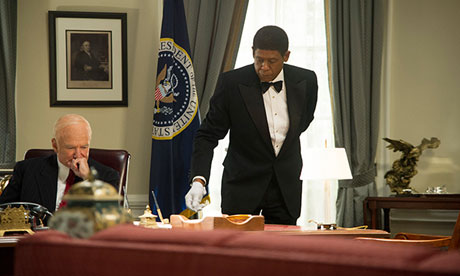
The ButlerI went this week to see the movie “The Butler”, about a man who was a butler in the White House for seven presidential administrations.  The movie is fiction, loosely based on life of a man named Eugene Allen, who was a butler for presidents from  Truman to Reagan.

In the movie, Cecil Gaines is an African-American man, born on a cotton plantation, who works his way up to the post of White House maître d’.  His career takes place against the background of the Civil Rights movement.  We see it unfold through Brown v. Board of Education, the integration of schools, the march from Selma to Montgomery, the assassinations of John F. Kennedy and Martin Luther King, Jr., and protests against the Vietnam War and apartheid in South Africa.

We see Cecil in the White House, serving with precision and elegance at sparkling, candlelit state dinners, at tables glittering with gold china, crystal, and silver, for presidents who agonize over what to do about integrating schools in Little Rock and whether they need to champion civil rights legislation.  We watch the African-American butlers work to maintain a mask, pretending to see nothing, hear nothing, react to nothing, even when what they see and hear affects them and their families deeply and personally.

The movie’s major personal conflict unfolds between Cecil and his son, who becomes a Freedom Rider and protester for civil rights, when Cecil just wants his son to stay safe and get an education and a job and family.  In one pivotal sequence, we see the camera flashing back and forth between two dinners.  In one, Cecil is precisely aligning gold-plated china, serving at a state dinner for elegantly attired world leaders, carefully maintaining his mask of indifference.  In the other, his son is sitting with a group of other young black and white people at a Woolworth’s counter, while townspeople berate them, hit them, spit in their faces, drag them onto the floor, beat them, and finally take them to jail.  Back and forth the camera goes, between these two very different dinners.

And then, toward the end of the movie, we come to understand how beloved Cecil is in the White House when Nancy Reagan invites him and his wife to be guests, not servers, at a state dinner, and he experiences being served rather than serving.

In all of these scenes, we understand what doesn’t need to be explained:  that who you eat with in many ways describes who you are in society; that our social roles are carefully organized, and you can tell who counts by where they are at a dinner – who they sit by, who they talk to, where they are allowed to be, whether they’re serving or being served, or in the kitchen, not even visible.

This is true from the most formal state dinner, to the lunch counter at Woolworth’s, to the stridently organized and separated social classes in a high school cafeteria, to the family dinner table.  The dinner table is much more than a convenient place to get nourishment – it is a symbol of how we relate to each other, and who we are in society.

Jesus, of course, understood this, and it helps explain why so much of the action in all the gospels, especially in Luke, takes place at meals.  In the gospels, we see Jesus eating with high-class leaders, like the Pharisees in today’s story, and with social outcasts, like Matthew the tax collector and a variety of prostitutes, sinners, and other outsiders.  We see a supposedly sinful woman breaking into a dinner party and anointing Jesus before his death.  We see dinners interrupted by arguments, teachings, and healings.  we see Jesus and disciples breaking the law by picking grain on Sabbath to eat.  We see other people who observe how much Jesus loves to go to banquets, and shockingly, calling Jesus a glutton and a drunkard.

We see a crowd of thousands of people sit down on a hillside, or a field, to eat what Jesus provides from a few loaves and fish, and miraculously there is enough for everyone with bushels of food to spare.  And then, the night before he dies, we see Jesus eating with his friends, giving bread and wine to them as his own body and blood, and commanding them always to do this to remember him – a command we obey every Sunday, at this family dinner table, this state dinner for the kingdom of God.

In this story and many others of meals, we come to understand some basic truths:  Everyone is welcome at Jesus’ table – at this altar and the world beyond it.  The table of Christ is not only a place for eating, but a place for recognizing who we truly are: beloved friends of God, and more than friends:  welcome and valued as family.  The banquet table we share is not only a place of physical nourishment, but a symbol of the kingdom of God, where all are fed and all are welcomed and there is plenty to go around for everyone who shows up to eat.

And, because God is the host, those who do not welcome everyone are in danger of being left out themselves – not by choice of the host, but by their own choice–and missing what is important – the presence of Christ, the guest of honor.  Like the most carefully calibrated state dinner, the banquet of the kingdom of God reveals who we are in relation to God and to each other.

So when Jesus begins to talk in today’s gospel, it may sound like an etiquette lesson or a list of tips for getting ahead – but Jesus is showing us what it means to live in the kingdom of God.  And remember, the kingdom of God isn’t something far away on the other side of death, the kingdom of God begins here and now, it’s so close that you can reach out your hand and touch it.

Jesus starts by talking about how to be a guest at God’s banquet.  Don’t exalt yourself, he says, don’t treat yourself as a guest of honor, but assume the lowest place, because all who exalt themselves will be humbled, and all who humble themselves will be exalted.  In the kingdom of God, everything is turned upside down and the ones that are least valued in our world are most valued by God.

This reversal of fortunes, like a butler invited as a guest at a state dinner, is a constant theme in Luke’s gospel.  Jesus’ mother Mary recognizes this reversal when she sings a song glorifying God before Jesus is even born:  in Jesus, she sings, God has brought down the mighty from their thrones and has lifted up the lowly; God has filled the hungry with good things and sent the rich away empty.

Christian life, it seems, should be a purposeful effort to align ourselves with those who are outcast, in need, unvalued.  Because this is how we come close to Christ – in the lowly and suffering, that’s where he says we will find him.

Yet, like the high school student who decides to leave her safe table in the cafeteria where all her friends eat, and go sit with the outcast kid who sits alone in the corner, we might be taking a personal risk in aligning ourselves with those who are less fortunate.  We might be beaten, like the protesters at Woolworths.

Or, something might happen like what happened in Raleigh, North Carolina this week, where a controversy erupted when a Christian ministry called Love Wins that had been feeding the homeless in a public park every Saturday for several years was told that if they fed anyone they’d be arrested.  Apparently this was an effort by the town to move the homeless along to other places, more convenient and less visible.  It points out the fact that loving our neighbor is often discouraged when that neighbor is un-presentable or low status.  Yet Jesus said loving our neighbor is what we’re called to do.

And then in today’s story, Jesus changes gear – he has been talking about how to be guests at God’s table, now he starts talking about how to be hosts.  If you’re the host, he says, don’t invite people who are going to invite you back, invite those who have nothing to give because it is God who will repay you for your kindness.

Since we are not talking about a simple dinner table here, but about the kingdom of God, it becomes clear that we who have enough are hosts in God’s kingdom, called to share with others.  Where it might be our inclination to wonder how to use what we have to our own advantage, inviting others who can benefit us, Jesus invites us to change our thinking from wondering how we can be blessed, to how we can be a blessing; from how we can receive, to how give.  Aligning ourselves with those who cannot do anything for us, Jesus says, is how to be a blessing.

Does this seem strange?  It’s certainly not how we’re taught to act in 21st century America – if you go to Barnes & Noble, you will find the shelves full of self-help books telling you how to raise yourself up, not to bring yourself down.  Yet things are reversed, in the kingdom of God.

And if ever that kind of reversal doesn’t make sense, I have to remind myself that this is what Jesus did in coming to us – he left his rightful place at the throne of God’s glory to come here and live as one of us – humble, lowly, suffering.

And I don’t know why, but our lectionary leaves off what I think is the punchline of this story: at the end of the story, the gospel says:

One of the dinner guests, on hearing this, said to him, ‘Blessed is anyone who will eat bread in the kingdom of God!’

That’s us – we eat at this table, a symbol and pre-experience of the reality of God’s kingdom.  We are Jesus’ guests, eating bread and drinking wine in the kingdom of God.  We have been invited to Jesus’ banquet, though we don’t deserve it – in the upside-down kingdom, maybe we’re even the last and lowliest behind those who are poorer and humbler than we are.

But here we are anyway – blessed and loved, welcomed and fed.  Fed with the very body and blood of the Son of God.

Like a butler in the White House, we should be serving the Lord of the feast.  But we’ve been invited to sit, and be served, and eat, as one of the family.

We have been richly blessed.  Now let us become a blessing to the world.

Sermon for 6.2.13

Scriptures for today are Here.

I grew up as the daughter of a career Army officer, moving every few years, making our home in different places all over the world, getting a taste of different cultures and different ways of life.  The foreign posting that I remember the best was Okinawa, which if you don’t know, is an island off the southern coast of Japan, where American forces have been stationed since the end of World War II.  And, while in many ways it was excellent cultural education to live there, in other ways, Americans on Okinawa kept to themselves – we lived on American bases, went to American schools, belonged to American churches, we were basically Americans associating mostly with other Americans.  I did learn some basic things about Japanese culture – how to count to 10, how to eat with chopsticks – but in other ways, it didn’t feel that different from living on an Army post in the U.S.

One thing that would have been extremely unusual was for a U.S. Army officer like my father to become interested in the local religion, or pay to build a local religious temple, or ask a local religious leader for healing.  An American who did that would find himself looked at very strangely by his peers.

Which is why today’s gospel story strikes me as so unusual.  Here is a Roman centurion, a foreign occupier of Israel, an officer about the rank of a major or lieutenant colonel, who becomes a patron of the local synagogue, is widely appreciated by the local townspeople, and asks a local religious guru for help with a sick servant.  It takes a lot of boundary crossing for him to do that.  Most Romans would have thought of themselves as superior to the local people, would have been somewhat afraid and suspicious that the local people wanted them out, would have been very reluctant to get too involved with Jewish people for fear it would compromise their careers.  Yet here is this centurion, praised as worthy and a friend of the synagogue, showing faith enough to ask Jesus for healing.

The English bishop and scholar N.T. Wright describes the centurion as “looking in at Israel and Israel’s God from the outside, liking what he sees, and opening himself to learning new truth from this strange, ancient way of life.” According to Wright, this outsider is able to see right to the heart of faith in Israel’s  “one true God,” and that “the one true God was personally present and active in Jesus.”  He seems to understand where Jesus’ authority comes from – from God, who has the authority to heal.

Jesus is amazed and praises the centurion’s faith – and what is interesting about the centurion’s faith is that it has nothing to do with belief.  The centurion has not said anything about Jesus being the son of God or any kind of doctrine at all.  And it has nothing to do with action either – Jesus does not tell the centurion to lay down his weapons and follow him.  Jesus doesn’t tell him to do anything.  And Luke tells us nothing about what the centurion did after this – so he doesn’t apparently become a disciple, or leave everything and follow Jesus.

The faith the centurion shows is not belief and it is not action.  It is simple trust that Jesus can and will do what he says he will do – and this trust is faith greater than anyone else in Israel has shown.

This is a story of boundary crossing – of an outsider opening his mind and heart to a new way of trusting a new God.  And on the other side, of Jesus ministering to the outsider, of Jesus reaching out to someone who has no religious credentials, is not a member of the chosen, inside group, of Jesus granting healing without any test of membership.

This kind of boundary crossing is very difficult for humans to do.  We like to create in groups and out groups, we like to know who the most-favored people are, we like to know that we are God’s favored ones.  And over and over, Jesus surprises us, defeats our expectations, includes those who we might assume should be excluded.  And annoyingly, sometimes he does it without any kind of test of belief or behavior.  He seems to recognize in all people, even the outsiders, a potential for an attitude of the heart that will open them to receiving the grace of God, and he responds.

Which brings us to Pope Francis, who raised all kinds of alarms in the Roman Catholic church recently by saying,

“The Lord has redeemed all of us, all of us, with the Blood of Christ: all of us, not just Catholics. Everyone! ‘Father, the atheists?’ Even the atheists. Everyone! And this Blood makes us children of God of the first class. We are created children in the likeness of God and the Blood of Christ has redeemed us all. And we all have a duty to do good. And this commandment for everyone to do good, I think, is a beautiful path towards peace.”

The press immediately responded with worldwide headlines proclaiming that the pope said atheists could go to heaven, leading the comedian Stephen Colbert to say, “If atheists can go to heaven, I want a refund on my Catholicism!”  And also prompting a Vatican spokesman to issue a statement saying that no, atheists still go to hell.

If you read carefully the pope’s words, you can see he’s actually not saying anything new.  First of all, he is not talking about going to heaven at all:  if you look at his statement in context, he is talking about how people can do good and meet together on a path to peace.  This is not controversial – we all know perfectly well that atheists as well as religious people can do good and work for peace.

And furthermore, he is using the word “redeemed” very carefully in its technical meaning.  “Redeemed” is a word that refers to paying a price, the way you would pay to redeem something you had pawned at a pawn shop, or you would pay a ransom for someone who had been kidnapped.  Redemption also refers to buying a slave’s freedom, so we say that God redeemed the people of Israel from their bondage in Egypt when Moses led them toward the Promised Land.

Redemption has always been seen as one thing that Jesus has done for us in his life and death.  However you think his life and death accomplished redemption, opened the way of freedom from our slavery to sin and death, we Christians believe that Jesus has already done it.  Whatever price was to be paid, Jesus has paid it, it’s already happened.  And Jesus has done this because God loved and offered the gift of redemption to not just Christians or Jews but all people, even all creation: God’s hope is to lead everyone, everything back into the state God intended for us to live in.

That part is not new – the question Christian thinkers have gotten hung up over is how you go about receiving that gift and who receives it.  If redemption is what Jesus has already done, salvation is how we appropriate that gift and make it our own.  I believe that our free will gives us the ability to reject God’s gift if we want – God will not force salvation on us.  And I think there are people like, say, possibly Hitler and others, who have let their minds and hearts grow so evil and so steeped in darkness that they will run and hide from God – who, when confronted with ultimate good, condemn themselves to an existence where God is absent.  That’s the definition of hell – a world without God.

So how do you accept God’s gift of salvation?  Do you have to be a baptized Christian, do you have to pray the sinner’s prayer, do you have to believe in certain doctrines, do you have to behave a certain way?  Jesus doesn’t impose any conditions on the centurion at all – he simply hears a request from someone who clearly recognizes his authority as God’s representative, grants the request, and then praises the centurion’s faith because the centurion understood that Jesus was someone to put his trust in.

And given the fact that the people Jesus criticizes most strongly in the gospels are the highly religious people who go around judging others, we have to think very carefully before we go around judging who is going to heaven and who is going to hell – Jesus seems to have different tests of who’s in and who’s out than we do.  Jesus looks at people’s hearts, not their memberships.

Which begs the question:  who’s going to heaven and who’s going to hell?  Well, as one of my mentor priests, Jon Coffey, used to say, thank God I’m not in charge of that.  We can trust Jesus to take care of that.  But then, if Jesus is going to go around including people indiscriminately, even people we don’t think meet the qualifications, letting just anyone get into heaven – why bother to be a Christian, why be part of a church?  Why not say, like Colbert, if atheists can go to heaven, I want a refund!

Well, let’s remember – going to heaven is not the whole point of Christianity!  We believe in everlasting life, but that’s only one part of being a Christian.  We also become Christians, become part of a church, because it changes our life on earth.  Even the Pope wasn’t talking about going to heaven – he was talking about making peace on earth.  Jesus talked about life on earth too, way more than he talked about heaven: after all, he taught us to pray, “Thy kingdom come, thy will be done, on earth as it is in heaven.”

So here’s why we Christians who trust Jesus become part of churches.  First, to be part of a community of people who continue Jesus’ mission on earth.  Jesus was a healer, a servant, a proclaimer of good news.  That’s what we’re called to be too – and we can do it far more effectively together, in communities of mission, than we can individually.  Churches, buildings, people, ministries, are powerful symbols of God’s love.  Second, to experience community together and learn to love each other, trust each other, and empower each other to do what God has called each of us to do.

And third, and most importantly, to develop the spiritual habits that allow us to open our hearts to the love and healing God wants to pour into us.  Through spiritual habits of praying and Bible reading and worshiping and thinking in dialogue with God about the issues that affect our lives and the people we encounter, we open our hearts so we can recognize and trust God, the same way the centurion recognized and trusted Jesus.  Trusting God is always crossing a boundary and opening ourselves up to something new and strange, the way the centurion did.

So why do we become Christians? We trust God for heaven, but we also hope to begin to experience life as citizens of God’s kingdom now.  To join with others in God’s mission of loving the world, and to be constantly nourished as God’s beloved children, fed with bread and wine and the word of God and the love of a church community.  To participate with God in the ongoing salvation that God wants to accomplish.  To join with God in God’s mission.  To experience the love of God: healing, strength, courage, faith, joy.  To learn to trust, and give that trust to God as our own holy offering of love.

Sermon for Easter 2013

Scriptures for today are here.  Options chosen are Acts, 1 Corinthians, and Luke.

Alleluia! Christ is risen!  [The Lord is risen indeed! Alleluia!]

This feels like a very happy Easter to me.  Last week, unexpectedly, I got a call from my mother that my father was dying, possibly within hours.  I dropped everything and flew to Austin to be with my parents.  And it turned out that it was a complete misdiagnosis – he just had a simple infection.  He is on antibiotics now, and is much better.  So for us, this year, the words of the hymn we just sang took on special meaning:  “Our despair he turned to blazing joy.”  This feels like an Easter miracle to us.

And so I feel optimistic about the future.  Optimism is something you feel when there are good signs, when it looks like things are going well.

But there are times when optimism is very difficult.  My friend works as a teacher for homebound high school students – some who are unwed mothers with infants, some who are ill with terminal diseases, some who are handicapped and unable to function in a regular classroom.  She sees teenagers and their parents in all kinds of difficult situations.  A couple of years ago she wrote me – I’m finding it hard to be optimistic these days, she said – she sees so many things to worry about.  And I wrote her back – when you can’t have optimism, try hope.

Optimism and hope are two different things.  Optimism is believing that a situation is heading in a positive direction.  Optimism means looking on the bright side, finding the silver lining, believing that evidence shows that events will come out well.  Optimism is a good thing when you’re facing a challenge: when you’ve interviewed for a job and the signs look good; when you think there’s a good chance you’ll get a good grade because you studied hard; when you’re undergoing treatment but the doctor says the prognosis is good.  Optimism is a belief in happy endings.

But not all endings are happy.  There are things that optimism doesn’t touch.  Optimism doesn’t help the cause that is lost.  Optimism doesn’t prevent the people we love from dying, eventually.  Optimism doesn’t bring the dead back to life.

Optimism is doing what the women did in our gospel story today, looking for the living among the dead – understanding that the dead stay dead, wanting only to anoint death with burial spices, finding something good and sweet and kind about the whole sad situation.

If Easter simply means optimism, a feeling that things will turn out all right if we look on the bright side, then we can enjoy our beautiful music, flowers, our pastel colors and Easter bunnies, our plastic eggs and marshmallow Peeps.  We’ll enjoy a little sunshine today, we’ll remember Jesus as a nice man who did good things.  But we won’t go home changed –our lives won’t be different.  The dead will not be resurrected.   When we wake up tomorrow, we will still be worried, distracted, will still be certain of only one thing in life – death – because optimism can take us only so far, but it cannot finally conquer darkness, evil and death.  Optimism can never do anything more than search for the living among dead.

But hope – hope is something different entirely.  Hope is not based on indications that things are going well.  Hope is born in the darkest of times when optimism has failed.  Hope means that all is not lost, even when nothing good is left.

In the movie The Shawshank Redemption, two inmates are in a hellish prison.  One of them, Andy, never loses hope.  He tells his friend, Red, “You have to have hope.  Hope is all you have when nothing is left.  Hope is a good thing, and no good thing ever dies.”  Red shakes his head and says, “Hope is a dangerous thing.  Hope can get a man killed.”

Well, hope IS a dangerous thing, because hope upsets everything we know.  Hope arises from the belief that some unexpected, inexplicable power outside the situation will change things; hope is a light that begins to gleam in utter darkness; hope opens our eyes to new possibilities optimism could never see.  Hope understands that God has hold of us and has no intention of letting go.

Hope is dropping the burial spices, losing our faith in death, listening to the voices of angels, and beginning a new day where we look for the living among the living, the blazing light of resurrection in each face gathered here today.

And hope – if we can find hope today, in our Easter celebration –then we will go home, transformed, renewed, newly created people shining w Easter light.  Because we will know that there is no darkness so deep, no evil so powerful, no death so final that God’s light cannot shine into it and bring us hope.

And friends, this Easter morning, we who follow Christ are not optimistic – we are hopeful, we are filled to the brim with hope – a hope that outshines optimism – a hope that begins in darkness and bursts into the light of day – a hope that is born in despair and becomes a blazing joy.

And we say with all the angels in heaven, Alleluia, Christ is risen! [The Lord is risen indeed. Alleluia!]

The thing is that Christ’s resurrection is true, and real, and makes a difference to this world.  Jesus gave himself up to death out of love for his disciples, love for his fellow Israelites, love for the Roman soldiers who crucified him, love for all of us.  He had choices: he could have fought or fled or called down legions of angels.  But he chose to die; Jesus allowed all of the evil and hatred and fear and sin of this world to overwhelm him; he went to his death willingly.

Jesus went into the darkness of death because all of us will go there too.  And it is only when all cause for optimism is lost, that God can give the gift of hope.  Hope arises out of darkness, when there is no more reason for optimism.  And friends, in our lives, we need hope.

So Jesus went to his death, but he didn’t stay dead – he rose from the dead.  Which means that death and evil and hatred and sin don’t rule this world any more – a new creation has begun.

Rowan Williams, former Archbishop of Canterbury, says:  at Easter, “we are really standing in the middle of a second ‘Big Bang,’ a tumultuous surge of divine energy as fiery and intense as the very beginning of the universe.”  If you throw a stone into water, it creates ripples in circles that radiate out.  In Jesus, on Easter day, the resurrection started a ripple of new creation, a wave of energy that has spread out for 2,000 years, an energy wave that hasn’t stopped yet, but will keep on growing until the evil powers of this world are completely destroyed, and all of us are brought from death into life.

This is not optimism, because it makes no sense. You can’t deduce resurrection, new creation, from any facts in our world today. You can’t get resurrection by looking on the bright side of a bad situation.  You get to resurrection only by dying.  And out of the darkness of death, God brings new life and new creation.  God gives us hope in Jesus Christ.

There are people here today, who are living in dark and difficult times.  Even if I didn’t know you, I would know that to be true.  I can be sure that in a crowd this size, there is someone experiencing the loss of a relationship, someone facing a serious illness, someone mourning the death of someone they love.  Optimism won’t touch those situations – not every cloud has a silver lining.

But, in the darkness of human life, God brings hope.  Resurrection hope, hope so glorious that it breaks all the rules, that no one can understand it.  For anyone who lives in darkness, the resurrection tells us that God’s love enters even into the deepest and darkest parts of human life.  And God’s love takes hold of us, and refuses to let us go.

Jesus Christ has been raised from the dead, and we, his beloved ones, are raised along with him, to new life and new creation.  And to this, there’s only one thing we can say: Alleluia, Christ is risen!  [The Lord is risen indeed!  Alleluia!]