
Sermon for 6.2.13

Scriptures for today are Here.

I grew up as the daughter of a career Army officer, moving every few years, making our home in different places all over the world, getting a taste of different cultures and different ways of life.  The foreign posting that I remember the best was Okinawa, which if you don’t know, is an island off the southern coast of Japan, where American forces have been stationed since the end of World War II.  And, while in many ways it was excellent cultural education to live there, in other ways, Americans on Okinawa kept to themselves – we lived on American bases, went to American schools, belonged to American churches, we were basically Americans associating mostly with other Americans.  I did learn some basic things about Japanese culture – how to count to 10, how to eat with chopsticks – but in other ways, it didn’t feel that different from living on an Army post in the U.S.

One thing that would have been extremely unusual was for a U.S. Army officer like my father to become interested in the local religion, or pay to build a local religious temple, or ask a local religious leader for healing.  An American who did that would find himself looked at very strangely by his peers.

Which is why today’s gospel story strikes me as so unusual.  Here is a Roman centurion, a foreign occupier of Israel, an officer about the rank of a major or lieutenant colonel, who becomes a patron of the local synagogue, is widely appreciated by the local townspeople, and asks a local religious guru for help with a sick servant.  It takes a lot of boundary crossing for him to do that.  Most Romans would have thought of themselves as superior to the local people, would have been somewhat afraid and suspicious that the local people wanted them out, would have been very reluctant to get too involved with Jewish people for fear it would compromise their careers.  Yet here is this centurion, praised as worthy and a friend of the synagogue, showing faith enough to ask Jesus for healing.

The English bishop and scholar N.T. Wright describes the centurion as “looking in at Israel and Israel’s God from the outside, liking what he sees, and opening himself to learning new truth from this strange, ancient way of life.” According to Wright, this outsider is able to see right to the heart of faith in Israel’s  “one true God,” and that “the one true God was personally present and active in Jesus.”  He seems to understand where Jesus’ authority comes from – from God, who has the authority to heal.

Jesus is amazed and praises the centurion’s faith – and what is interesting about the centurion’s faith is that it has nothing to do with belief.  The centurion has not said anything about Jesus being the son of God or any kind of doctrine at all.  And it has nothing to do with action either – Jesus does not tell the centurion to lay down his weapons and follow him.  Jesus doesn’t tell him to do anything.  And Luke tells us nothing about what the centurion did after this – so he doesn’t apparently become a disciple, or leave everything and follow Jesus.

The faith the centurion shows is not belief and it is not action.  It is simple trust that Jesus can and will do what he says he will do – and this trust is faith greater than anyone else in Israel has shown.

This is a story of boundary crossing – of an outsider opening his mind and heart to a new way of trusting a new God.  And on the other side, of Jesus ministering to the outsider, of Jesus reaching out to someone who has no religious credentials, is not a member of the chosen, inside group, of Jesus granting healing without any test of membership.

This kind of boundary crossing is very difficult for humans to do.  We like to create in groups and out groups, we like to know who the most-favored people are, we like to know that we are God’s favored ones.  And over and over, Jesus surprises us, defeats our expectations, includes those who we might assume should be excluded.  And annoyingly, sometimes he does it without any kind of test of belief or behavior.  He seems to recognize in all people, even the outsiders, a potential for an attitude of the heart that will open them to receiving the grace of God, and he responds.

Which brings us to Pope Francis, who raised all kinds of alarms in the Roman Catholic church recently by saying,

“The Lord has redeemed all of us, all of us, with the Blood of Christ: all of us, not just Catholics. Everyone! ‘Father, the atheists?’ Even the atheists. Everyone! And this Blood makes us children of God of the first class. We are created children in the likeness of God and the Blood of Christ has redeemed us all. And we all have a duty to do good. And this commandment for everyone to do good, I think, is a beautiful path towards peace.”

The press immediately responded with worldwide headlines proclaiming that the pope said atheists could go to heaven, leading the comedian Stephen Colbert to say, “If atheists can go to heaven, I want a refund on my Catholicism!”  And also prompting a Vatican spokesman to issue a statement saying that no, atheists still go to hell.

If you read carefully the pope’s words, you can see he’s actually not saying anything new.  First of all, he is not talking about going to heaven at all:  if you look at his statement in context, he is talking about how people can do good and meet together on a path to peace.  This is not controversial – we all know perfectly well that atheists as well as religious people can do good and work for peace.

And furthermore, he is using the word “redeemed” very carefully in its technical meaning.  “Redeemed” is a word that refers to paying a price, the way you would pay to redeem something you had pawned at a pawn shop, or you would pay a ransom for someone who had been kidnapped.  Redemption also refers to buying a slave’s freedom, so we say that God redeemed the people of Israel from their bondage in Egypt when Moses led them toward the Promised Land.

Redemption has always been seen as one thing that Jesus has done for us in his life and death.  However you think his life and death accomplished redemption, opened the way of freedom from our slavery to sin and death, we Christians believe that Jesus has already done it.  Whatever price was to be paid, Jesus has paid it, it’s already happened.  And Jesus has done this because God loved and offered the gift of redemption to not just Christians or Jews but all people, even all creation: God’s hope is to lead everyone, everything back into the state God intended for us to live in.

That part is not new – the question Christian thinkers have gotten hung up over is how you go about receiving that gift and who receives it.  If redemption is what Jesus has already done, salvation is how we appropriate that gift and make it our own.  I believe that our free will gives us the ability to reject God’s gift if we want – God will not force salvation on us.  And I think there are people like, say, possibly Hitler and others, who have let their minds and hearts grow so evil and so steeped in darkness that they will run and hide from God – who, when confronted with ultimate good, condemn themselves to an existence where God is absent.  That’s the definition of hell – a world without God.

So how do you accept God’s gift of salvation?  Do you have to be a baptized Christian, do you have to pray the sinner’s prayer, do you have to believe in certain doctrines, do you have to behave a certain way?  Jesus doesn’t impose any conditions on the centurion at all – he simply hears a request from someone who clearly recognizes his authority as God’s representative, grants the request, and then praises the centurion’s faith because the centurion understood that Jesus was someone to put his trust in.

And given the fact that the people Jesus criticizes most strongly in the gospels are the highly religious people who go around judging others, we have to think very carefully before we go around judging who is going to heaven and who is going to hell – Jesus seems to have different tests of who’s in and who’s out than we do.  Jesus looks at people’s hearts, not their memberships.

Which begs the question:  who’s going to heaven and who’s going to hell?  Well, as one of my mentor priests, Jon Coffey, used to say, thank God I’m not in charge of that.  We can trust Jesus to take care of that.  But then, if Jesus is going to go around including people indiscriminately, even people we don’t think meet the qualifications, letting just anyone get into heaven – why bother to be a Christian, why be part of a church?  Why not say, like Colbert, if atheists can go to heaven, I want a refund!

Well, let’s remember – going to heaven is not the whole point of Christianity!  We believe in everlasting life, but that’s only one part of being a Christian.  We also become Christians, become part of a church, because it changes our life on earth.  Even the Pope wasn’t talking about going to heaven – he was talking about making peace on earth.  Jesus talked about life on earth too, way more than he talked about heaven: after all, he taught us to pray, “Thy kingdom come, thy will be done, on earth as it is in heaven.”

So here’s why we Christians who trust Jesus become part of churches.  First, to be part of a community of people who continue Jesus’ mission on earth.  Jesus was a healer, a servant, a proclaimer of good news.  That’s what we’re called to be too – and we can do it far more effectively together, in communities of mission, than we can individually.  Churches, buildings, people, ministries, are powerful symbols of God’s love.  Second, to experience community together and learn to love each other, trust each other, and empower each other to do what God has called each of us to do.

And third, and most importantly, to develop the spiritual habits that allow us to open our hearts to the love and healing God wants to pour into us.  Through spiritual habits of praying and Bible reading and worshiping and thinking in dialogue with God about the issues that affect our lives and the people we encounter, we open our hearts so we can recognize and trust God, the same way the centurion recognized and trusted Jesus.  Trusting God is always crossing a boundary and opening ourselves up to something new and strange, the way the centurion did.

So why do we become Christians? We trust God for heaven, but we also hope to begin to experience life as citizens of God’s kingdom now.  To join with others in God’s mission of loving the world, and to be constantly nourished as God’s beloved children, fed with bread and wine and the word of God and the love of a church community.  To participate with God in the ongoing salvation that God wants to accomplish.  To join with God in God’s mission.  To experience the love of God: healing, strength, courage, faith, joy.  To learn to trust, and give that trust to God as our own holy offering of love.
Sermon for Easter 2013

Scriptures for today are here.  Options chosen are Acts, 1 Corinthians, and Luke.

Alleluia! Christ is risen!  [The Lord is risen indeed! Alleluia!]

This feels like a very happy Easter to me.  Last week, unexpectedly, I got a call from my mother that my father was dying, possibly within hours.  I dropped everything and flew to Austin to be with my parents.  And it turned out that it was a complete misdiagnosis – he just had a simple infection.  He is on antibiotics now, and is much better.  So for us, this year, the words of the hymn we just sang took on special meaning:  “Our despair he turned to blazing joy.”  This feels like an Easter miracle to us.

And so I feel optimistic about the future.  Optimism is something you feel when there are good signs, when it looks like things are going well.

But there are times when optimism is very difficult.  My friend works as a teacher for homebound high school students – some who are unwed mothers with infants, some who are ill with terminal diseases, some who are handicapped and unable to function in a regular classroom.  She sees teenagers and their parents in all kinds of difficult situations.  A couple of years ago she wrote me – I’m finding it hard to be optimistic these days, she said – she sees so many things to worry about.  And I wrote her back – when you can’t have optimism, try hope.

Optimism and hope are two different things.  Optimism is believing that a situation is heading in a positive direction.  Optimism means looking on the bright side, finding the silver lining, believing that evidence shows that events will come out well.  Optimism is a good thing when you’re facing a challenge: when you’ve interviewed for a job and the signs look good; when you think there’s a good chance you’ll get a good grade because you studied hard; when you’re undergoing treatment but the doctor says the prognosis is good.  Optimism is a belief in happy endings.

But not all endings are happy.  There are things that optimism doesn’t touch.  Optimism doesn’t help the cause that is lost.  Optimism doesn’t prevent the people we love from dying, eventually.  Optimism doesn’t bring the dead back to life.

Optimism is doing what the women did in our gospel story today, looking for the living among the dead – understanding that the dead stay dead, wanting only to anoint death with burial spices, finding something good and sweet and kind about the whole sad situation.

If Easter simply means optimism, a feeling that things will turn out all right if we look on the bright side, then we can enjoy our beautiful music, flowers, our pastel colors and Easter bunnies, our plastic eggs and marshmallow Peeps.  We’ll enjoy a little sunshine today, we’ll remember Jesus as a nice man who did good things.  But we won’t go home changed –our lives won’t be different.  The dead will not be resurrected.   When we wake up tomorrow, we will still be worried, distracted, will still be certain of only one thing in life – death – because optimism can take us only so far, but it cannot finally conquer darkness, evil and death.  Optimism can never do anything more than search for the living among dead.

But hope – hope is something different entirely.  Hope is not based on indications that things are going well.  Hope is born in the darkest of times when optimism has failed.  Hope means that all is not lost, even when nothing good is left.

In the movie The Shawshank Redemption, two inmates are in a hellish prison.  One of them, Andy, never loses hope.  He tells his friend, Red, “You have to have hope.  Hope is all you have when nothing is left.  Hope is a good thing, and no good thing ever dies.”  Red shakes his head and says, “Hope is a dangerous thing.  Hope can get a man killed.”

Well, hope IS a dangerous thing, because hope upsets everything we know.  Hope arises from the belief that some unexpected, inexplicable power outside the situation will change things; hope is a light that begins to gleam in utter darkness; hope opens our eyes to new possibilities optimism could never see.  Hope understands that God has hold of us and has no intention of letting go.

Hope is dropping the burial spices, losing our faith in death, listening to the voices of angels, and beginning a new day where we look for the living among the living, the blazing light of resurrection in each face gathered here today.

And hope – if we can find hope today, in our Easter celebration –then we will go home, transformed, renewed, newly created people shining w Easter light.  Because we will know that there is no darkness so deep, no evil so powerful, no death so final that God’s light cannot shine into it and bring us hope.

And friends, this Easter morning, we who follow Christ are not optimistic – we are hopeful, we are filled to the brim with hope – a hope that outshines optimism – a hope that begins in darkness and bursts into the light of day – a hope that is born in despair and becomes a blazing joy.

And we say with all the angels in heaven, Alleluia, Christ is risen! [The Lord is risen indeed. Alleluia!]

The thing is that Christ’s resurrection is true, and real, and makes a difference to this world.  Jesus gave himself up to death out of love for his disciples, love for his fellow Israelites, love for the Roman soldiers who crucified him, love for all of us.  He had choices: he could have fought or fled or called down legions of angels.  But he chose to die; Jesus allowed all of the evil and hatred and fear and sin of this world to overwhelm him; he went to his death willingly.

Jesus went into the darkness of death because all of us will go there too.  And it is only when all cause for optimism is lost, that God can give the gift of hope.  Hope arises out of darkness, when there is no more reason for optimism.  And friends, in our lives, we need hope.

So Jesus went to his death, but he didn’t stay dead – he rose from the dead.  Which means that death and evil and hatred and sin don’t rule this world any more – a new creation has begun.

Rowan Williams, former Archbishop of Canterbury, says:  at Easter, “we are really standing in the middle of a second ‘Big Bang,’ a tumultuous surge of divine energy as fiery and intense as the very beginning of the universe.”  If you throw a stone into water, it creates ripples in circles that radiate out.  In Jesus, on Easter day, the resurrection started a ripple of new creation, a wave of energy that has spread out for 2,000 years, an energy wave that hasn’t stopped yet, but will keep on growing until the evil powers of this world are completely destroyed, and all of us are brought from death into life.

This is not optimism, because it makes no sense. You can’t deduce resurrection, new creation, from any facts in our world today. You can’t get resurrection by looking on the bright side of a bad situation.  You get to resurrection only by dying.  And out of the darkness of death, God brings new life and new creation.  God gives us hope in Jesus Christ.

There are people here today, who are living in dark and difficult times.  Even if I didn’t know you, I would know that to be true.  I can be sure that in a crowd this size, there is someone experiencing the loss of a relationship, someone facing a serious illness, someone mourning the death of someone they love.  Optimism won’t touch those situations – not every cloud has a silver lining.

But, in the darkness of human life, God brings hope.  Resurrection hope, hope so glorious that it breaks all the rules, that no one can understand it.  For anyone who lives in darkness, the resurrection tells us that God’s love enters even into the deepest and darkest parts of human life.  And God’s love takes hold of us, and refuses to let us go.

Jesus Christ has been raised from the dead, and we, his beloved ones, are raised along with him, to new life and new creation.  And to this, there’s only one thing we can say: Alleluia, Christ is risen!  [The Lord is risen indeed!  Alleluia!]


Sermon for Palm Sunday 2013

Scriptures for today are here.

I have never been fond of roller coaster rides.  The slow chug up to the top, looking out at the crowds and the amusement park below, the hesitation as the car reaches the top, the fear that wells up as you realize what is about to happen, the sudden swoosh as the car leaps over the peak and hurls you straight down at the ground, the dizzying whirls and loops as your stomach leaps up into your chest.  All these are things I can live without.

Well, if you don’t like roller coaster rides, then Palm Sunday may not be your favorite day at church – because this liturgy is like nothing so much as a huge, dizzying roller coaster ride, hurling us from jubilant high to stomach-churning low with barely a pause for breath.  It is a day of polar extremes – from the beginning of joy and jubilation, as we hail Jesus as our king and shout Blessed is he who comes in the name of the Lord!  Hosanna in the highest! – to the dizzying drop into darkness and sorrow as we watch Jesus die, slowly and painfully, on the cross, with helpless loved ones looking on.

This is a day so bipolar that we have to give it two names:  the official name of this day is Palm Sunday/Passion Sunday.  And if you want to ask, why is the Palm Sunday/Passion Sunday liturgy so strange, why couldn’t they adopt one theme – either Palm or Passion – and stick with it– there are several excellent practical answers: the foremost being the fact that you truly cannot experience Easter as a day of resurrection, unless you have also experienced the death that preceded resurrection – you can’t have Easter without Good Friday.  If you try, you will end up with celebration that involves pastel colors, eggs, bunnies, visits from grandma, but you will not have Easter.  Since many people will not or cannot worship on Good Friday, our calendar is set up so that we all experience some of Good Friday today.

Fair enough–but there is more to this roller-coaster day than that.  Because when I read the gospel, I think Jesus set this whole thing up knowing that it would come out exactly as it did.

To give you some context, Marcus Borg and John Dominic Crossan (two writers whose theology I don’t agree with, but who give interesting historical context), in their book “The Last Week,” describe two processions arriving in Jerusalem that day.  From the west arrives a column of Roman soldiers, Pontius Pilate at their head; though they live and prefer to stay in Caesarea Maritima, the new Roman capital of Judea on the coast 60 miles to the west, once a year at Passover, they make the journey to Jerusalem.  They come, not out of any reverence for the Jewish festival, but in order to keep an eye on the population and the 200,000 pilgrims who swell a town of 40,000 to celebrate the Jews’ deliverance from an earlier empire that held them as slaves, and to squelch any trouble that might arise.

So imagine the Roman procession, say Borg & Crossan: “a visual panoply of imperial power: cavalry on horses, foot soldiers, leather armor, helmets, weapons, banners, golden eagles mounted on poles, sun glinting on metal and gold.  Sounds: the marching of feet, the creaking of leather, the clinking of bridles, the beating of drums.  The swirling of dust.  The eyes of the silent onlookers, some curious, some awed, some resentful.”

The Roman procession demonstrates not only Rome’s power, but also Rome’s theology:  Caesar was called Son of God, Lord, Savior – he was considered divine.

On the other end of town, from the east, an entirely different kind of procession is occurring, almost as a parody of the first, certainly as a challenge.  A ragged prophet from a no-account town in the northern countryside, has found a donkey to ride into Jerusalem; his crowd of followers follow him, proclaiming him king, and curious onlookers who are avoiding Roman procession on other end of town flood into the streets to join in the mayhem – not necessarily understanding what the fuss was about or even knowing about Jesus and his mission, but enjoying the insult to Rome.

Jesus has chosen this mode of entry to not only proclaim himself king, a king of peace, but also deliberately to set up a contrast and a challenge to Rome.  If the Roman procession describes the world as it is, a world ruled by power and brutality, Jesus’ procession describes the world as it should be: a world that recognizes and hails the Son of God when he comes, bringing healing and forgiveness.

Jesus does this knowing that Rome’s answer will be swift, unhesitating and brutal – knowing that the fate of anyone who challenged Rome was slow death on a cross.

And Luke, our gospel writer, of all the four gospel writers the one who writes most from the heart, catalogs the emotions of the week with precision:  the shouting; the exultation so fierce that the very stones might cry out; the betrayal; the arrest in the garden; the armed defense that Jesus stops by healing the ear of the servant; the denial and then the bitter weeping of Peter; the trial; the complicity of God’s Temple in the death of God’s Son; the contempt of Herod and the soldiers; the sudden friendship of two incompetent tyrants, Herod and Pilate; the release of an insurgent terrorist while the king of peace is put to death; the weeping of the daughters of Jerusalem; the crucifixion; the prayer, “Father, forgive them, for they do not know what they are doing”; the women watching from afar. The darkness. The death.

It is a roller coaster ride from jubilation to agony, this Palm Sunday / Passion Sunday.  And why would Jesus set us up for this?  Why take us on this ride, why go to Jerusalem at all, why not hide out till all the fuss blows over and live to minister another day?  Why come riding into Jerusalem in a way guaranteed to get him killed?  Why celebrate this colossal disaster in this liturgy of Palm Sunday / Passion Sunday?

Jesus is determined to get himself killed, because he believes that dying is his mission. That somehow, the brutal death that he dies will display a kind of kingship that puts the paltry human kingship of Herod and Pilate to shame.  That his death will somehow open a path for all of us of reconciliation with God.

How does his death help us?  Luke, our gospel writer, gives us a clue, a new understanding.  The executioners nail Jesus to the cross, and he responds, incredibly, with love: Father, forgive them, for they do not know what they are doing.

The Son of God is in physical agony – and yet the love of God looks at people who are doing this terrible thing, sees that the violence they are doing, the violence that has become their way of life, has de-humanized them, has left them ignorant people who hurt others without thought.  And the sight of a human being de-humanized by the sin he is committing is so horrifying to the Son of God that it outweighs even the pain of crucifixion.  Jesus loves his executioners so much he wants them forgiven, reconciled, restored – as the centurion will be restored, praising God by the end of this story.

Jesus loved the centurion, his head executioner. And Jesus loves us too –every bit as much.  Even though we sometimes don’t know what we’re doing, even though we are sometimes de-humanized by our own sins.

The great poet W.H. Auden was asked once why he was a Christian, instead of a Buddhist or a Confucian, since all these religions share similar ethical values. And Auden said, “Because nothing in the figure of Buddha or Confucius fills me with the overwhelming desire to scream, “’crucify him’.”

Like the crowds in Jerusalem who one day shouted Hosanna, and  days later shouted out for him to be crucified, we are not innocent bystanders.  We are the same people shouting Hosanna and Crucify him.  As the Episcopal priest Fleming Rutledge says, “The liturgy of Palm Sunday is set up to show you how you can say one thing one minute and its opposite the next.  This is the nature of the sinful human being.”  It’s the nature of each one of us.

On the cross we see Jesus identifying with the innocent victims of the world, those put to death, mired in poverty, stuck in hopelessness, homelessness, or despair, those who watch as their loved ones suffer, those who have lost their way and those who have nothing left – we see Jesus giving his life for them.

But it is not only the suffering victims Jesus identifies with on the cross, it is the other extreme too: the torturers and perpetrators, the arrogant and the guilty.  When Jesus says, “Father, forgive them, for they do not know what they do,” he is taking on the burden of the innocent and the guilty.  And as we shout the words Hosanna and Crucify him, we recognize that we are both of these things – the victims who need to be rescued, and the sinners who are causing their suffering.

As Rutledge says: “he makes himself one, not only with my pain but with my sin–because I myself, and you yourselves, and all of us ourselves, are sometimes victims of others and sometimes torturers of others and sometimes both, and when we recognize this we are, as Jesus says to the scribe, ‘not far from the kingdom.’”

So here we are, on this dizzying roller coaster of a day, hovering on the brink of disaster, careening madly downhill into Holy Week.  And yet here we are, not far from the kingdom of God.  As we veer downhill, there is one still point in this turning, churning world: the Son of God is motionless, suspended on the cross – fixed there by his love for you and for me.

Acts 8 Missionary Gathering: I Dream of a Church

The Episcopal Church is in an Acts 8 Moment.  What’s an Acts 8 Moment?  Here’s one take on it:

And here’s another:

An Acts 8 Moment happens when the church is no longer comfortable – when the old ways of doing things don’t work any more, when we have to learn to listen to the voice of the Holy Spirit, when we suddenly find ourselves out on the wilderness road, learning to reach new people in new ways.

The Episcopal Church has been too comfortable for too long – and finally, the pressures of declining membership and finances have gotten our attention.  Things aren’t comfortable any more.  It’s time to start doing things in new ways.

At the last General Convention, we created a Restructuring Task Force.  But the job before us today is about more than structure.  It’s about evangelism and outreach and social justice and letting our voice be heard by people who have given up on the church, or who never gave it a thought.

Acts 8 is a group of lay and ordained leaders in the church – like you! – who want to dream and imagine a new church.  Join us in Scottsdale April 22-24 to talk about how we can lead the church in a new era.  We’ll have some speakers on interesting topics, and we’ll talk together about how God is calling us to transform the church and our ministries.

What kind of church do you dream of?

REGISTER NOW

Acts 8 Flyer

Preliminary Gathering Agenda

Sermon for 3.17.13

Scriptures for today are Here

This is what life is like:  you can be going along, knowing what you’re doing, pretty sure of what your life is going to be like tomorrow, pretty confident in who you are, when suddenly life comes along and interrupts you.  Sometimes the interruptions are good: you get a job offer, you have a great idea, you meet someone who gets your heart beating faster, a child is born.  Sometimes the interruptions are bad: you find a lump where there wasn’t one before, you get a phone call in the middle of the night, you find out that someone you love has been in trouble for a long time and you never knew.

These interruptions turn your life upside down, make you re-think who you were and where you thought you were going, require you to focus on the few things that are most important and let the unimportant things go.  And it’s in these changes, these interruptions, these transition points in life, that many of us find God: we find that Jesus, who maybe we’ve believed in in some way, maybe we’ve worshiped, but who was never real to us, suddenly becomes the sustaining presence that gets us through, that helps us see our way to the new kind of life we are being called to live.

Which is exactly what happened to St. Patrick.  You may think of him as a leprechaun-looking person drinking green beer.  But Patrick of Ireland was real, and human, and a true hero of our faith – and he had his life utterly and entirely interrupted one day.  He was British (not Irish), from a Christian family who was prominent in the Roman Empire-dominated government of Britain when he was born, around the year 390.  His life was going just fine – until it was interrupted.

At age 16, he was captured by Irish pirates, and was  taken to Ireland, where he was sold as a slave.  He lived in Irish compound with other slaves, some of whom would have been Christians like him, who might have carried on Christian traditions, and he also spent a lot of time out on the hillside, tending his master’s flocks.  In his trouble, fear, loneliness, suffering, Patrick began to recall the Christian teachings of his family, began learning to pray for comfort.

In his memoirs, he wrote:  “After I came to Ireland, every day I had to tend the sheep, and many times a day I prayed – the love of God and his fear came to me more and more, and my faith was strengthened.  And my spirit was moved so that in a single day I would say as many as a hundred prayers, and almost as many as night, and this even when I was staying in the woods and on the mountains; I used to get up for prayer before daylight, through snow, through frost, through rain, and felt no harm.”

Like so many people before and since, Patrick came to know Christ in the interruptions of his life:  when he was suffering, when he had hit bottom, when he was living without hope.  That’s when Christ became for him a tangible presence, a beacon of hope.

After 6 years, his life was interrupted again: he had a dream that a boat was waiting, escaped from his master, walked to the seacoast, found a boat there, just has it had been in his dream, talked his way on board and sailed back to Britain.  Back home with his family, he studied to become a priest, and settled down to live a comfortable life at home – when his life was interrupted again.  He had another dream, in which he heard the voice of the Irish, saying, “We beg you, young man, come and walk among us once more.”  He got himself ordained bishop of Ireland, and went.

Ireland at this time was a pagan country.  It had never been part of the Roman empire, so it was not civilized in the way Roman people would expect, and therefore not ripe ground for evangelization the Roman way.  Roman Christians assumed you had to be civilized to be Christianized, with government, towns, transportation already in place.  Ireland wasn’t like that: it was tribal and nomadic, with no towns, no settlements, no roads bigger than a cowpath.  People moved around from place to place, never settling in any one place.

But Patrick understood the Irish from inside out, understood how to talk to them, believed God was already working among them, knew they were ready to hear about Jesus.  And he began to evangelize them, with a very specific method.  He would send out missionary groups of a dozen or so, including some priests but mostly lay people, and would establish a sort of monastic community.  The community would be Christian, founded on prayer and work and study like any monastery, but composed of men, women, children, married people and single people.

That community would settle, begin to farm and work, would welcome guests, engage them in conversation, pray with them, encourage questions.  They would live a life steeped in prayer, where every common activity was seen as happening in the presence of God, where they had prayers for everything, for milking cows, for lighting fires, where every aspect of life was God-steeped and God-blessed.

Their highest priority was hospitality, so every monastery had a guest house, and when anyone without a place to stay would show up – a laborer without work, say, or a teenager who had been abused – interrupted – the community would drop everything else and make welcoming that stranger their highest priority.  And they would invite the newcomers to join them in prayer, work, study.  And slowly as people joined their communities, they would find themselves integrated into community life, community beliefs.  They belonged first, and then they started to believe.  And as they began to believe, they were welcomed into their community officially through baptism.  And as the communities grew, they would send out new teams to settle in new places.

Within 2-3 generations, Patrick and his followers had converted all of Ireland, making him one of the greatest evangelists the world has ever known.  Especially since, when the Roman empire fell soon afterwards, and most of Europe was plunged into the Dark Ages, and not only Christianity but most of the knowledge, art, architecture, literature of the ancient world was lost, Irish monks preserved a lot of that learning, and eventually became the missionaries who re-evangelized Britain and Europe for the Christian faith.  Which is “How the Irish Saved Civilization,” according to the book by Thomas Cahill.

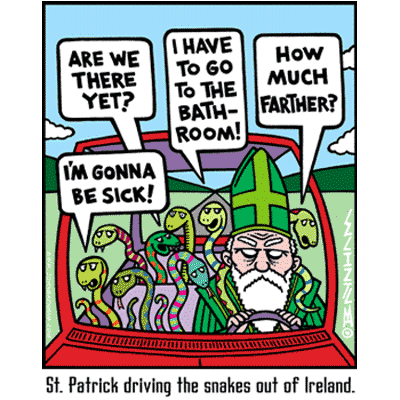
Patrick was no cartoon character.  Well, OK, there is one cartoon I like.  Here it is.

st_-pat-driving-snakes-out-723585

Other than that, Patrick was no cartoon character – he had a burning intensity, a driving passion to share the gospel.  All stemming from that interruption in his life – that lonely, frightening moment when he was captured, and he found Christ right there with him.

And what is so interesting today, on his feast day, is that we read the words of Paul, a man whose passion to share the gospel was similar.  In Philippians today, we read Paul’s story: he had everything – learning, respect, a promising career, position in his community – and then he experienced a crisis.  On the road to Damascus, he was blinded by a light from heaven, he heard the voice of Jesus saying, “Saul, Saul, why do you persecute me?” – and he entered into a three-year period of rethinking his entire life, learning about Jesus, and changing everything he had ever expected or hoped for.

From the greatest persecutor of the Christian faith, he changed into the greatest evangelist – taking the gospel to new people in new ways.

And Paul says in our New Testament lesson today – paraphrasing – I had everything, but I gave it all up because only one thing was worth having – knowing Christ Jesus my Lord.  Nothing else is worth anything, he says, compared to the value of knowing Christ and making the power of his suffering and resurrection my own.  Not that I deserve to make it my own, he says, but I place my faith in him, and therefore everything God has done for Christ, God will do for me.

Out of crisis, out of the dark night of the soul, this man learned to know Christ – and it changed not only his life, but the history of the world.

Yesterday here at Nativity, we had our Good News Summit – our time to talk together about what good news we have to share with other people.  Evangelism is a word that simply means “good news.”  And we may hear it as something to be avoided, something that fundamentalists do by scaring people with threats of hell.  But evangelism is something much simpler than scaring people into believing the way we want them to believe–evangelism simply means telling good news.

For most of us, there is good news to share – we are in church for a reason.  Something in what we experience in our Christian faith brings us hope and joy.  At yesterday’s summit, we talked together about times in our life when we have felt God’s presence strongly, when we have been grateful for that awareness of God being present with us.  And we discovered that almost everyone has at least some moment they could point to when they were aware of God reaching out to them.  Maybe a dramatic moment like Paul, being struck by a blinding light and hearing a voice from the clouds.  Or maybe a less obvious, slower moving awareness like Patrick, on the hillside tending the flocks, praying for God to be with him in his loneliness and homesickness, and being aware of God’s presence and strength.

Some of us have experienced miracles through God’s presence; some of us have learned how to forgive and how to accept forgiveness; some of us have had our own darkness lightened as the hand of God reached out to give us comfort.  Because that’s what Christ does: he comes and sustains us through interruptions in our lives.

And all of us know other people in similar situations.  I read a story about a woman who was having a hard time in her life, getting together with 6 other women on a Saturday, who offered her comfort.  But she needed more, she felt she needed the presence of God in her life, so on Sunday she got up and went to a nearby church.  To her amazement, she looked around and saw 5 of the 6 women she had talked to the day before right there in the church.  Which told her two things: first, that it was a sign that she was in the right place.  But second, that not one of those women, offering her comfort, had even thought to invite her to church.  She had no idea they even belonged to a church – they never talked about it.

We have something to share, something that can help people, something that can mean something to people.

We discovered at our Good News Summit that the time when people are most open to coming to a new church is the time of interruption: good changes in life, like marriage, relocation, birth of a child; or difficult changes like divorce, death in the family, illness, crisis.  These are the times when people are looking for community support, when they need the reassurance of God’s presence.

And a church community can provide it.  All we have to do is invite them to share in the good news we have found, welcome them as honored guests to God’s earthly kingdom right here on earth.

It’s OK to Call Yourself a Christian

UCC pastor Lillian Daniels has written a terrific piece about people who say they believe in Jesus, but refuse to call themselves Christians.  It begins:

It seems to be a growing trend—people who claim to love Jesus but don’t want to call themselves Christians. The latest to stake a claim for not staking a claim is Marcus Mumford, the front man of the wildly popular Mumford & Sons, whose Christian-themed lyrics have been a source of fascination to believers and nonbelievers alike.

In Rolling Stone’s upcoming cover story, Mumford demurred when asked if he considered himself a Christian, as a teaser on the magazine’s website revealed. “I don’t really like that word. It comes with so much baggage,” he said, in terms that many fans will relate to. “So, no, I wouldn’t call myself a Christian.”

Why should we call ourselves Christians?  Why should we worship in community, or bother with the church?  Read Lillian’s article here.