Mission … Mission … Mission – Part Three

This post is a continuation of parts one and two, discussing TREC’s Study Paper on Governance and Administration

In the first post, Theophilus, I discussed TREC’s (the Taskforce for Re-imagining the Church’s) suggested reforms in general, and pointed out that their financial recommendation to cut the diocesan asking to the biblical tithe (10%) could cost DFMS as much as $27 million in revenue.  In the second post, I talked about their suggested reforms to General Convention and estimated that they might save around $400,000 in all.  In this post, I will discuss the rest of their suggestions and count up where we are, money-wise.

The Office of Presiding Bishop

Episcopal-Church-picks-new-presiding-bishop-52-year-old-is-first-woman-to-lead-U-S-denomination

What are the absolutely vital tasks that we need a Presiding Bishop to do?  What are the other tasks that have fallen to the Presiding Bishop over the years that could be accomplished in other ways?  What are the most appropriate ways to do these other things?

The Presiding Bishop, as I have argued before, fills three roles in our church:

  • Presiding Officer of the House of Bishops.  This was the original office.  As presiding officer, the PB has big responsibilities in governance, including General Convention, Executive Council, and so forth, and also properly handles responsibilities such as pastoral development of bishops and bishop disciplinary matters.  This role includes a lot of travel within TEC.
  • Primate.  The PB is the spokesperson for the church to the world, including representing us in the councils of the Anglican Communion and ecumenical affairs, advocating for justice issues, speaking for the church in times of national crisis, etc.  This role includes a great deal of U.S. and international travel.  This function was not contemplated in the original job description of the PB, but we need this kind of public leader.  If we didn’t have one, we would invent one.
  • CEO and Head of Staff.  The original office of PB certainly never contemplated that the PB would have a staff, other than perhaps an administrative assistant.  But the church-wide staff has grown to the point that it would be impossible for a PB to do her other two roles and keep track of the staff as well.  Therefore, staff oversight is mostly delegated to a Chief Operating Officer who functions, effectively, as the CEO, and is accountable only to the PB.

The first role is the original office, and it is a vital one.  The second role was added much later, as it became more and more necessary to have a bishop who would act as the church’s face to the world.  I think it is vital for the PB to fill these two roles, and frankly, filling these two roles is all any one human being can do.

I do not think it is vital for the PB to fill the third role.  In fact, I think it is inappropriate – in the sense that if the PB is CEO and head of staff, it means the staff is accountable only to one person who was elected by only one house of General Convention and who really doesn’t have time to oversee them because of his/her other two vital roles.  Unless General Convention is willing to bring a PB up on charges (which I hope will not happen in my lifetime), Convention is required to fund offices that it has no ability to hold accountable.

In addition, PBs are not (or should not be) elected for their administrative abilities.  They are (or should be) elected because they are inspiring leaders and speakers, and we want them to be our spokespersons to the world.  Let’s turn them loose to do what they were elected to do, and let capable administrators run the Church Center (wherever it is located), with appropriate oversight from the church’s elected representatives.

The PB does, of course, need staff in her own office to help her fulfill her duties.  That would include governance, communication, and disciplinary duties, as well as Anglican Communion liaisons and ecumenical officers, in my opinion.  It makes sense for those functions to be handled through the Primate’s office, since she is our spokesperson to the world.

But I believe that the bulk of the DFMS staff should report to a different person who is accountable to both houses of Convention.  Staff who report to different officers can still all be paid by DFMS and be subject to DFMS human resources, employment, and travel policies.

Therefore, as far I am concerned, Alternative II in the TREC paper moves in completely the wrong direction, centralizing even more duties in the hands of the PB than she already has, and making the job even more impossible than it already is.  Alternative III is better, but seems to envision the PB taking on too small a church-wide role, possibly keeping her diocesan see (what this accomplishes is unclear).  Therefore, I think Alternative I is the best choice: keeping a healthy view of the PB’s leadership, while allowing for Council oversight (not micro-management) of the head of staff (“CEO” is a poor name for this position).  Alternative I also seems to be the one that TREC has thought hardest about, judging from the verbiage devoted to the three alternatives.

images-1The Money Scorecard

Alternatives I and II don’t save us any money, but they don’t cost us any money either.  We already pay both a PB and a Chief Operating Officer.  Alternative III will cost us money, because the poor diocese that is saddled with a PB as its diocesan bishop will need a subsidy to call a suffragan bishop.  Let’s say Alternative III costs us $500,000 per triennium. 

Executive Council

What is the Executive Council?  What do they need to do that no one else can do, how many people does it take to do those things, and where do they fit within the power structures of the church?

ens_022713_TS_CouncilOtherBizWell, full disclosure – I serve on Executive Council (that’s me in the photo, in the green jacket just over Silvestre Romero’s left shoulder).  I was elected by Convention in 2012, and my term goes until 2018 – argghh, that seems like a long time!

Executive Council, as TREC points out, has two roles.  (1) It is the designated body to carry out Convention’s policies while Convention is not in session.  And (2) it is the legal Board of Directors of DFMS / The Episcopal Church.  These are two, not-always-congruent roles.

Executive Council IS a large group – it is hard for a group of 40 people to act as a board of directors.  However, most of Council’s work happens in committee (just as is the case with General Convention).  Could a group of 21 accomplish the work of Council?  Probably, if all 21 are good, active representatives, and not blowhards or inactives.  Is it worth a try?  Sure, if we think it will really accomplish something.  The money spent by Council in meetings is not that much in the context of an overall budget in excess of $111 million (Council meetings cost less than $750,000 for the triennium, less than 1% of our budget, and this presumably includes the cost of having a significant staff contingent at each meeting), but if the church wants to reduce the size of Council, I won’t protest as long as there are other provisions to accomplish Council’s work (and note that Council’s work may increase under the proposals).

I think it would make sense for the remaining CCABs, and for task forces established by Convention, to report to Council, and for Council to have authority to establish other task forces as necessary, as TREC proposes.  Note that I have already recommended that we do away with the provincial structure, so I think TREC should re-think how Council is elected.

The good thing about Council is that it is, in fact, a representative group.  We are elected by the Church to be leaders.  Those Council elections are important, especially if, as I believe should happen, these representative leaders are given more responsibility to oversee (not micro-manage) the work of the head of staff.  I do believe that Council, as an elected, representative group, is the best-situated group to do this oversight work on behalf of the whole Church.

Future Council members:  come prepared to lead.  Come with an agenda for action.  Don’t accept the role of routine rubber-stamper or passive accepter of the status quo.  The church needs more than that from us.  It needs us to be leaders, catalysts for change, and innovators.

images-1

The Money Scorecard

The budget for Council meetings is approximately $750,000 per triennium.  Let’s say we can save $300,000 under this proposal – a generous estimate. 

Staff

What is the staff for?  What things do we need to pay people to do?  What things can DFMS do that no one else can do?  And by the way, what kind of functions should a church-wide headquarters building support? 

It is hard for me to believe that TREC issued a report on “Governance and Administration” and barely touched the question of what the staff should be doing.  The report’s main discussion of staff was about who should supervise them.

Yet TEC’s 2013-15 triennial budget shows 12% spent on Governance, including only $2 million on General Convention, which takes up the bulk of the TREC report, and 78% on everything else, including 30% on Administration.  This 78% of our expenditures wasn’t worth discussing?  Governance has to bear the full weight of our restructuring efforts?   Folks, we’re not going to get down to a 10% tithe  without addressing Administration, staff roles and responsibilities, and what kind of headquarters building we need.

So what do we need a church-wide staff to accomplish?  Do we want program staff?  Do we want all program functions to devolve to voluntary networks instead?  What do we think is unnecessary?

Note that TREC’s proposals listed above have barely affected the cost of our church-wide structure at all, maybe saving $1 million at most (less than one percent of our DFMS budget).  If we’re going to get the church-wide assessment down to the biblical tithe (which I think is a terrific number! but remember, that is as much as a $27 million reduction!), the staff plus other projects NOT EVEN MENTIONED IN THE TREC REPORT are going to bear the brunt of the reduction.

If they don’t want to talk about it, I will.

I think we can divide our budget into:

(1) things DFMS can do that need to be done and no one else can do;

(2) things DFMS can do that are nice to have done and no one else can do; and

(3) things DFMS can do that are nice to have done but other people can do.

If we are going to cut the budget by $22 to $27 million, we are going to have to decide something like the following:  The church-wide budget needs to support (1), should support (2) to the extent we have the funds, and should not support (3), perhaps not cutting these amounts immediately, but working to reduce them over time.

(1) Things DFMS Can Do That Need to be Done and No One Else Can Do

  • Functions of governance – PB office, PHoD office, General Convention, CCABs, Secretary of Convention, Title IV work, etc. (Discussed in part two.; current budget around $13 million)
  • Ecumenical, interfaith, and Anglican Communion work.  (Current budget $8 million)
  • Federal Ministries.  (Current budget $1.6 million)
  • Communications, including marketing strategy for The Episcopal Church (no postcards, please).  (Current budget $9.1 million)
  • Finance, human resources, legal, and information technology.  (Current budget $19 million, not counting debt service or facilities maintenance.)
  • Maintenance of some sort of headquarters location.  It, ahem, doesn’t have to be in Manhattan.  (Current budget includes $8 million of debt service and $7 million of facilities maintenance, offset by $5 million of rental income, total $10 million.)

episcopal-church-centerThese are necessary functions and we need to accomplish them at the church-wide level – not to say that there isn’t room for cutting budget funding in these areas.  Maybe we could bring the litigation to an end, someday?  Do we really need such a costly administrative staff?  Maybe we could get rid of those debts and get a cheaper headquarters location?  The 2012 General Convention voted to move the Church Center away from its current location in Manhattan, an action I supported.  Of course, that action has run into resistance from the Church Center itself.  Executive Council continues to work on this issue, and we are making some progress, but the real issue won’t be solved until we know what kind of staff we need and are able to fund.

Note that the “Administration” line in our church-wide budget is over 30% of our spending for the triennium – a cool $34 million.  TREC hasn’t even glanced at these expenditures.

(2) Things DFMS Can Do That are Nice and No One Else Can Do

  • Most of our program offices, from Christian Formation to Ethnic Ministries, fall into this category.  Most ministry in these areas happens at the local level, but church-wide coordination and support for learning and networking is certainly valuable.  For instance, with proper funding, some great work could be done by the Office for Hispanic/Latino Ministries in developing lay and ordained leadership training for church planting nationwide.  (Current budgets: Formation & Vocation $3 million; Congregational Development $4 million; Ethnic Ministries $4 million)
  • Sending of missionaries into other parts of the world.  (Current budget $3.6 million.)
  • Social justice advocacy, including the Office of Government Relations.  (Current budget:  $3.3 million)

I support all of these efforts, but we need to look carefully at how much we can actually afford in each area.  Especially if we’re going to reduce our diocesan asking to the biblical tithe, as TREC recommends.  TREC: which of these functions would you like to get rid of?  Reducing our asking from 19% to 10%, a $27 million reduction, is going to require some painful inroads into this category, I am afraid.

(3) Things DFMS Can Do That Are Nice and Other People Can Do

  • Marks of Mission Grants – I really like these grants, especially Mission Enterprise Zones, which I think could be truly transformative across the church.  But the fact is, these grants take money given by the dioceses and give the money back to the dioceses.  They are redistribution schemes – from committed and/or wealthy dioceses to dioceses with good ideas.  Do we want to continue sustaining redistribution schemes?  If so, we are not going to be able to get our asking down to 10%.  Marks of Mission grants totaled $5.5 million in the current triennium.  When I say “other people can do” these things, I mean, maybe we will have to decide to leave this money in the dioceses we got it from, to support mission in those dioceses.
  • Grants for Province IX dioceses, non-self-sustaining dioceses within the US and Europe, and Anglican Communion partners – we spend huge amounts on these ($10 million within TEC, $2.7 million on grants and covenants within the Anglican Communion).  I don’t think we can just drop these folks cold turkey.  Can we work these partners toward sustainability over time?  This project is already underway in Province IX.
  • Grants for other supported entities, such as Historically Black Episcopal Colleges (current budget $1.8 million).
  • CCABs:  most work of the CCABs can be accomplished by informal networks and elected representatives.  (Current budget $730,000)
  • Support for provinces – I think we can eliminate the provincial structure.  (Current budget $300,000; most savings will come at the diocesan level.)
  • General Board of Examining Chaplains – if we need this function, it can support itself by increased user fees.

And so on – this category requires careful analysis.  Are we willing to pull back on all these commitments?

You may disagree with my classifications, and whether we should be funding categories 1, 2, or 3 as the highest priority.  Terrific – let’s have the discussion.  TREC hasn’t had it, as far as I can tell.

The point is: we need to decide what we want our church-wide staff and budget to accomplish.  Until we have decided this, simply suggesting new asking percentages like the biblical tithe is not going to fix anything.  TREC: please tell us what you think our church-wide structures should be doing.  Your almost-exclusive focus on governance (which, by the way, doesn’t really end up saving much money at the church-wide level) allows the majority of our expenditures to escape notice altogether.  What about the other category in your paper’s title – Administration?

Back to the main question: what do we want to actually accomplish at the church-wide level?  Until we have answered this question, we are just wandering through the weeds, speculating on how many deputies we should have per diocese, a fairly minor question in the overall financial picture.

images-1

The Money Scorecard

TREC Proposals: no effect.  No attention paid to this category whatsoever.

Conclusion

TREC makes an utterly unrealistic recommendation to reduce the asking to the biblical tithe.  Oh, it can be done, but not based on the reforms they are suggesting, which might save $1 million at best.  Unless TREC does some real work to find another $26 million of cuts, it would fall to the heroic efforts of PB&F to find those cuts at the last minute, should such a proposal pass the next General Convention.  Which would make PB&F the ACTUAL Taskforce to Restructure the Church, the same as it was in 2009, no matter what it is called.  If TREC doesn’t do this work, then I think it is irresponsible of them to suggest such a reduction and leave the burden to someone else.

Let me reiterate:  I am completely in support of reducing our diocesan asking.  I think it is far too high, and I think we need to look carefully at what we are asking our church-wide structures to do so that we can make significant reductions in the asking.  But reducing the budget by $27 million would end up being, effectively, the true restructuring of our church.  Is that what we want – restructuring by budget cuts on the second to last day of Convention?  Or do we want TREC to take a realistic, comprehensive, and responsible look at what they are suggesting that we do?

In the end, it’s all about mission: what should The Episcopal Church be doing?  How should we be reaching out to new folks with the life-transforming love of Christ?  How should we be changing the world?  How much of this work can the church-wide structure empower and support?  And what should we NOT be doing?

Mission … Mission … Mission – Part Two

This post is a continuation of Part One, discussing TREC’s Study Paper on Governance and Administration.

In my previous post, I talked about TREC’s (the Taskforce for Reimagining the Church’s) recommended reforms on Governance and Administration in general.  I pointed out that the financial effect of their suggestion to reduce the diocesan asking to the biblical tithe (10%), while a great idea, could cost DFMS as much as $27 million in revenue, and said that we will need to take some serious looks at how we spend our money if we are going to take such a cut.  In this series, I will assess the recommendations in general and try to estimate the costs (or cost savings) involved.  In this post, I will take about their recommendations for General Convention.

General Convention

Why do we have a General Convention?  What things do we need it to do that no other structure can appropriately do? What needs to happen between Conventions to keep the work of the church going? 

We have a General Convention because we believe in shared episcopal, clergy, and lay leadership.  We believe in electing representatives to do the governance work of the church.  The founders of The Episcopal Church probably never dreamed that the church would grow to 110 dioceses, or 880 deputies – it is certainly an overwhelmingly large gathering.

But interestingly, if you take a look at the way TEC actually spends our money, General Convention is not that expensive in the overall scheme of things.  the 2013-15 triennium shows a cost of $2.1 million for Convention itself.  And guess what, we receive $1.2 million of revenue from General Convention, meaning the net cost of Convention at the church-wide level is just a little under $900,000 – less than one percent of our $111 million budget.  The rest of the $13 million “Governance” cost (12% of our overall budget of $111 million) relates to governance functions of the PB’s office, the President of the House of Deputies office (the PHoD herself is unpaid, but she does have staff and office expenses), the General Convention Secretary’s office, the Archives, Executive Council, CCABs, etc.  In this whole restructuring movement, an exclusive focus on General Convention in order to save money is misguided:  we spend 31% of our budget on Administration, for instance.  (Click here for the full 2013-15 budget passed by the last Convention.)  Why does Administration get a free pass on restructuring?  Maybe TREC is planning to look at it sometime – but their report is supposed to be about “Governance and Administration,” and I don’t see them talking about Administration at all.  I will talk about it, in Part Three.

General_Convention_PhotoWell and good: back to Convention.  TREC has proposed to reduce the number of clergy and lay deputies per diocese from eight to six, and to limit voting in the House of Bishops to active bishops.  These are good proposals.  There might be some side effects: some folks argue that such a reduction would reduce age and race diversity in the House of Deputies, but I am not convinced.  It is clear, however, that it would make our voting system less conservative.  Right now, controversial issues are subject to a “vote by orders” in the HOD, which means that to pass, we need to have a majority of clergy and lay deputations voting 75% or more in favor.  The reduction from four to three deputies per order in each diocese would mean controversial issues would only need to pass by 67%.  Are we okay with that?

The proposal to reduce the number of deputies would save money at the diocesan level: if each diocese sends all of its voting representatives plus one alternate in each order, the average diocese would send nine people to Convention (including the bishop) rather than eleven, an 18% cost savings.  My own diocese, Arizona, appears to budget $45,000 per triennium for General Convention, so maybe it will save $8,100 over the course of three years, or $2,700 a year.  Not huge, but maybe it will pay a few expenses.

At the church-wide level, we don’t save much on this part of the proposal.  The cost to DFMS might be somewhat reduced because a smaller meeting space might be found, though I doubt it would save 18% of the meeting cost, since 660 deputies still need a pretty big room, and we still need an exhibit hall, a room for the bishops, etc.  Reducing the total time of Convention would save some money, but not if the extra time is used for a “Mission Convocation” instead.  And our total cost might actually increase for the Mission Convocation: we would need meeting space for the convocation, speaker fees for the great folks who will be teaching us stuff, etc.  I’d say that at the church-wide level, this proposal is a wash – we won’t save any money on this, all things considered.  We might actually spend more.

Note:  I think having a Mission Convocation is a great idea.  I am not sure whether it would be successful – for one thing, will laypeople who are attending Convention on their hard-earned vacation time come for two weeks when the main work they were elected to do happens in one?  However, if that many members of the church are getting together to do something, by all means let’s make it a learning and enriching experience.  My hope would be that such a gathering would be different from a regular conference, though.  If it’s just a programmed gathering with a few keynotes and lots of workshops led by approved luminaries, it doesn’t sound that interesting.  How about a lot of keynotes and then open-source gathering time for any group to bring people together that wants to reserve a space/time slot?  It would be up to the group to gather a crowd interested in participating.  That’s what we did in 2012 for the Acts 8 Moment, and that gathering was a wonderful respite in the midst of an otherwise exhausting Convention.

Back to reducing the cost of Convention:  while we’re at it, can we look at other ways of reducing Convention’s size?  What about looking hard at small dioceses that are not financially viable, have tiny populations, yet have the same representation in Convention as high-population giants like Los Angeles, Texas, and New York?  Could we start working hard on combining unviable dioceses, taking a step toward more-proportional representation?  If not, maybe we should truly take a look at proportional representation, allowing small dioceses to be represented in proportion to their population.

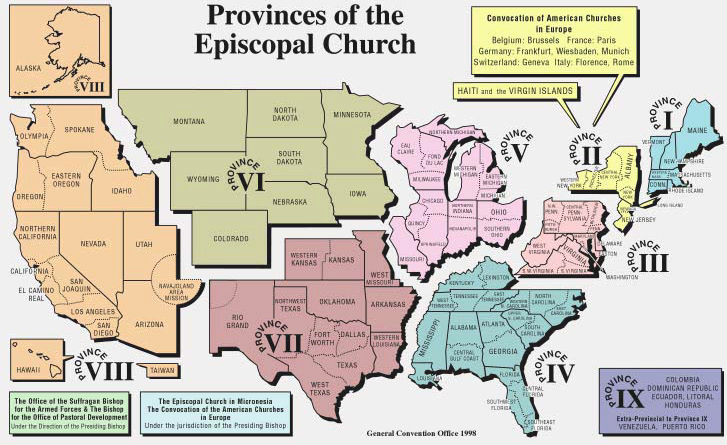
provincesAnd can we take a look at our provincial structure?  Is there a reason we still need to organize by geography in the digital age?  Our dioceses are expected to pay assessments to provinces, which work with varying degrees of effectiveness.  Why not do away with this whole level of organization and trust that in the digital age, we can communicate with others who are across the country, just as well as we can with those who are two hours’ drive away?  (Or, in the case of my own gigantic Province VIII, as much as 8 hours’ airplane flight away.)  For those provincial network groups that are still valuable, such as the Province VIII young adult gatherings, there is nothing to prevent them still meeting if they want to, even if this whole level of governance doesn’t exist.  I don’t understand why TREC is not asking these questions.  Maybe it plans to, and just hasn’t gotten there yet.

Regarding General Convention:  TREC has correctly identified the most important things that only Convention can do:

  • constitutional and canonical changes
  • changes to liturgy and the Book of Common Prayer
  • adoption of a budget
  • elections canonically required to be held at GC (maybe we could reduce their number!)
  • governance and structural reform

Their proposal to establish a screening process to permit only the most important resolutions on social justice issues has caused some alarm.  But if we are honest, we have to admit that often, in cases that are not high-profile issues, many deputies are voting on issues they have may not have much knowledge about, trusting the relevant committee to have made appropriate judgments, and voting “yes” on what they recommend.  Even on high-profile issues such as Israeli-Palestinian peace, the legislative committee in 2012 did significant work to sift through competing priorities and controversial and complex issues that the rest of us were not privy to, especially if we were serving on other committees.  We had to trust the committee to make responsible judgments.

That means the church’s social justice portfolio is already effectively in the hands of a small group of people.  Here’s one idea: elect this group of people at Convention and empower them to make judgments on social justice issues while Convention is not in session, only involving all of Convention on the most high-profile issues.  The fact is that many social justice priorities arise in the interim between Conventions anyway, and Executive Council ends up creating positions for the whole church (at the recommendation of the relevant Council committee, an even smaller group).  We don’t wait three years between updating our thoughts on these matters.

church-planting-logoMy major concern with the proposal to limit legislation is with mission matters.  How about this: at the last Convention, we approved the concept of Mission Enterprise Zones to give grants for new church communities.  PB&F (Program, Budget, and Finance) responded by giving $2 million to this priority.  In 2009, we approved the Strategic Plan for Latino/Hispanic Ministries, and it was partially funded in response to overwhelming support on the House floor and in PB&F hearings.  What happens if we’re not allowed to bring such creative resolutions to the floor?  Should PB&F be in charge of dreaming up cool mission priorities all by its lonesome?

I might agree with TREC’s proposal if it is broadly stated enough to allow such creative mission priorities to come to the floor and get the opportunity for funding.  Perhaps these initiatives fall under the category of “adoption of a triennial budget.”

TREC’s other proposals about streamlining the work of legislative committees make sense, though I don’t see what reducing the number of legislative committees will accomplish.  It’s not like the legislative committees fill up their spare hours by dreaming up more resolutions to waste Convention’s time with.  They respond to the resolutions that others submit.  Reducing the number of committees just increases the workload of each committee, taking more time to bring legislation to the floor and potentially lengthening Convention, while increasing the number of deputies that don’t have a committee to work with and therefore aren’t fully utilized.

Allowing legislative committees to meet in advance is a good idea, and will promote efficiency.  There will be some additional costs for electronic meetings and so forth – not significant, but they will be there.  This is not a cost-saving measure per se, but it might save time on-site.

Reducing the number of CCABs is a perfectly fine idea.  From my work on Council, I am aware that some of the CCABs don’t really even know what they are supposed to be doing.  There’s no use having groups just because we’re supposed to have them.  Appointing task forces to do real, identified work is a good idea.  The work of thinking up resolutions to submit to Convention, which CCABs are supposed to be doing now – that’s what deputies and bishops are elected for, right?  Get to work, deputies and bishops – band together, dream up good ideas, and file those resolutions.  We don’t need to appoint groups to have meetings, spend money, and do it for us.

images-1The Money Scorecard
So far, if you’re keeping score on the money issue:  the proposal to eliminate most CCABs is the ONLY proposal that will save us much money (let’s say, $400,000 over the triennium, a generous estimate of the savings).  The other proposals to change Convention will save the dioceses some money, but may even increase costs at the church-wide level. 

Next Post:  I will continue discussing the work of the Presiding Bishop, Executive Council, and the Staff.

Sermon for March 2, 2014

Scriptures for this Sunday are Here

Listen to this sermon here:

On March 18, 1958, the Trappist monk Thomas Merton, one of the great writers on Christian spirituality in the 20th century, was walking down an ordinary street in the shopping district of Louisville, Kentucky, as crowds went about their business, when something happened: he looked around and saw something.  He wrote about it in his journal the next day:  “Yesterday, in Louisville, at the corner of Fourth and Walnut, in the center of the shopping district, I was suddenly overwhelmed with the realization that I loved all those people, that they were mine and I theirs, that we could not be alien to one another even though we were total strangers.  It was like waking from a dream.”

Years later, he wrote about the experience:  “It is a glorious destiny to be a member of the human race, though it is a race dedicated to many absurdities and one which makes many terrible mistakes: yet, with all that, God Himself gloried in becoming a member of the human race. As if the sorrows and stupidities of the human condition could overwhelm me, now that I realize what we all are. And if only everybody could realize this! But it cannot be explained. There is no way of telling people that they are all walking around shining like the sun.”

Walking around shining like the sun? That may be true for spiritual giants like Merton, we might say; for Jesus, the Son of God – but surely it cannot be true for us.

After all, we got up this morning, didn’t we?  We brushed our teeth, we ate breakfast, we rushed to get into the car in time, we got ourselves and our children here to church, we settled into our chairs and tried to figure out the tune to the opening hymn, we are ordinary people who every now and then get a glimpse of what God might want for us.  But surely we are not shining like the sun.  Shining like the sun is what Jesus did, on the mountaintop, in the Transfiguration story we read today.

Today is the last Sunday of Epiphany.  And Epiphany is the season of light: it begins with a bright star shining in the Western sky, bringing wise men from the East to find a child in Bethlehem.  And Epiphany ends with that child full-grown, shining in transfigured glory on a mountaintop, dazzling his disciples with uncreated light.  In the meantime, during Epiphany, we see how Jesus is light to the world, and we hear him tell us that we are also the light of the world.

Today’s story provides a clear bookend with the story we hear in the first Sunday after the Epiphany, when Jesus emerges from the waters of baptism to hear the words, “You are my Son, the Beloved, with you I am well pleased.”  Today we hear the same words, as a voice from the clouds interrupts Peter:  This is my Son, the Beloved; with him I am well pleased; listen to him!

Dazzling light, shining clouds, Moses and Elijah, a mysterious voice!  It is transcendent glory we hear about today.  It is glory that looks backward to the baptism that began Jesus’ ministry, and it is glory that looks forward at the long Lenten journey to the cross that awaits Jesus when he comes down from the mountain.  It is glory that looks even further than the cross, as Jesus commands the disciples to tell no one about their experience until after he has been raised from the dead.  Apparently there is something about this experience that cannot be understood except in the light of Easter, glorious resurrection light.  And it looks forward beyond Easter, to the moment when the risen Jesus leads disciples out to a new mountaintop and promises to be with them always.

The Transfiguration story is the centerpiece of Matthew’s gospel.  Yet we could be forgiven for hearing this story and simply scratching our heads and asking: what could the Transfiguration possibly mean to us?

I have put a lot of thought into this question, and I have come to the conclusion that this story means everything to us.  Not because transfiguration is something that we can see happening every day.  Transfiguration is not an everyday human experience.  It’s not the same thing as transformation, for instance – transformation is an excellent word to describe human growth and change, new orientation, new understanding – these are vital things in our spiritual journey, so vital that transformation is part of our mission statement at Nativity:  transforming lives with the love of Jesus Christ.

But transfiguration is not about transformation.  What happened to Jesus on that mountaintop was not just an important spiritual growth experience – he began to shine with God’s uncreated light.  The glory that was his as Son of God was revealed in unexplainable splendor.  And anyone who tries to express in words what happened that day, to dissect it, to analyze it, to make sense out of it, to explain it away in terms of ordinary everyday human experience like transformation is doomed to failure.

Because Peter, James and John were confronted with a truth beyond human comprehension – they saw something that transcended the laws of physics.  And we cannot describe or explain what they saw.  We can only say that they experienced a miracle of vision.  A veil was lifted from their eyes and they saw something that ordinary humans normally don’t see.

And after years of thinking about this, I have come to the conclusion that what they saw was the truth as it always exists.  Jesus always, from beginning to end of his life, shone with God’s uncreated light – and for one brief moment, the veil of ordinary human existence was lifted from their eyes and they saw him as he truly was, shining with God’s light.

It is the same light that shone around him in the manger in Bethlehem.  It is the same light that shone around him as he healed the sick and preached good news to the poor.  It is the same light that shone around him as he hung gasping for air, crying out with pain, on the cross, and the same light that shone around him as he rose from the dead, astonishing his friends.

And what is absolutely remarkable, amazing to me, is that somehow, some way, I believe God’s light shines around each of us in the same way.  We are baptized children of God, adopted into God’s family, sisters and brothers of Jesus the Christ, shining with his light.  Thomas Merton saw that light, ordinary human beings shining like the sun as they went about their daily business.

My ancestor, the great Puritan preacher Jonathan Edwards, known best for railing at people about their sin, also knew about that light shining around us; he wrote: “The rainbow that follows the rain is light reflected through a multitude of drops that are like God’s little jewels, each a little star that represents the saints of Heaven, the children of Christ receiving and reflecting the light of the sun just breaking out of the cloud that had been till now darkened. The whole rainbow, composed of innumerable, beautiful shining drops, all united in one, arranged in such excellent order . . . the different colors, one above another, in such exact order is the church of the saints, each with a particular beauty, each drop very beautiful within itself, but the whole as united together much more beautiful.”  We are the light of the rainbow, he says; we are shining with God’s light.

So what does it mean that you and I are here, ordinary people in an ordinary church on an ordinary day, shining with uncreated splendor?  Think about that, that God’s light might be shining around you right now.  Think about yourself as not only God’s beloved child, though you are.  Think about yourself not only as God’s anointed minister and messenger to your family and your community, though you are.

Think of yourself as a being shining with such glory that God has to veil all of our eyes so that we don’t all blind each other all the time.  God’s Holy Spirit like tongues of fire, leaping from you to me to you, back and forth all the time, the whole time we talk, the whole time we listen, the whole time we look at each other and experience the events of our lives, the loves and the resentments and the irritations and the laughter and the tears, God’s uncreated light shining in us and through us every moment.

And what if it is really true?  What if we are truly loved, not because we are good or kind or helpful, but because we are God’s children, because we are glorious?  Then could we forgive ourselves our quirks, our helplessness, our insecurities?  Could we let ourselves experience our anger and our pain and our sinfulness and our thoughtlessness?   Knowing the whole time that there is nothing we could do that could ever stop God from loving us, because we are like God, not despite of the fact but because we are human, because we are created in God’s image?

And what would it be like if we could see past the veil that darkens our eyes, could believe that if it were lifted and we looked around at each other, we would see that same uncreated glory shining in our neighbors too?  What if we could see each other as God sees us, bright and beautiful and shining with God’s love, God’s very being?  What if every Christian could see that radiance in every human being, even those who are despised and rejected as Jesus was?.  How would the world change?  How could we judge, hurt, deprive each other?  How could we not love and care for each other?  How could we help but love our neighbors as we love ourselves, when every person we meet shines with God’s glory?


Mission … Mission … Mission – Part One

missionary-societySix of my friends and colleagues in the Acts 8 Moment have been blogging about this question: What does it mean to be a 21st century missionary society?  Go read their posts!  All six of these amazing folks have great things to say, from very different perspectives, and these vital perspectives should be part of the conversation as we move into Episcopal Church restructuring, or re-imagining, as the Taskforce for Reimagining the Church (TREC) likes to put it.

All this talk of mission, and of what it takes to be a missionary society in the 21st century, is right on point with the whole restructuring movement.  Recall how this movement got started:  DFMS Chief Operating Officer Stacy Sauls made a presentation to the House of Bishops arguing that church-wide “governance and administration” costs were too high compared to “mission” costs. The bishops got to work at their diocesan conventions, restructuring became a clarion cry, and the 2012 General Convention unanimously (unanimously!) passed a resolution establishing TREC.

missionNote the overriding concern that began this whole restructuring movement:  the budget, and how we spend our money to support mission.  Recall also what the biggest controversy was leading up to that 2012 General Convention: ALSO the budget, and how our money is spent to support mission.  I had a big part in that conversation, and my blogging, I think, helped inspire a re-visioned budget for the current triennium that is based on the Anglican Five Marks of Mission.  (Scott Gunn and Tom Ferguson don’t have a monopoly on crowing about their ancient blog posts.)

treasure1All this is to say:  in all this talk about restructuring the church, let’s pay attention to how the proposals we make will affect the way we spend our money, because money is what started this conversation, and money is a vital part of this movement to restructure the church.  Money is not some dirty, tangential thing; money is a direct measure of our priorities.  Jesus knew this, which is why he told us over and over in many different ways that money is one of the most important spiritual issues of our lives.  Let’s be sure we are putting our treasure where want our hearts to be (heaven), because Jesus said clearly that wherever we put our treasure, our hearts will follow.

So does TREC have this goal in mind, of putting our treasure where we know our hearts should be?  They do seem to be operating on the unstated assumption that one purpose of this restructuring is to save money, or use it more wisely.  Hence the proposal to reduce the number of voting deputies, to save money (well, and be more “nimble” – Bingo!  There’s one of our special words!  I am feeling nostalgic for the 2012 General Convention!).

But other than that, their only mention of the issue that started this whole process is this, on page 3:

In the reform of the budget process, reduce the general assessment to dioceses to something closer to the biblical tithe, and develop a sensible means of holding dioceses accountable for paying their assessments.

For the record, I think both of these things are great ideas.  The problem is that (as far as I can tell) TREC hasn’t taken the least tiny look at how we actually spend our money, and whether such a reduction would be possible, and they certainly haven’t begun to propose reforms that would bring our spending down to that level.

TREC thinks the biblical tithe, or 10%, is a nice round number.  That sounds like a nice round number to me, too, and as the chair of the Executive Council budget process, I will work with you to try to make it happen if I possibly can.

But let’s be clear – a reduction from 19% to 10% is a huge reduction in TEC’s revenues.  Based on my quick-and-dirty estimate of the revenue lost if this reduction had happened in 2013, this reduction might cost us $27 million over the triennium.  (Even if we could convince every diocese paying less than 10% to up the ante to a full 10%, we would still have to cut $22 million from the budget.)  You can’t propose reform of that magnitude without telling us how you plan to accomplish it.  Otherwise we could end up, not with TREC doing a careful three-year process to create a coherent restructuring, but instead with PB&F doing the actual, effective restructuring on the second-to-last day of Convention, as happened in 2009.

Note: in these three blog posts, I will do my best to count up the financial effect of the reforms proposed so far – not because money is the only important aspect of these reforms (it’s not), but because it’s something I can do that as far as I can tell, no one else (including TREC) has done.  Hint: they’re not anywhere close to saving us $27 million yet.

Cool Modified Structures (11)That’s not to say that this restructuring movement is entirely about money.  There are lots of inefficiencies, oddly constructed power structures, and unclear mandates in the way our systems have evolved, and this is a great time to correct those things.  TREC has some good ideas for how to do this.  And, as TREC correctly points out, The Episcopal Church needs to concentrate on mission, and restructuring “will not save the church or do the work of reaching out to the world in new ways with the transforming good news of the gospel.”  Underlying all the anxiety about money is the fact that the Church has less money now than it used to have because our numbers of active disciples are shrinking.  I hope that as this restructuring movement continues, we can find a way to empower mission and evangelism in the church.

The TREC Report on Governance and Administration

With that in mind, let’s take a look at the latest TREC Study Paper on Governance and Administration.  I am glad to see that TREC is finally getting to specifics, and some of their proposals have real merit.

The problem is that they seem to be lost in the weeds.  Why are we restructuring the church?  What are we hoping to achieve?  What do we want our church-wide structure to accomplish?  What should DFMS (the Episco-geek term for the church-wide corporate structure, including the staff) be doing?  What do we want the staff to concentrate on?  What are the major functions of the church-wide governing and staff structures?

In TREC’s “Identity and Vision Draft,” they talked about these questions at the 30,000-foot level, concluding that the church-wide structure should be a Catalyst, Connector, Capability Builder, and Convener.  Now they swoop right down to the 1-foot level, speaking about numbers of deputies per deputation, who reports to whom, and what to do with the CCABs (never mind if you don’t know what these are).  These are important questions, but we skipped some steps.

Unless we know what important things MUST be done at the church-wide level, we will never achieve clarity on our restructuring or on how we use our resources and our staff.  Some definition work needs to happen:

  • Why do we have a General Convention?  What things do we need it to do that no other structure can appropriately do?  Are there other things that could happen in conjunction with Convention to empower mission in the church?  What needs to happen between Conventions to keep the work of the church going?
  • What are the absolutely vital tasks that we need a Presiding Bishop to do?  What are the other tasks that have fallen to the Presiding Bishop over the years that could be accomplished in other ways?  What are the most appropriate ways to do these things?
  • What is the Executive Council?  What do they need to do that no one else can do, how many people does it take to do those things, and where do they fit within the power structures of the church?
  • What is the staff for?  What things do we need to pay people to do?  What things can DFMS do that no one else can do?  And by the way, what kind of functions should a church-wide headquarters building support?  (Recall that the 2013-15 budget includes $11 million of expenditures related to the Church Center building alone.)

Once we have defined these roles, we can figure out how we need to be structured, what things we need to get rid of, what things we need to keep or expand, and how much everything will cost.

In the next post, I will talk about the role of General Convention.

Executive Council, Feb. 2014: Let’s Hope It’s About Jesus

Each morning at an Executive Council meeting, we begin with prayers and meditation on a Bible passage.  At my table last week, during our discussion of one passage, a member said that every time he stands up to preach, or to lead a church group or meeting, he says to himself, “I hope this is about Jesus.”

It’s a good way to think about what Council does.  All the minutiae of budgets, by-laws, and boards – tiresome as it can be, I hope it’s about Jesus.  And surely it is.  The way we use our resources, organize ourselves to make decisions, and argue and advocate for different positions, may be complex.  But in the end, if all that politics helps us to advance the mission of Jesus, it’s all worth it.  I hope.

Executive Council just concluded its February 2014 meeting, and addressed some important issues, though we left some questions unresolved.  We have mountains of work to do, and not enough time in our three-day meetings to plow through all of it, though we do the best we can.

You can read a full report of our decisions on the Episcopal News Service site, here. While many areas Council worked on at this meeting were important (such as addressing human trafficking and football team names that support racial stereotypes), I want to talk about a few issues in particular here.  My apologies for a long blog post aimed at Episcopal Church groupies!

UTO Agreement

First, after much debate and dissension in the blogosphere over conflict between Church Center staff and some former board members of the United Thank Offering, Council approved new by-laws for the UTO.

The GAM (Governance and Administration for Mission) committee heard heartfelt explorations of the issues that led to the controversy at our last meeting (October 2013).  Those discussions were in executive session, so I wasn’t privy to their content (I serve on FFM, the Finances for Mission committee).  GAM then formed a committee of Council members who worked with current UTO board members to come to an agreement.  The only Church Center staff member present was Paul Nix, the legal counsel.  This group met over four days in January 2014, and did a lot of work to get to know each other, to explore the history and mission of UTO, and to discuss the way the UTO operates.  They came out of their meeting with a unanimous proposal for new by-laws and a new memorandum of understanding (MOU).

I asked Steve Hutchinson, the chair of GAM, to explain why new by-laws were necessary.  He said there were some unworkable provisions in the old by-laws, such as the requirement for a 75% affirmative vote for anything to pass; a no-excuses rule that required every board member to be present at every meeting, with one absence a cause for dismissal; and presidential power to dismiss any other board member at any time without reason.  I read through the new by-laws, and concluded that they were simply innocuous.  I have no objection to them; they are simply a standard set of governance by-laws.

I had a few more questions about the MOU, which I shared with Steve privately and in Council session.  My basic concern is that parts of the MOU can be interpreted in a way that allows Episcopal Church leadership (however that is defined) to create granting criteria for the UTO, and I do not believe it is Council’s intention to impose our judgment (or the staff’s) on the UTO.  Steve assured me that that was not the intention, that everyone understands that the process would be:  (1) the UTO creates granting criteria and proposes them to Council; (2) Council ratifies them in our usual rubber-stamp manner when given a proposal that others have labored hard over; (3) UTO goes away and does the work to determine grant recipients; (4) Council approves their grant requests (again, a rubber stamp in every situation I am aware of).  Steve also assured me that the MOU (unlike by-laws) is not a legal document, but one that will continue to evolve and be modified, and that my concerns will be taken into account as the MOU is corrected and changed over the next few months.

For the record, I voted in favor of the new by-laws, because as I said above, they are simply innocuous.  I voted against the MOU, because I would rather have a “fully evolved” and clear understanding of the process in any MOU that is adopted.  However, I do trust Steve that the intent is right, and that all parties are satisfied.  At some point, I hope Christians can stop relying on paper documents to do our work, and start trusting and working in partnership with each other.  I think that the UTO and Council are already at that point, and I hope that whatever conflicts have existed between the UTO and staff will be reconciled.  I am deeply grateful for the hard work that has been done by Steve Hutchinson and the other Council members to reach this point.

Once again, it should be clearly stated: no donated money will go to any other cause than to UTO grants.  UTO administrative costs are paid entirely from UTO trust funds, which are administered by DFMS.  We can all trust that our thank offerings are going 100% to their intended recipients.

Note that there is continuing confusion and unclarity about the status of “boards” (such as the UTO, the Board of Transition Ministries, the Archives, etc.), and how much oversight Church Center leadership has over staff working in areas of board operations.  These groups are not separate legal entities, but are parts of DFMS and are legally subject to Executive Council/General Convention oversight.  How much oversight staff is authorized to exercise is a curious question.  GAM is undertaking further work to clarify this question, and I look forward to seeing their report.

Location of the Church Center

I serve on the subcommittee for the Location of the Church Center, which is working to respond to Resolution D016 from the 2012 General Convention, which stated that it is the will of Convention to move the Church Center away from 815 Second Avenue, New York City.  There are two separate and interrelated questions involved here.  First, if we are going to move, where should we go and what is our vision for a reconstituted Church Center (or similar creature by another name)?  Second, what should we do with the real estate asset that we leave behind?  We are making some progress on both of these questions, though they are large and complex questions that cannot be answered quickly.  I can’t say much about what we are doing in response to the second question, because these deliberations are confidential due to real estate valuation considerations.  But please believe me that we are progressing well on the real estate question.

With regard to the first question, we have received some very helpful responses to our survey conducted last fall.  We had nearly 1200 responses, and they listed the following as the top five most important factors for a new Church Center to embody:

  • Is affordable
  • Provides affordable nearby accommodations
  • Provides excellent hospitality
  • Provides affordable meeting space
  • Provides easy access for members to fly to

“Affordable” is obviously a very important consideration, as is the idea that a new Church Center should be a gathering place that people can get to easily, gather comfortably, and stay nearby at a reasonable price.  This is a vision that I certainly agree with.  We will be researching how we can respond to these hopes, and reporting back on our progress.

Budget for the Current Triennium

Good news on the budget front for the current triennium – we expect to receive $885,000 more per year in 2014 and 2015 than budgeted, mostly due to better than expected collections from two large dioceses.  At our October meeting, Council agreed to use $258,000 to fund a new racial reconciliation officer.  At the February meeting, we agreed to use $150,000 to fund a critically needed digitization project at the Archives.

In addition, we expect to use $312,000 in 2015 to support the Anglican Communion Office, in response to a request from the Presiding Bishop.  If approved, this will raise our ACO commitment from $700,000 for the triennium to $1,012,000.  According to Presiding Bishop Katharine, her request came not only in recognition of greatly improved relations with the Communion, but also as a gesture of support for some very beneficial work, such as the continuing Indaba project and reconciliation work.  We did not officially vote on this request at this meeting, because it affects the 2015 budget, which does not come up for an official vote until October.  However, I expect we will approve it then.  Note that our 2013 and 2014 payments to the ACO were made as if we were spreading a total of $1,012,000 over three years.  If the increased 2015 budget is not approved in October, the ACO will experience a severe cut, to $25,333 in 2015.

I support the archives work and the ACO increase, but I hope the budget requests stop there.  These new revenues and expenditures will leave us with a surplus of about $1,050,000.  In my view, this money should be used to reimburse the endowment for part of the cost of the Development Office.  The Development Office announced the receipt of a pledge for $5 million for work in Haiti, which is good – they have now officially broken even, and have raised more than it costs to run the office.  They always said it would take time to build their contact list, and I have no doubt that success in this area is a long-term endeavor.  However, I don’t think the Development Office should be funded from the endowment.  If the office were raising funds for the endowment, this might be appropriate, but they are not.  They are raising funds for projects like Haiti and Navajoland – critical needs, but operating, not endowment needs.  We need to find ways to fund this office from operations.

Budget Proposal for the Next Triennium

One of the most important responsibilities of Executive Council is to propose a budget to the next General Convention.  The last two triennia, it has been a fiasco.  Without rehearsing those prior failures, I can say that I came into Council determined that we should not repeat them.  I was promptly appointed the chair of the Budget Process subcommittee, which has been working almost since the beginning of this triennium to put together the 2015 budget proposal.  We hope that this will be a document that embodies a true, inspiring, vision for the church.

Here’s what we’ve done so far:  requested all the CCABs (Commissions, Committees, Agencies, and Boards) to undergo a visioning process and tell us of their visionary priorities for the church’s work in the next triennium.  The Standing Committees of Council have now reviewed those priorities and ranked their most important ones.  Among our findings from this process:

  • First, there is widespread agreement about continuing to engage in Marks of Mission initiatives, and in some cases expanding them.
    • The current work being done in Mission Enterprise Zones, Province IX Sustainability, Young Adult Service Corps, and Engagement with Domestic Poverty was widely supported.
    • Some other exciting and visionary initiatives were proposed.
      • There was great interest in expanding our work with underrepresented ethnic groups, including evangelism, church planting, leadership development and support, strategic planning, providing resources in non-English languages, and anti-racism training.
      • There was interest in considering issues of lifelong Christian formation, ranging from a church-wide conversation on theological education to grants for campus ministries to paying special attention to Christian formation of non-English speakers.
      • There was a proposal to hold hearings across the country on issues of injustice and racism.
      • There was an idea to encourage companion relationships between TEC parishes and dioceses and parishes and dioceses in other countries by providing funds for matching grants for mission projects.

In addition to these Marks of Mission projects, there were a number of excellent proposals for strengthening the ways our infrastructure supports our mission (which I won’t bore you with here).

At our June meeting we will take up the question of revenue: how much should we be asking our dioceses to pay toward support of The Episcopal Church?  We currently ask 19%, but diocesan compliance with this rate varies widely, giving rise to much resentment on the part of dioceses that pay the full rate toward those that do not.  In my opinion, 19% is too high, and poses an unfair burden on the dedicated dioceses that pay full freight.  I believe we should lower the asking rate, though it will result in millions of dollars of reduction in TEC revenues.  A lower asking will allow more money to stay in local hands, where it will contribute to mission in important and tangible ways. 

At the June meeting, Council will be requested to make a decision on the revenue question, so this is the time to begin making noise if you have an opinion on the subject!  Once we have a revenue estimate, we can begin to create a real budget, which weighs the priorities we have identified against the revenue available.

2018 General Convention in Austin

While we’re on the subject of paying the diocesan asking – the General Convention Planning Committee brought to Council a proposal to hold the 2018 Convention in Austin, Texas.  This met with a question, because the Diocese of Texas is not paying its full asking – though it has recently raised its payment to 10%.  Should we be holding Convention in a diocese that does not meet its full obligations?  The answer the Planning Committee gave was that they have received assurances that Texas will be increasing their payment to full compliance before 2018.  After receiving this assurance, Council voted to approve Austin as the 2018 Convention site.

This raises the whole question of our unjust system of asking.  The most dedicated dioceses pony up the full amount, while recalcitrant ones get away with paying much less without penalty.  What kind of accountability should we have?  Should large church-wide meetings be prohibited from happening in dioceses that do not pay the full amount?  Should non-paying dioceses be asked to explain their choice?  Should the voluntary “asking” become a required “assessment?” I hope the 2015 General Convention will take up these questions.

I Hope it’s About Jesus

I have to say that attending Council is both an exhilarating and an exhausting experience.  We work hard to get a huge amount of work done in a few too-short days.  We do the best we can to make wise decisions in the face of a lot of time pressure and a lot of uncertainty.  Sometimes it all seems very institutional and bureaucratic, and it is.  But we are ultimately doing the best we can to steer a very large ship in the direction of God’s mission.  In the end, I hope it’s all about Jesus.

Sermon Notes for 12.15.13

Scriptures for this Sunday are Here

A year and a day ago, Scarlett Lewis sat in a firehouse in Newtown, Connecticut, waiting to hear news of her son, Jesse.  She watched as one by one, parents received the news that their first-grade children had died, and then she watched as a sheriff’s deputy approached her, knelt down in front of her, and gently gave her the news that Jesse would never be coming home again.  She learned what the other first-graders had told the police: that in a classroom where 10 first-graders were hiding, when the shooter walked in and paused to reload, Jesse stood and shouted “Run!” to all the others.  They did run, and escaped, but Jesse didn’t –  at 6 years old, he gave his life for nine other first-graders.

Devastated, she and her older son went to her parents’ house and stayed for several weeks, not sure they could face going home to a house without Jesse.  But finally, they decided to face it and went home, and when she went into her kitchen, she looked at the chalkboard the family used to write messages to each other.  And there she saw Jesse’s last message to her: misspelled in a first-grader’s way, but unmistakably his crooked handwriting, three words he had recently learned:  Nurturing Healing Love.

From that moment, she decided that she would take those words as a mantra.  She decided that she would not let her grief drive her to despair.  She decided that she would let the meaning of Jesse’s life, and death, be his last words to her: Nurturing Healing Love.  That is the title of her book, in which she tells the story of the months that followed Jesse’s death, and how her own choice of how she would look at her son’s life and death inspired others to look at their own lives differently too.  It is a story of courage in the face of unimaginable devastation, a story of beginning to heal after a disaster that very few people could heal from.  And because it shows how she was able to choose how to see Jesse’s life and death, it is a story of how our own minds in a way create the reality we live in.

In fact, this is the job of a prophet – not to foretell the future – the prophet in Bible is the person who sees a reality that not many others can see, and therefore helps create it.  The prophet is a person who can see God’s will coming to life before it happens, whose mind, understanding God’s desires, can actually speak that reality and help make it come true.  The prophet looks at ordinary prosaic life and sees where God is working – sees an underlying reality that others don’t see, by the power of inspiration and imagination.  And by imagining this reality, the activity of God that underlies everything that exists, and describing it to others, the prophet helps make it real.  It becomes an outer, visible reality and not just an imagined one – God’s reality.

In our scriptures today, we hear of two prophets: Mary and John.  Mary sings the song we hear in place of our psalm today – the Magnificat, named after the Latin for its first line: “My soul magnifies the Lord.”  Mary has stood in the presence of an angel, she has heard that nothing will be impossible with God, she has discovered that she is pregnant, and she has come to visit her cousin Elizabeth, also miraculously pregnant.  Seeing Elizabeth, Mary breaks into song, not a characteristic song for an uneducated peasant girl: Mary turns into a prophet who can see God’s reality.  She has been told that she will bear a son who is the Son of God.  And she understands not only this fact, but what it means – she describes a vision of God’s hope for the world, singing in the past tense as though it has already happened.  She sings of the greatness of the Lord, she sings of God who brings down the mighty from their thrones and lifts up the lowly, she sings that the hungry will be filled and the rich sent away empty.

We who are skeptical may believe that this is religious romanticism.  But we should not underestimate the power of the religious imagination.  It was a modern-day prophet, Dr. Martin Luther King, who was able to imagine and describe a nation in which his four little children would be judged not by the color of their skin, but by the content of their character.  And by imagining it, and describing it in a way that other people could imagine it too, he helped make it a reality.  That’s what the prophetic imagination can do – help God describe and therefore create a new reality.

But what if the converse is true?  If you can’t imagine it, then it is not reality?  What happens if you can’t imagine a reality that runs under the surface of all things?  What happens if you believe that the mundane everyday world is all that exists or can exist?  Maybe you can’t see a deeper reality even if it’s there.

Some reporters at the Washington Post decided to test this question in 2007.  (See the Pulitzer Prize-winning article by Gene Weingarten about this experiment here.)  They set up a hidden camera in a subway station in Washington DC.  A young man in jeans, Washington Nationals baseball cap and T-shirt walked into the station, set down a violin case, took out a violin, put a few dollars and coins in the case to seed the pot, and began to play.  For next 43 minutes, he played 6 classical pieces as 1,097 people passed by.  He played some very difficult, soaringly beautiful classical pieces, and he played the best-known religious song in the world – Schubert’s Ave Maria.

The reporter wrote later, “The violin is an instrument that is said to be much like the human voice, and in this musician’s masterly hands, it sobbed and laughed and sang — ecstatic, sorrowful, importuning, adoring, flirtatious, castigating, playful, romancing, merry, triumphal, sumptuous.”

What the commuters didn’t know was that the young man was Joshua Bell, one of the finest classical musicians in the world, playing his multi-million dollar Stradivarius.  Three days before he had sold out Boston’s Symphony Hall, with tickets at $100 apiece.

During the 43 minutes he played in the subway station, out of 1,097 people who passed by, 7 people stopped to listen for a while; a few put in money; only one person actually recognized him; his take for the day was $32.17.  Many people interviewed outside the subway station didn’t even remember that there had been a musician there.

From the Post article: “The poet Billy Collins once laughingly observed that all babies are born with a knowledge of poetry, because the lub-dub of the mother’s heart is in iambic meter. Then, Collins said, life slowly starts to choke the poetry out of us. It may be true with music, too.”  Interestingly, every single child who walked by stopped, pulled parent toward the violinist, wanted to listen, and every single parent hurried their child away.

The Post’s question was this: “His performance was arranged by The Washington Post as an experiment in context, perception and priorities — as well as an unblinking assessment of public taste: In a banal setting at an inconvenient time, would beauty transcend?” The answer, apparently, was no.  Or maybe it was just the setting – we expect to hear beauty in symphony hall.  In a subway station, we can’t imagine it – so we just don’t hear it.

Maybe this was John the Baptist’s problem in the gospel today – what he imagined the Messiah to be – wrath, fire, separating wheat from chaff, awe-inspiring displays of God’s power – isn’t what Jesus is doing – so he sends a message to ask: are you the one to come, or is there another?

Jesus sends a message back to his cousin inviting him to imagine a different reality: a reality that the prophets Isaiah and Mary had described.  The blind see, the deaf hear, the lame walk, the poor have good news brought to them.  Imagine, Jesus says, that this is how God works – not by setting the world on fire, but by bringing new life and healing to the poor and suffering, as Mary sang.  Imagine that God’s kingdom could become a reality on earth in a whole new way than John had imagined – a way that comes quietly, like a baby in a manger, to the least and the lowest, without displays of power, but with humility.  With nurturing, healing, love that invites the world to join in.

We don’t know whether John was convinced – Matthew doesn’t tell us – but we know that this was exactly how Jesus continued his ministry, in a way that wasn’t obvious.  It takes God’s imagination to understand that what Jesus was bringing was God’s kingdom.  Jesus’ kind of ministry was so unimaginable to most people as a picture of God’s kingdom that they ended up putting him to death.  Most people missed it altogether.

Could this be true of us too?  Could God be in action all around us and we can’t see it because we can’t imagine it?  Could the Holy Spirit be weaving beautiful music all around us, the most beautiful music we’ve ever heard, the music of the Kingdom, the music Mary heard, that caused her to burst into song– and we can’t hear it because we can’t imagine it?  Maybe we can only imagine Jesus at work in church, and can’t see or hear what he’s doing the other 167 hours a week of our lives – and because we can’t see it or hear it, we can’t live in the reality of God’s kingdom, we can’t be like Mary the prophet, or even like Scarlett Lewis, the grieving mother in Newtown.

Maybe we’re the blind and the deaf who need to be healed, we’re the lame who need to be taught how to walk, we’re the dead who need to learn to live.  Maybe we’re the poor who need to hear good news, or we’re the rich who need to join God in God’s mission, knowing that it is our mission too.

So let’s ask God to open our eyes, ears, imaginations. Let’s ask Jesus to show us: where is God working in our lives?  What is God calling us to do with the other 167 hours a week?  How are our lives holy and blessed, how do they answer God’s call?  How are we living in a way that answers the call of Mary’s Song, and sings along?


Sermon for 12.8.13

Scriptures for this Sunday are Here

UnknownNear Tucson, you can see an ecological experiment called BioSphere 2.  BioSphere 1 is the Earth.  BioSphere 2 is a self-contained dome that was built to create an eco-system and research how to make it sustainable.  Back in the ’90s some researchers lived in the BioSphere for extended periods of time and worked on agriculture, living only on what they produced.  Some of the experiment was successful, but the researchers were very puzzled about why the trees wouldn’t grow right. They had the sunlight and water and nutrients they needed, but they couldn’t stand up straight – they just flopped over on the ground.

The researchers finally figured out what was missing: wind.  Apparently, as trees grow, the wind blows and causes them to bend, creating tiny little cracks in the trunks and branches.  As the tree grows, it forms scar tissue, healing the cracks, and the scar tissue is what makes the tree grow strong and straight.  The wind damage makes the tree stronger than it was before.  For trees, their weaknesses become their strengths. Recognizing their imperfections and healing them is what makes them strong and healthy.

Perhaps this is what happened to Nelson Mandela.  In his youth, he was a commander of guerilla forces seeking to overthrow the South African apartheid system by force, but then he spent 27 years at hard labor in prison.  Anglican Archbishop Desmond Tutu wrote after Mandela died this week, “The truth is that the 27 years [he] spent in the belly of the apartheid beast deepened his compassion and capacity to empathize with others. On top of the lessons about leadership and culture to which he was exposed growing up, and his developing a voice for young people in anti-apartheid politics, prison seemed to add an understanding of the human condition.”

When he emerged from prison, his perspective had changed.  He believed that the way to end apartheid was to negotiate, to work in partnership with the people who had held him captive and oppressed his race.  He negotiated with President F.W. de Klerk to end apartheid together; he invited his former prison guard to be a VIP guest at his inauguration as the first president of a free South Africa; he invited the prosecutor at his trial, who had asked for the death penalty, to lunch at the presidential palace.

And instead of civil war bloodbath that most assumed would be the only way to end apartheid, he helped guide country to a much more peaceful transition.  He had learned a message through his hard years:  he said, “No one is born hating another person because of the color of his skin, or his background, or his religion. People must learn to hate, and if they can learn to hate, they can be taught to love, for love comes more naturally to the human heart than its opposite.”  This was the lesson that his years of suffering had taught him.

In our gospel today, we have images of suffering and judgment: John the Baptist cries out that even now the axe is lying at the foot of the tree, he promises that one is coming who will separate wheat from chaff, and burn the chaff with unquenchable fire.   These images sound harsh while we’re busy preparing for the baby Jesus: shouldn’t we be doing what new parents do, preparing to love a new sweet baby, picking out swaddling clothes, painting the manger?  Surely preparing for an axe and a winnowing fork and fire isn’t in the Christmas spirit – surely such a message could never be popular.

And yet – what was it that brought all those crowds out to hear John preach, to repent and be baptized?  What is the attraction of this angry man with the odd wardrobe and the unbalanced diet, preaching fire and brimstone and the wrath of God?

First, understand that when John shouts “Brood of vipers! Who warned you to flee from the wrath to come?” – he is talking to Pharisees and Sadducees.  Pharisees were careful and rigid observers of the law, good people who had a tendency to judge harshly anyone who didn’t meet their religious standards.  Sadducees were the sect of priests and leaders of the Jerusalem Temple – collaborators with the Romans and with the corrupt leadership of King Herod.  These are people who aren’t really concerned w God at all; they just want to make themselves as comfortable as possible, whether others are suffering or not.  For a brief moment, these groups come together as allies, opposing John.

John says both of these groups are missing the point of God’s promise, and will be answerable to God – he says that what we do on this earth matters.  And whether we sin on the side of never thinking about God at all, other than engaging in elaborate religious rituals, but not bothering to act ethically or lovingly toward others (Sadducees), or whether we sin on the side of being positive that we are doing everything right and that our behavior is perfect in God’s sight (Pharisees) – we will stand before God and answer for it.

But note:  there is a third group of people in this story – the people in the middle.  Matthew tells us that people are coming from Jerusalem and all over Judea to hear John preach, and that they’re confessing their sins and being baptized.  Matthew doesn’t tell us that John screams about God’s wrath to these ordinary folks – he tells us that John preaches a very simple sermon to them:  Repent, for the kingdom of heaven has come near.

Now you and I may hear this simple sermon and find it negative and frightening.  There are lots of Christians who like to judge others, call them to repent, threaten them with fires of hell – we shouldn’t judge the Pharisees of Jesus’ time when there are plenty of Pharisees in the Christian world today.  We hear these words, Repent, for the kingdom of heaven has come near, and we hear them as this kind of judgment.

But the people who hear this sermon are not the Pharisees and Sadducees.  They are ordinary people who live very difficult lives in the middle of an oppressive empire that cares nothing for their troubles.  These crowds who are confessing their sins are hearing something very different from hellfire and damnation when they hear John cry, Repent!  In a time of turbulence, instability, oppression, poverty, they live in a world where people are routinely strung up on crosses and made examples of.  It’s a world ruled by violence, power and fear, with no hope for any improvement.

These ordinary people are waiting for God to act, hoping for God’s justice, longing for a new and better world to come.  To a people with little hope, a people who live in longing for salvation, John brings a glimmer of light: a hope that God is about to act, that something new is around the corner:  a hope for salvation and new birth and new life.  They believe that God is about to do a new thing: they want to be part of whatever mighty action God is about to take to bring about a new kingdom, and so they prepare themselves to join God in God’s kingdom by repenting.  Allowing themselves to break just a little, like a tree bending in wind, so that God can build them back stronger.

The word John uses that is translated as repentance is a Greek word, Metanoia.  This word doesn’t mean what we think of when we hear “repent” – we hear it as meaning to feel guilty and shameful.  This word comes from the Greek words for “understand from above” – it means get a new vision, a new mind.  A metanoia is a reorientation, a fundamental transformation of outlook that changes everything about how we see ourselves and the world.

Metanoia changes the heart of a man in prison for 27 years and reorients him toward a new world of peace; metanoia changes our hearts too, because it opens our eyes to see the world with God’s eyes, as we repent, prepare for Jesus’ coming.  Repentance for us means consciously looking at ourselves and how we have been living our lives, and letting God give us new eyes, new hearts.  It means taking the Spirit Christ has given us at baptism and pouring that Spirit into joining God in God’s project of reorienting world from hate to love, and giving ourselves to that project, in words and in actions.  It means praying and working for the day when that kingdom will come as Isaiah describes in the Old Testament lesson today: the time when we wll see the Messiah ruling with righteousness and equity, the wolf lying down with the lamb.

Every Advent, while the world around us dissolves into the overwhelming stress of a holiday season that seems to bring more and more obligations each year, we come to church and hear instead this Advent vision of a new world, anchored in the peace that passes understanding, ruled by Christ, the Messiah.  And every Advent, we undergo metanoia – we ask God to help us change.  Like a tree bending in the wind, metanoia, repentance, means opening our weak spots to God and letting God heal them, making us stronger, letting us become part of kingdom work God is doing here and now.

In Advent, we give up on the things that are keeping us separated from God – our self-righteousness, like Pharisees, or our indifference to God or to anything but our own wealth, comfort, success, like the Sadducees.  We give up on our belief that a world of violence and power, where people live with poverty and oppression, is the only way the world can work. And begin truly to live in, pray for, a new world, God’s kingdom.  We repent and we prepare for Jesus to come into our hearts once more.  Loving God and loving our neighbors, entering into a new kingdom of peace.


Executive Council Thoughts, October 2013

The Episcopal Church’s Executive Council just finished its meeting in Chicago.  We meet three times a year, and the meetings are generally gracious, prayerful, and carefully deliberative.  This one was no exception.  I am grateful to serve alongside such wise and dedicated servants as my fellow Council members.

This meeting opened with some anxiety, and I think some anticipation of fireworks to come.  Happily, fireworks did not go off in my presence.  However, the Council addressed some important issues.

The Conflict over the United Thank Offering.  Without going into the details of the current UTO controversy, I can say how Council addressed it.  I think that some people were looking for Council to sail in and resolve the issue at this meeting.  With deep conflicts, however, a quick fix is often a mistake, resulting in a mere band-aid that doesn’t treat the underlying injury.  The issue was taken up by the Governance and Administration for Mission committee, which properly addresses questions of by-laws and governance.  In executive session, GAM heard what I understand to be very frank and sometimes emotional explanations of how different people experienced the conflict.  I don’t serve on GAM, so I don’t know the substance of those conversations.  In plenary session, the full Council approved a resolution (see the news story here), and heard that GAM and the UTO each plan to appoint four members to a working group that will spend significant time addressing the issues and the decisions that need to be made.  This has now become a matter for Executive Council rather than staff, as I hoped it would.  It will appropriately go through Council’s normal channels: in-depth research by a committee, followed by a report and recommendation to the full Council.  I expect we will hear that report in February.  I appreciate the calm leadership of Steve Hutchinson, the chair of GAM, and I trust this group to address the conflict carefully and with appreciation for the ministry of the UTO and the historical leadership of Episcopal Church women in its decisions.

Please note, regarding the UTO:  100% of money collected goes to grants, and this will not change.  UTO administrative costs are paid out of dedicated trust funds managed by the Church Center.  You don’t have to withhold your contributions to UTO out of fear they will end up in the wrong hands, or be used for the wrong purposes – this will not happen.  And speaking as a member of Council, we have no interest in interfering with UTO grant priorities.  If it turns out that some sort of legal rule requires that Council approve grants, I can promise you that it will be a rubber stamp, as it is with a number of other grants that Council approves.

Location of the Church Center.  In 2012, General Convention passed resolution D016 to move the Church Center away from 815 2nd Ave. in Manhattan.  In February 2013, the Executive Oversight Group of the Church Center issued a report recommending that the Church Center NOT move.  This recommendation caused significant controversy, and led to Council creating a joint subcommittee of GAM and Finances for Mission (FFM).  I serve on that subcommittee (and on FFM).  Up until this meeting, I was concerned about the pace of the subcommittee’s work, but after this meeting, I am convinced that work is proceeding and the right investigations are happening.  We are exploring two issues: (1) what kind of Church Center (if any) does the church need? and (2) what is the best and highest use of the real estate we own in Manhattan?  I can’t say very much about what we are discussing, due to the sensitivities of talking publicly about real estate plans.  But I can say that we have retained outside experts to advise us, and are working on both questions.  Very soon, we will be issuing a survey so church members can weigh in on what kind of Church Center we would like to have.  Be patient, because this is a complex question – but I can promise you that D016 is being taken seriously.

The Budget Process.  I am the chair of the new budget process, by which we will come up with a budget to propose to the 2015 General Convention.  Program, Budget & Finance is working closely with us on this process.  Our goal in creating a new budget process has been to avoid the total fiasco that erupted with last triennium’s Executive Council budget, which was created by a small cadre of inner-circle leaders, with last-minute input from the rest of Council in plenary, and some significant mathematical errors by staff.  We don’t want those problems!  Our goal is to get wide and visionary input from ministry leaders (not just staff or Council) about what the church should be doing.  So far, we have reached out to ministry leaders in Committees, Commissions, Agencies, and Boards (CCABs) and other groups for their priorities, hopes and dreams for their areas of ministry.  We are currently working with Council standing committees to assess the input we have received and to set priorities among all the proposals named.

A couple of notes about what we have experienced so far:

> More than a few CCABs are not functioning very well this triennium.  I think this may be because of the lack of money for face-to-face meetings, along with a lot of turnover in some CCABs.  Whether this makes a difference to the 2015 General Convention remains to be seen.  I’m guessing we don’t need as many CCABs as we have, anyway.

> Some responses indicate that it is too early in the triennium to know what kind of budget needs ministries will have.  Our system expects budgets to be decided at the last minute by major advocacy efforts.  As Bishop Mark Hollingsworth (the chair of FFM) says, “we need to re-train our system.” Can we train ourselves to think with more vision, and longer-term?  I hope so – budget fiascos at Convention get a little wearisome.

> There’s a lot of work ahead of us to put together a visionary, coherent budget!

More Money to Spend!  Due to better-than-expected collections from dioceses, TEC will have more revenue this triennium than budgeted, to the tune of about $1.5 million.  Church Center leaders and the leaders of the Advocacy & Networking committee of Executive Council (A&N) came in with a proposal to hire a new racial reconciliation officer.  After in-depth and difficult discussion in both FFM and plenary session (see the news story here), the Council decided to approve the new officer.  This brings up some issues that I believe Council and FFM need to address before our February meeting.

> No one doubts that the racial reconciliation officer will do worthy and important work.

> However, it is troubling from a process perspective to have one priority funded immediately when others were proposed and not funded (at least not right away), including:

>> A heartfelt plea to restore Anglican Communion funding to 2012 levels, due to greatly improved relations in the Communion, from World Mission, Presiding Bishop Katharine, and Canon Chuck Robertson (Canon to the Presiding Bishop who leads our diplomatic relations with the Communion, and whose excellent work is greatly responsible for our improved relations), even though funding was cut at General Convention.  This decision was deferred to February because FFM wished to consult with PB&F about the action they took to cut the funding at the last Convention.  However, we advanced 2015 funds into 2014 so that the 2014 allocation will be as high as if we had made this decision.

>> Long-delayed and very important work on digitizing the Archives – decision deferred to a later date.

>> Support for Navajoland, which we believe will be necessary in 2014 – they will run out of money by June.  What are we going to do to support them?

> Many other priorities that might have been proposed if their advocates had known that money was available.  Church Center leadership knew about the money, and proposed their highest priority.  Would Council’s decision have been the same if we had been presented with a list of priorities and asked to choose among them?

> Joseph Farrell of North Carolina made the very good point that in his state legislative work, they follow the principle that a one-time increase in funding should not be used to fund a need that will continue (such as a staff position, which obligates us into the next triennium).  Careful stewardship means making judicious decisions that consider such points.

> John Floberg of North Dakota, who serves a Native American population, noted that when racial tensions arose in his area last year, the local churches organized and acted on their own, without the need for a church-wide officer to do it for them.  This brings up the whole question of subsidiarity.  Do we really need more church-wide officers at a time when we are trying to empower more ministry at the local, rather than the church-wide, level?

> There were a number of priorities passed by the last two General Conventions that were not funded.  Instead, we have funded a new position that was not proposed at the last Convention and does not have legislative support.  (BTW, this is not the same position as the anti-racism officer that was cut in 2009 – this position has a completely different job description.)  Should we have gone back to unfunded legislative priorities first, before coming up with new initiatives?  I think particularly of an area I am interested in, Latino/Hispanic ministries.  In 2009, we passed a Strategic Plan for Latino/Hispanic ministries, with great enthusiasm, and it was partly funded.  In 2012, we forgot about it altogether, instead funding Mission Enterprise Zones, but abandoning strategic initiatives that were planned such as marketing to Latinos and raising up and training Latino lay and ordained leaders.  Our attention span is so short that we swing from one priority to another without thinking broadly about our overall strategy as a church.

I believe that FFM needs to come up with a plan (before the February meeting) about how future excess funds are to be allocated.  This should involve consulting with PB&F about unfunded initiatives from the last two Conventions (and, I believe, giving them priority over new initiatives), and some sort of process to open up invitations for funding requests to a wider constituency than knew about this opportunity.

I do support the new racial reconciliation officer, and I’m sure she/he will do excellent work.  I just hope that we can change our approach as a governing board to think about how we use our resources in a more encompassing and strategic way.

Sermon for 9.1.13

Scriptures for this Sunday are Here

The ButlerI went this week to see the movie “The Butler”, about a man who was a butler in the White House for seven presidential administrations.  The movie is fiction, loosely based on life of a man named Eugene Allen, who was a butler for presidents from  Truman to Reagan.

In the movie, Cecil Gaines is an African-American man, born on a cotton plantation, who works his way up to the post of White House maître d’.  His career takes place against the background of the Civil Rights movement.  We see it unfold through Brown v. Board of Education, the integration of schools, the march from Selma to Montgomery, the assassinations of John F. Kennedy and Martin Luther King, Jr., and protests against the Vietnam War and apartheid in South Africa.

We see Cecil in the White House, serving with precision and elegance at sparkling, candlelit state dinners, at tables glittering with gold china, crystal, and silver, for presidents who agonize over what to do about integrating schools in Little Rock and whether they need to champion civil rights legislation.  We watch the African-American butlers work to maintain a mask, pretending to see nothing, hear nothing, react to nothing, even when what they see and hear affects them and their families deeply and personally.

The movie’s major personal conflict unfolds between Cecil and his son, who becomes a Freedom Rider and protester for civil rights, when Cecil just wants his son to stay safe and get an education and a job and family.  In one pivotal sequence, we see the camera flashing back and forth between two dinners.  In one, Cecil is precisely aligning gold-plated china, serving at a state dinner for elegantly attired world leaders, carefully maintaining his mask of indifference.  In the other, his son is sitting with a group of other young black and white people at a Woolworth’s counter, while townspeople berate them, hit them, spit in their faces, drag them onto the floor, beat them, and finally take them to jail.  Back and forth the camera goes, between these two very different dinners.

And then, toward the end of the movie, we come to understand how beloved Cecil is in the White House when Nancy Reagan invites him and his wife to be guests, not servers, at a state dinner, and he experiences being served rather than serving.

In all of these scenes, we understand what doesn’t need to be explained:  that who you eat with in many ways describes who you are in society; that our social roles are carefully organized, and you can tell who counts by where they are at a dinner – who they sit by, who they talk to, where they are allowed to be, whether they’re serving or being served, or in the kitchen, not even visible.

This is true from the most formal state dinner, to the lunch counter at Woolworth’s, to the stridently organized and separated social classes in a high school cafeteria, to the family dinner table.  The dinner table is much more than a convenient place to get nourishment – it is a symbol of how we relate to each other, and who we are in society.

Jesus, of course, understood this, and it helps explain why so much of the action in all the gospels, especially in Luke, takes place at meals.  In the gospels, we see Jesus eating with high-class leaders, like the Pharisees in today’s story, and with social outcasts, like Matthew the tax collector and a variety of prostitutes, sinners, and other outsiders.  We see a supposedly sinful woman breaking into a dinner party and anointing Jesus before his death.  We see dinners interrupted by arguments, teachings, and healings.  we see Jesus and disciples breaking the law by picking grain on Sabbath to eat.  We see other people who observe how much Jesus loves to go to banquets, and shockingly, calling Jesus a glutton and a drunkard.

We see a crowd of thousands of people sit down on a hillside, or a field, to eat what Jesus provides from a few loaves and fish, and miraculously there is enough for everyone with bushels of food to spare.  And then, the night before he dies, we see Jesus eating with his friends, giving bread and wine to them as his own body and blood, and commanding them always to do this to remember him – a command we obey every Sunday, at this family dinner table, this state dinner for the kingdom of God.

In this story and many others of meals, we come to understand some basic truths:  Everyone is welcome at Jesus’ table – at this altar and the world beyond it.  The table of Christ is not only a place for eating, but a place for recognizing who we truly are: beloved friends of God, and more than friends:  welcome and valued as family.  The banquet table we share is not only a place of physical nourishment, but a symbol of the kingdom of God, where all are fed and all are welcomed and there is plenty to go around for everyone who shows up to eat.

And, because God is the host, those who do not welcome everyone are in danger of being left out themselves – not by choice of the host, but by their own choice–and missing what is important – the presence of Christ, the guest of honor.  Like the most carefully calibrated state dinner, the banquet of the kingdom of God reveals who we are in relation to God and to each other.

So when Jesus begins to talk in today’s gospel, it may sound like an etiquette lesson or a list of tips for getting ahead – but Jesus is showing us what it means to live in the kingdom of God.  And remember, the kingdom of God isn’t something far away on the other side of death, the kingdom of God begins here and now, it’s so close that you can reach out your hand and touch it.

Jesus starts by talking about how to be a guest at God’s banquet.  Don’t exalt yourself, he says, don’t treat yourself as a guest of honor, but assume the lowest place, because all who exalt themselves will be humbled, and all who humble themselves will be exalted.  In the kingdom of God, everything is turned upside down and the ones that are least valued in our world are most valued by God.

This reversal of fortunes, like a butler invited as a guest at a state dinner, is a constant theme in Luke’s gospel.  Jesus’ mother Mary recognizes this reversal when she sings a song glorifying God before Jesus is even born:  in Jesus, she sings, God has brought down the mighty from their thrones and has lifted up the lowly; God has filled the hungry with good things and sent the rich away empty.

Christian life, it seems, should be a purposeful effort to align ourselves with those who are outcast, in need, unvalued.  Because this is how we come close to Christ – in the lowly and suffering, that’s where he says we will find him.

Yet, like the high school student who decides to leave her safe table in the cafeteria where all her friends eat, and go sit with the outcast kid who sits alone in the corner, we might be taking a personal risk in aligning ourselves with those who are less fortunate.  We might be beaten, like the protesters at Woolworths.

Or, something might happen like what happened in Raleigh, North Carolina this week, where a controversy erupted when a Christian ministry called Love Wins that had been feeding the homeless in a public park every Saturday for several years was told that if they fed anyone they’d be arrested.  Apparently this was an effort by the town to move the homeless along to other places, more convenient and less visible.  It points out the fact that loving our neighbor is often discouraged when that neighbor is un-presentable or low status.  Yet Jesus said loving our neighbor is what we’re called to do.

And then in today’s story, Jesus changes gear – he has been talking about how to be guests at God’s table, now he starts talking about how to be hosts.  If you’re the host, he says, don’t invite people who are going to invite you back, invite those who have nothing to give because it is God who will repay you for your kindness.

Since we are not talking about a simple dinner table here, but about the kingdom of God, it becomes clear that we who have enough are hosts in God’s kingdom, called to share with others.  Where it might be our inclination to wonder how to use what we have to our own advantage, inviting others who can benefit us, Jesus invites us to change our thinking from wondering how we can be blessed, to how we can be a blessing; from how we can receive, to how give.  Aligning ourselves with those who cannot do anything for us, Jesus says, is how to be a blessing.

Does this seem strange?  It’s certainly not how we’re taught to act in 21st century America – if you go to Barnes & Noble, you will find the shelves full of self-help books telling you how to raise yourself up, not to bring yourself down.  Yet things are reversed, in the kingdom of God.

And if ever that kind of reversal doesn’t make sense, I have to remind myself that this is what Jesus did in coming to us – he left his rightful place at the throne of God’s glory to come here and live as one of us – humble, lowly, suffering.

And I don’t know why, but our lectionary leaves off what I think is the punchline of this story: at the end of the story, the gospel says:

One of the dinner guests, on hearing this, said to him, ‘Blessed is anyone who will eat bread in the kingdom of God!’

That’s us – we eat at this table, a symbol and pre-experience of the reality of God’s kingdom.  We are Jesus’ guests, eating bread and drinking wine in the kingdom of God.  We have been invited to Jesus’ banquet, though we don’t deserve it – in the upside-down kingdom, maybe we’re even the last and lowliest behind those who are poorer and humbler than we are.

But here we are anyway – blessed and loved, welcomed and fed.  Fed with the very body and blood of the Son of God.

Like a butler in the White House, we should be serving the Lord of the feast.  But we’ve been invited to sit, and be served, and eat, as one of the family.

We have been richly blessed.  Now let us become a blessing to the world.

Moses, Eldad, Medad, and the Office of Presiding Bishop


BSBR150201900
In Numbers 11:16-30, the Israelites are facing a big problem.  Lots of logistical issues are facing them – wandering in the desert, tiresome manna to eat all day, meat coming out of their nostrils, that sort of thing – and it turns out that the solution to their problems is not better logistics, but better leadership.  Moses finds that he can’t do the job alone, so God pours out the spirit on 70 elders to share the burden of leadership.  Because one leader – Moses – is willing to empower others, the gifts of the community multiply.  Moses is even willing to empower the leadership that springs up on the margins, as Eldad and Medad begin their unauthorized prophesying, and Moses affirms their ministry.

Leadership in the church works this way.  A transformative, visionary leader gathers together other leaders and empowers them for mission, delegating and sharing with them the task of leadership.  As all are empowered with the Spirit, the Body of Christ grows healthier and stronger.

I think real transformation happens with real leadership.  And because I believe this, I can’t agree with the Crusty Old Dean’s suggestion that we elect a caretaker/interim PB at the next Convention.  His argument is that we can’t elect a PB until we have defined the job.  But I think that in order to change, we should elect a transformational leader, who shares the church’s vision and passion for change, and who has the ability to gather others around that vision.

Certainly I understand that we are not a single-leader church – that The Episcopal Church is governed by a balance of people in various roles and various orders of ministry.  I appreciate and participate in our democratically elected governance structures.  And yet – I think that sometimes it takes a leader who is committed to change to empower all the many people who have to be on board to create real transformation. The whole group can create the vision, but it takes a leader to bring the vision to life, in all the many smaller groups that meet and carry out the work of the church.  Otherwise the system works to maintain the same balance that it has always known, staying comfortable in familiar structures.  Rabbi Edwin Friedman called this dynamic “homeostasis.”  I worry that without a leader who is committed to leading the church through change, our passion for transformation will founder, and whatever changes the 2015 General Convention makes to our structure won’t have any effect against the powerful forces preventing real change.

I believe that it is perfectly possible for us to elect a real agent of transformation as our next leader, and that that leader will be able to inspire change that our current structures will find very difficult to imagine.  We need the kind of change that even the Task Force for Reimagining The Episcopal Church (TREC), with its mandate to consider new ways of doing things, will find it hard to convince the rest of the church to risk.  That is why I hope the next Presiding Bishop will turn his/her attention from the issues that were most pressing in the current triennium (relations with the Anglican Communion and our own breakaway groups), to the issue that will be most pressing in the next (transformation for mission within the church).

In our church, the clear leader is the Presiding Bishop.  Yet, as Crusty Old Dean points out, we do need to redefine the office of PB.  The current office has evolved to the point that one person can’t possibly be gifted at all the areas covered.  The office as it currently exists comprises three broad areas:

05episcopal.600> Presiding officer of the House of Bishops.  This was the original office.  As presiding officer, the PB has big responsibilities in governance, including General Convention, Executive Council, and so forth, and also properly handles responsibilities such as pastoral development of bishops and bishop disciplinary matters.  If this were all that the job encompassed, the PB (1) could be thought of as an equivalent office to the PHoD, and (2) probably could continue as a diocesan bishop as well.  But that’s not all, because we have added …

Schori,Williams,others> Primate.  The PB is the spokesperson for the church to the world, including representing us in the councils of the Anglican Communion and ecumenical affairs, advocating for justice issues, speaking for the church in times of national crisis, etc.  This function was not contemplated in the original job description of the PB, but we need this kind of public leader.  If we didn’t have one, we would invent one. I don’t see how a diocesan bishop can function in these two necessary roles, with all the travel involved, which is why I don’t think the PB should remain as a diocesan bishop.  And this Primate function is why the PHoD will never be an equivalent office to the PB, because a non-bishop will never be seen as a Primate.

Effectively, the two roles above are enough for any human to handle.  And yet, we have added …

Episcopal-Church-picks-new-presiding-bishop-52-year-old-is-first-woman-to-lead-U-S-denomination> CEO and Head of Staff.  The original office of PB certainly never contemplated that the PB would have a staff, other than perhaps an administrative assistant.  But the churchwide staff has grown to the point that it would be impossible for a PB to do her other two roles and keep track of the staff as well.  Therefore, staff oversight is mostly delegated to a Chief Operating Officer who functions, effectively, as the CEO, and is accountable only to the PB.

Let’s pause there and think about that. What corporate board does not have the ability to oversee the work of the CEO or COO?  How is this a healthy situation, for the General Convention and its elected interim representative, Executive Council, to have the power to fund a staff, but little power to hold the staff accountable?  For the House of Deputies, one whole house of General Convention, to have no oversight over staff priorities because the staff is accountable to the Presiding Bishop and his/her appointed officers?  (Please do not read this question as a criticism of the current CEO, COO, and staff, or anything they have done, but rather of the strange way these roles have evolved.)

This is why I think the Crusty Old Dean’s suggestion of having an elected COO, from any order of ministry, has real merit.  General Convention has defined the need for a churchwide staff, and funds the positions.  Let Convention, or its interim representative, Executive Council, which is the church’s Board of Directors, select a CEO/COO/Head of Staff who is separate from the PB. Let that office be accountable ultimately to General Convention, and in practice, to Executive Council.

Selection of the Presiding Bishop.  The nomination process for the PB is budgeted to cost $226,000 this triennium.  Incredible!  As a member of the Finances for Mission committee of Executive Council, I can say we were all astounded and troubled by this figure, but we couldn’t see how the JNCEPB could do the work it was given by canon for less.  So – let’s change the canons.  My friend Del Glover, a former member of Executive Council, proposed to me by private email that we elect the PB by considering every bishop who is young enough to serve the full term a nominee; and then having both houses of Convention vote (by orders) until the same candidate is elected by both houses.

Get that?  All three orders of ministry would be voting on the Presiding Bishop, just the same way that in a diocesan election, both the lay and clergy orders get to vote until both orders have agreed.  The person elected by all three orders would truly be a Primate for the whole church, and not just a representative of the bishops.  This is appropriate because our PB is not just the presiding officer of one house of Convention; she/he is the Primate for the whole church.

In our current system, the lay and clergy role in selecting the PB is expressed in the nominations process, and in the HOD’s rubber-stamp ratification of the HOB’s choice.  Couldn’t we accomplish the election more appropriately, and more simply, by letting all three orders vote?

So I like Del’s proposal, in the sense that it saves a big nominating expense, while still honoring what the JNCEPB accomplishes (lay and clergy voice in the PB election).  I would refine it as follows:

> Consider every bishop who is young enough to serve the full term (and who doesn’t refuse to stand as a candidate) a nominee, and then honor the HOB’s role in selecting its own presiding officer by allowing it to vote as many times as necessary to narrow the field of candidates down to three.  This allows the House of Bishops, whose members know each other quite well, to serve as the nominating committee.  Then ….

> Submit those three candidates to both houses for a vote, until the same candidate is elected by all three orders.

Note that it would not make sense for a similar two-house vote to occur for the PHoD, because the PHoD is only the presiding officer of the HOD, and not a Primate who speaks for the whole church and represents the church to the world.

Some things haven’t changed that much since the time of Moses.  Leadership is still a key to transformation.  I pray that visionary leadership in the years to come helps to usher the church into a new era of mission to our world.