 The Scriptures for Monday in Holy Week can be found here.
I’ve spent most of my life living in border states – first Texas, then Arizona. If you’ve ever spent time in a border state, and driven right down to the border, you know the borderlands are their own country: not really one thing or the other thing, not just the US or Mexico, but a glorious multi-cultural mix of both, a place where people switch easily back and forth between two languages, sometimes twice in the same sentence. The borderlands are a place where, yes, there’s a bright line between one place and the other, but it’s a porous line, where the cultures leak easily back and forth across the border.
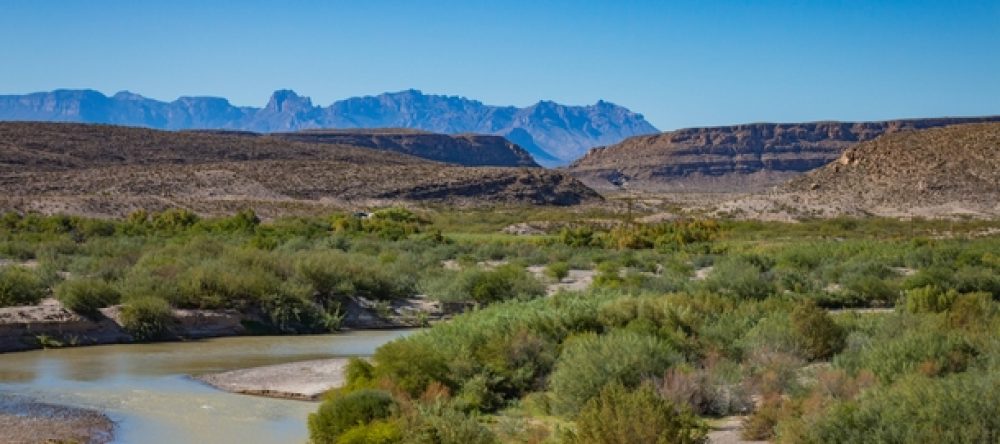
My introduction to border country was years ago in Big Bend National Park in Texas, at a place called Boquillas. At Boquillas, I’m not sure you can still do this, but 20 years ago you could walk down a little dusty path to the Rio Grande River, ring a bell, wait a while, and a thin old man with a creased face and a bowed back would pole a little raft across the river, smile and hold out his hand and help you on board the raft, and you could pay him a couple of dollars to pole you across to the other side. There were no border guards, no walls, no signs, no passports, just a smiling man to pole you across. And when you get to the Mexican side, you see mountains that look the same as on the US side, the same dusty path leading up from the river, but the path is lined with children wanting to sell you a rock for a dollar. And in the tiny dusty town, there’s a cantina where you can get a bean burrito and a Dos Equis, and while away the afternoon while a giant fan blows hot air out of the corner, and a man tries to drown out the noise of the fan with a guitar.
And then you walk back down the dusty road to the river, and the same thin old man as before smiles and holds out his hand, and poles you across again, and you’re back in your home country, knowing that it’s a different place, yet not so different. People who live in the border country know that people move across it all the time, and yet if you look at the border in larger perspective, over centuries instead of years, you realize that it’s not just the people who move, it’s the border that moves, so that the same piece of land can be sometimes in one country and sometimes in another, which explains why the border country is a land of its own, with constantly shifting language, customs, and culture.
Bill Countryman, in his book Living on the Border of the Holy, says that’s the kind of land we live in as priests and deacons – we live in the border land between the physical, material world we are so accustomed to, and the greater spiritual reality that surrounds us at all times and in all places. He writes about this border country we live in: “It is a country in which, at privileged moments of access, we find ourselves looking over from the everyday world into another, into a world that undergirds the everyday world, limits it, defines it, gives it coherence and meaning, drives it. Yet this hidden world is not another world, but the familiar world discovered afresh. It is the everyday world seen at new depth, with new comprehension…. In the border country one discovers connection, roots, limits, meaning. To live there for a while is like having veils pulled away. In the long run we find that the border country is in fact the place we have always lived, but it is seen in a new and clearer light.”
In one sense, there’s a bright line between us and God, between life and death, between humanity and divinity. But in another sense, this borderland we clergy live in is a porous country, with the reality of one world constantly pouring through into the reality of the other. If we’re lucky, we sometimes get to take a day trip to the other side and see what it’s all about, and on our best days we priests and deacons can manage to catch a glimpse of the greater spiritual world, through our prayers and our Bible study, through the great privilege of standing at the altar of our Lord Jesus Christ, through our constant witness at the border of life and death with the people we pastor through baptism, marriage, illness, and burial, through our adoption as best we can of the ministry of loving our neighbors as Jesus has loved us. In all these things we are living on the borders of the holy. We enact the sacraments, we allow the sacred to pour through the ordinary things of this world, we interpret the world to the church and the church to the world.
I remember about a month after I was ordained a priest, I had been through the whole thing: COM and CPE and CDSP, and rounds of approvals and exams, and two ordinations, and I was finally a priest. And about a month later, I had a dream, in which I went back to medical school and became a doctor, and in my dream I was thrilled and happy because I was finally doing something useful with my life. Now, I have never wanted to be a doctor – but I think that dream pointed to a deep insecurity that we clergy sometimes have about our calling – that it’s not really much use to anyone. There’s a part of what we do as clergy that seems impractical, ridiculously romantic, absurdly non-useful for the pressing urgency of our human lives. And yet I think living on the borders of the holy could possibly be the most useful thing any of us could do for the sake of the people we serve. It is our great service to the world – to live in the border country and to constantly call people’s attention to the greater reality that lives on the other side.
If you look at Mary of Bethany in the gospel today, that is what she is doing. Here is Jesus, who Bill Countryman says is not only the true high priest, but “is the very border country in which our human priesthood is lived out; Jesus is the HOLY made flesh.” Jesus lived constantly in that border country, in fact he WAS the borderland, where human and divine are both fully present.
But Mary is the priest, the deacon, the border dweller, who sees the truth of what is happening and who takes priestly action to embody it with ritual. People say women weren’t ordained till 40 years ago; I call BS (as Emma Gonzalez would say), because if there is any clearer picture of a priest than Mary today, I don’t know what it might be. Most people would see an ordinary dinner with friends; Jesus though is busy planning his next day’s arrival into Jerusalem, his great demonstration on a donkey (a donkey!). And Mary understands what no one else sees: she sees the truth of what is coming, she somehow knows he is on his way to the cross, and she anoints Jesus for his death.
And haven’t so many of us been there? Haven’t many of us stood in the border country, seen the death of a beloved parishioner coming before the family understood that was the story being enacted? Haven’t many of us anointed our beloved friends for their burial, prayed over them for them to see and know the greater reality surrounding them, felt the presence of God with them, been the one to declare the moment of their crossing that border? I know I have. And it has been an incredible privilege to stand with people in the moments of their greatest reality – to give thanks for them at their birth, and to anoint them for their death, and to walk with them through all the times in between, and to declare the truth that God is present in all of it.
And haven’t we priests and deacons declared other truths too, the truth of God’s love for us in Jesus, the truth of our calling to love one another, the truth that the border we see between life and death, between us and God, between the ordinary and the transcendent, is not so much a clear bright line, but rather a porous boundary, with God’s love pouring across it and surrounding us at every moment of our lives?
And so many of us have enacted the truth of that love by crossing other borders – by entering into prisons and being the visible presence of Jesus. By working amidst heartbreak, poverty, and disaster, and bringing life and hope and healing. By healing the sick and feeding the hungry and clothing the naked and proclaiming the year of the Lord’s favor. By standing at the altar of our Lord and declaring that the common things of bread and wine are the very body and blood of our Lord, given for us. By being a light to the nations, to open the eyes of the blind and bring God’s people out of darkness.
Bill Countryman says “The only absolute qualification of a priest” (by which he means all baptized Christians who are called to minister to others) “is insight, an insight that comes from some encounter with the arcana, some time spent in awareness in the border country.” And haven’t we had the privilege to be called to that ministry of insight, to be priests and deacons (and even bishops) as Mary was, to proclaim the truth of what is happening in our world in the midst of the everyday and ordinary? That’s the truth of God’s love that is not separated from us by some great divide, but is living and present and pouring across into our lives through the borderland that is Jesus, fully human and fully divine.
So much of our lives as clergy are filled with the mundane – the budgets, the bulletins, the vestry meetings, the people who have urgent complaints about the flowers and the music and the way someone didn’t clean up the coffeepot right. Sometimes this calling can be, let’s face it, irritating and draining. Sometimes people can focus on us in unhealthy ways, blaming us for their problems with God, or else elevating us to a holy status we don’t deserve. Sometimes we can start to believe our own press. And sometimes it’s easy to forget the truth of our calling, our citizenship in this border country.
But the truth is, Jesus was the ultimate deacon (who said, “I am among you as one who serves.”) Jesus was the great high priest, the great shepherd of the sheep. Jesus was the breaker of barriers, the crosser of borders, the builder of bridges, not walls, between God and this ordinary everyday world.
And thank God for this calling of ours – this calling to live out the ministry of Jesus in this holy border country called the church. This is a calling that, for us too, means building bridges instead of walls, breaking down the divisions between people, looking for the sacred in the everyday, respecting the dignity of every human being, doing loving acts of service, speaking the words that bring the gospel to life in this world, reenacting the ritual acts that make the everyday sacred. Re-forming our world in the image of Christ, the crucified one, the borderland between the human and the divine.
And thank God for the one thing that we ultimately know is true: the absolute truth of our faith that we proclaim this Holy Week and Easter. The truth that one day we will approach that border for a final time, that border that is a bright white line between this life and the resurrection life that is promised us through our Christian faith. And we will find that it is not a wall, but only a border, and it will be our turn to cross over that border from life into a new kind of life that we don’t yet understand. And we will look, and the man poling the boat across the river, holding out his hand to us in welcome, smiling as we approach the border, will be Jesus Christ our Lord.
 Today is Good Shepherd Sunday, which happens every year the 4th Sunday of Easter – the Sunday when we get to read the beloved 23rd Psalm. And when we read it, we often think of its images as soft pastoral things, in pastel colors with sweet lambs frolicking in green fields. But the truth is that the 23rd psalm is utterly realistic about the dangers of our lives – about the valley of the shadow of death that we all travel through at times, that we need a shepherd to help us face. Many people believe that this psalm was written by David himself, the shepherd boy who grew up to be the great king – and of course he knew about herding sheep, its dangers, its discomforts, the fact that the shepherd must be prepared to face wild beasts and dangerous rock ledges and all kinds of perils for the sake of his sheep. But the striking thing about this psalm is that King David does not claim to be the shepherd of Israel – he knows God is their shepherd. He knows that human leaders fail, but God can be utterly trusted. And so he puts his trust in God to lead him through the many valleys of the shadow of death of his own life, his own mistakes, his own heartbreaks. And when God does lead him through those valleys, David’s cup runs over with gratitude, and he knows that he will dwell in the house of the Lord for ever – God will never abandon him.
 Why was Jesus baptized, and what does his baptism mean for us as baptized people? One of the all time great baptism scenes in movies shows us one particular theology and idea about what baptism means: O Brother, Where Art Thou. The three escaped convicts, led by George Clooney, are walking through the woods when suddenly mysterious figures, adressed in white, begin to appear. They are singing a classic gospel song and walking down to the river. The convict Delmer says, “Appears to be some kind of a congregation.” They watch as one after another of the white-robed owiokw walks into the river and gets dunked by the pastor. Delmar gets inspired. He goes running down into the water, pushes his way to the front, and in his dirty brown clothes, gets dunked. As he comes up out of the water, he shouts out, “Well, that’s it, boys, I been redeemed. The preacher done washed away all my sins and transgressions. It’s the straight and narrow from here on out, and heaven everlasting’s my reward.” George Clooney says, “Delmar, what are you talking about? We got bigger fish to fry!” Delmar says, “The preacher said all my sins been washed away, including that Piggly Wiggly I knocked over in Yazoo.” George Clooney says, “I thought you said you was innocent of those charges.” Delmar says, “Well, I was lying and the preacher said that that sin’s been washed away too! Neither God nor man’s got nothing on me now. Come on in, boys, the water is fine.”
 This came to mind for me as I was reading today’s gospel story. John Chapter 10 is known as the Good Shepherd Discourse because in it, Jesus says I am the Good Shepherd, and offers an extended meditation on what that means. We tend to think of this as a kindly, pastoral, comforting set of images. Jesus as the Good Shepherd goes in our minds with Psalm 23, a wonderful psalm of comfort and assurance that God will be with us throughout our lives, restoring our souls, leading us beside still waters, comforting us in the valley of shadow of death, promising us that we will dwell in the house of the Lord forever. And certainly this is part of what Jesus wants us to understand, when he calls himself the Good Shepherd – we can trust and depend on him. He will never lose a single one of his sheep. He will care for us and give us eternal, abundant life.
 I smelled that smell in Church of the Holy Sepulchre in Jerusalem, on the anointing stone where supposedly Jesus’ body was laid out and anointed for burial (picture above). People still come to that spot and anoint the stone, weeping and praying and crying out their love for Jesus as they rub it with oil, so throughout the whole vast church, from the place of Jesus’ death to the tomb where he arose you can turn a corner and catch another whiff of the sweet scent of nard.
 A Good and Joyful Thing