
Sermon for Palm Sunday 2013

Scriptures for today are here.

I have never been fond of roller coaster rides.  The slow chug up to the top, looking out at the crowds and the amusement park below, the hesitation as the car reaches the top, the fear that wells up as you realize what is about to happen, the sudden swoosh as the car leaps over the peak and hurls you straight down at the ground, the dizzying whirls and loops as your stomach leaps up into your chest.  All these are things I can live without.

Well, if you don’t like roller coaster rides, then Palm Sunday may not be your favorite day at church – because this liturgy is like nothing so much as a huge, dizzying roller coaster ride, hurling us from jubilant high to stomach-churning low with barely a pause for breath.  It is a day of polar extremes – from the beginning of joy and jubilation, as we hail Jesus as our king and shout Blessed is he who comes in the name of the Lord!  Hosanna in the highest! – to the dizzying drop into darkness and sorrow as we watch Jesus die, slowly and painfully, on the cross, with helpless loved ones looking on.

This is a day so bipolar that we have to give it two names:  the official name of this day is Palm Sunday/Passion Sunday.  And if you want to ask, why is the Palm Sunday/Passion Sunday liturgy so strange, why couldn’t they adopt one theme – either Palm or Passion – and stick with it– there are several excellent practical answers: the foremost being the fact that you truly cannot experience Easter as a day of resurrection, unless you have also experienced the death that preceded resurrection – you can’t have Easter without Good Friday.  If you try, you will end up with celebration that involves pastel colors, eggs, bunnies, visits from grandma, but you will not have Easter.  Since many people will not or cannot worship on Good Friday, our calendar is set up so that we all experience some of Good Friday today.

Fair enough–but there is more to this roller-coaster day than that.  Because when I read the gospel, I think Jesus set this whole thing up knowing that it would come out exactly as it did.

To give you some context, Marcus Borg and John Dominic Crossan (two writers whose theology I don’t agree with, but who give interesting historical context), in their book “The Last Week,” describe two processions arriving in Jerusalem that day.  From the west arrives a column of Roman soldiers, Pontius Pilate at their head; though they live and prefer to stay in Caesarea Maritima, the new Roman capital of Judea on the coast 60 miles to the west, once a year at Passover, they make the journey to Jerusalem.  They come, not out of any reverence for the Jewish festival, but in order to keep an eye on the population and the 200,000 pilgrims who swell a town of 40,000 to celebrate the Jews’ deliverance from an earlier empire that held them as slaves, and to squelch any trouble that might arise.

So imagine the Roman procession, say Borg & Crossan: “a visual panoply of imperial power: cavalry on horses, foot soldiers, leather armor, helmets, weapons, banners, golden eagles mounted on poles, sun glinting on metal and gold.  Sounds: the marching of feet, the creaking of leather, the clinking of bridles, the beating of drums.  The swirling of dust.  The eyes of the silent onlookers, some curious, some awed, some resentful.”

The Roman procession demonstrates not only Rome’s power, but also Rome’s theology:  Caesar was called Son of God, Lord, Savior – he was considered divine.

On the other end of town, from the east, an entirely different kind of procession is occurring, almost as a parody of the first, certainly as a challenge.  A ragged prophet from a no-account town in the northern countryside, has found a donkey to ride into Jerusalem; his crowd of followers follow him, proclaiming him king, and curious onlookers who are avoiding Roman procession on other end of town flood into the streets to join in the mayhem – not necessarily understanding what the fuss was about or even knowing about Jesus and his mission, but enjoying the insult to Rome.

Jesus has chosen this mode of entry to not only proclaim himself king, a king of peace, but also deliberately to set up a contrast and a challenge to Rome.  If the Roman procession describes the world as it is, a world ruled by power and brutality, Jesus’ procession describes the world as it should be: a world that recognizes and hails the Son of God when he comes, bringing healing and forgiveness.

Jesus does this knowing that Rome’s answer will be swift, unhesitating and brutal – knowing that the fate of anyone who challenged Rome was slow death on a cross.

And Luke, our gospel writer, of all the four gospel writers the one who writes most from the heart, catalogs the emotions of the week with precision:  the shouting; the exultation so fierce that the very stones might cry out; the betrayal; the arrest in the garden; the armed defense that Jesus stops by healing the ear of the servant; the denial and then the bitter weeping of Peter; the trial; the complicity of God’s Temple in the death of God’s Son; the contempt of Herod and the soldiers; the sudden friendship of two incompetent tyrants, Herod and Pilate; the release of an insurgent terrorist while the king of peace is put to death; the weeping of the daughters of Jerusalem; the crucifixion; the prayer, “Father, forgive them, for they do not know what they are doing”; the women watching from afar. The darkness. The death.

It is a roller coaster ride from jubilation to agony, this Palm Sunday / Passion Sunday.  And why would Jesus set us up for this?  Why take us on this ride, why go to Jerusalem at all, why not hide out till all the fuss blows over and live to minister another day?  Why come riding into Jerusalem in a way guaranteed to get him killed?  Why celebrate this colossal disaster in this liturgy of Palm Sunday / Passion Sunday?

Jesus is determined to get himself killed, because he believes that dying is his mission. That somehow, the brutal death that he dies will display a kind of kingship that puts the paltry human kingship of Herod and Pilate to shame.  That his death will somehow open a path for all of us of reconciliation with God.

How does his death help us?  Luke, our gospel writer, gives us a clue, a new understanding.  The executioners nail Jesus to the cross, and he responds, incredibly, with love: Father, forgive them, for they do not know what they are doing.

The Son of God is in physical agony – and yet the love of God looks at people who are doing this terrible thing, sees that the violence they are doing, the violence that has become their way of life, has de-humanized them, has left them ignorant people who hurt others without thought.  And the sight of a human being de-humanized by the sin he is committing is so horrifying to the Son of God that it outweighs even the pain of crucifixion.  Jesus loves his executioners so much he wants them forgiven, reconciled, restored – as the centurion will be restored, praising God by the end of this story.

Jesus loved the centurion, his head executioner. And Jesus loves us too –every bit as much.  Even though we sometimes don’t know what we’re doing, even though we are sometimes de-humanized by our own sins.

The great poet W.H. Auden was asked once why he was a Christian, instead of a Buddhist or a Confucian, since all these religions share similar ethical values. And Auden said, “Because nothing in the figure of Buddha or Confucius fills me with the overwhelming desire to scream, “’crucify him’.”

Like the crowds in Jerusalem who one day shouted Hosanna, and  days later shouted out for him to be crucified, we are not innocent bystanders.  We are the same people shouting Hosanna and Crucify him.  As the Episcopal priest Fleming Rutledge says, “The liturgy of Palm Sunday is set up to show you how you can say one thing one minute and its opposite the next.  This is the nature of the sinful human being.”  It’s the nature of each one of us.

On the cross we see Jesus identifying with the innocent victims of the world, those put to death, mired in poverty, stuck in hopelessness, homelessness, or despair, those who watch as their loved ones suffer, those who have lost their way and those who have nothing left – we see Jesus giving his life for them.

But it is not only the suffering victims Jesus identifies with on the cross, it is the other extreme too: the torturers and perpetrators, the arrogant and the guilty.  When Jesus says, “Father, forgive them, for they do not know what they do,” he is taking on the burden of the innocent and the guilty.  And as we shout the words Hosanna and Crucify him, we recognize that we are both of these things – the victims who need to be rescued, and the sinners who are causing their suffering.

As Rutledge says: “he makes himself one, not only with my pain but with my sin–because I myself, and you yourselves, and all of us ourselves, are sometimes victims of others and sometimes torturers of others and sometimes both, and when we recognize this we are, as Jesus says to the scribe, ‘not far from the kingdom.’”

So here we are, on this dizzying roller coaster of a day, hovering on the brink of disaster, careening madly downhill into Holy Week.  And yet here we are, not far from the kingdom of God.  As we veer downhill, there is one still point in this turning, churning world: the Son of God is motionless, suspended on the cross – fixed there by his love for you and for me.
Sermon for 3.17.13

Scriptures for today are Here

This is what life is like:  you can be going along, knowing what you’re doing, pretty sure of what your life is going to be like tomorrow, pretty confident in who you are, when suddenly life comes along and interrupts you.  Sometimes the interruptions are good: you get a job offer, you have a great idea, you meet someone who gets your heart beating faster, a child is born.  Sometimes the interruptions are bad: you find a lump where there wasn’t one before, you get a phone call in the middle of the night, you find out that someone you love has been in trouble for a long time and you never knew.

These interruptions turn your life upside down, make you re-think who you were and where you thought you were going, require you to focus on the few things that are most important and let the unimportant things go.  And it’s in these changes, these interruptions, these transition points in life, that many of us find God: we find that Jesus, who maybe we’ve believed in in some way, maybe we’ve worshiped, but who was never real to us, suddenly becomes the sustaining presence that gets us through, that helps us see our way to the new kind of life we are being called to live.

Which is exactly what happened to St. Patrick.  You may think of him as a leprechaun-looking person drinking green beer.  But Patrick of Ireland was real, and human, and a true hero of our faith – and he had his life utterly and entirely interrupted one day.  He was British (not Irish), from a Christian family who was prominent in the Roman Empire-dominated government of Britain when he was born, around the year 390.  His life was going just fine – until it was interrupted.

At age 16, he was captured by Irish pirates, and was  taken to Ireland, where he was sold as a slave.  He lived in Irish compound with other slaves, some of whom would have been Christians like him, who might have carried on Christian traditions, and he also spent a lot of time out on the hillside, tending his master’s flocks.  In his trouble, fear, loneliness, suffering, Patrick began to recall the Christian teachings of his family, began learning to pray for comfort.

In his memoirs, he wrote:  “After I came to Ireland, every day I had to tend the sheep, and many times a day I prayed – the love of God and his fear came to me more and more, and my faith was strengthened.  And my spirit was moved so that in a single day I would say as many as a hundred prayers, and almost as many as night, and this even when I was staying in the woods and on the mountains; I used to get up for prayer before daylight, through snow, through frost, through rain, and felt no harm.”

Like so many people before and since, Patrick came to know Christ in the interruptions of his life:  when he was suffering, when he had hit bottom, when he was living without hope.  That’s when Christ became for him a tangible presence, a beacon of hope.

After 6 years, his life was interrupted again: he had a dream that a boat was waiting, escaped from his master, walked to the seacoast, found a boat there, just has it had been in his dream, talked his way on board and sailed back to Britain.  Back home with his family, he studied to become a priest, and settled down to live a comfortable life at home – when his life was interrupted again.  He had another dream, in which he heard the voice of the Irish, saying, “We beg you, young man, come and walk among us once more.”  He got himself ordained bishop of Ireland, and went.

Ireland at this time was a pagan country.  It had never been part of the Roman empire, so it was not civilized in the way Roman people would expect, and therefore not ripe ground for evangelization the Roman way.  Roman Christians assumed you had to be civilized to be Christianized, with government, towns, transportation already in place.  Ireland wasn’t like that: it was tribal and nomadic, with no towns, no settlements, no roads bigger than a cowpath.  People moved around from place to place, never settling in any one place.

But Patrick understood the Irish from inside out, understood how to talk to them, believed God was already working among them, knew they were ready to hear about Jesus.  And he began to evangelize them, with a very specific method.  He would send out missionary groups of a dozen or so, including some priests but mostly lay people, and would establish a sort of monastic community.  The community would be Christian, founded on prayer and work and study like any monastery, but composed of men, women, children, married people and single people.

That community would settle, begin to farm and work, would welcome guests, engage them in conversation, pray with them, encourage questions.  They would live a life steeped in prayer, where every common activity was seen as happening in the presence of God, where they had prayers for everything, for milking cows, for lighting fires, where every aspect of life was God-steeped and God-blessed.

Their highest priority was hospitality, so every monastery had a guest house, and when anyone without a place to stay would show up – a laborer without work, say, or a teenager who had been abused – interrupted – the community would drop everything else and make welcoming that stranger their highest priority.  And they would invite the newcomers to join them in prayer, work, study.  And slowly as people joined their communities, they would find themselves integrated into community life, community beliefs.  They belonged first, and then they started to believe.  And as they began to believe, they were welcomed into their community officially through baptism.  And as the communities grew, they would send out new teams to settle in new places.

Within 2-3 generations, Patrick and his followers had converted all of Ireland, making him one of the greatest evangelists the world has ever known.  Especially since, when the Roman empire fell soon afterwards, and most of Europe was plunged into the Dark Ages, and not only Christianity but most of the knowledge, art, architecture, literature of the ancient world was lost, Irish monks preserved a lot of that learning, and eventually became the missionaries who re-evangelized Britain and Europe for the Christian faith.  Which is “How the Irish Saved Civilization,” according to the book by Thomas Cahill.

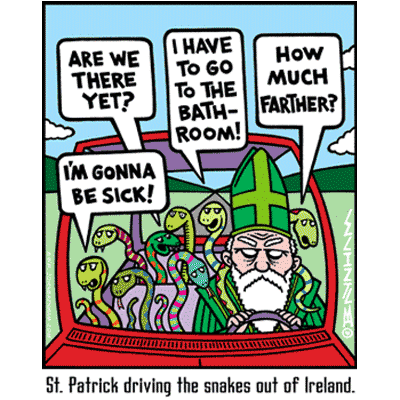
Patrick was no cartoon character.  Well, OK, there is one cartoon I like.  Here it is.

st_-pat-driving-snakes-out-723585

Other than that, Patrick was no cartoon character – he had a burning intensity, a driving passion to share the gospel.  All stemming from that interruption in his life – that lonely, frightening moment when he was captured, and he found Christ right there with him.

And what is so interesting today, on his feast day, is that we read the words of Paul, a man whose passion to share the gospel was similar.  In Philippians today, we read Paul’s story: he had everything – learning, respect, a promising career, position in his community – and then he experienced a crisis.  On the road to Damascus, he was blinded by a light from heaven, he heard the voice of Jesus saying, “Saul, Saul, why do you persecute me?” – and he entered into a three-year period of rethinking his entire life, learning about Jesus, and changing everything he had ever expected or hoped for.

From the greatest persecutor of the Christian faith, he changed into the greatest evangelist – taking the gospel to new people in new ways.

And Paul says in our New Testament lesson today – paraphrasing – I had everything, but I gave it all up because only one thing was worth having – knowing Christ Jesus my Lord.  Nothing else is worth anything, he says, compared to the value of knowing Christ and making the power of his suffering and resurrection my own.  Not that I deserve to make it my own, he says, but I place my faith in him, and therefore everything God has done for Christ, God will do for me.

Out of crisis, out of the dark night of the soul, this man learned to know Christ – and it changed not only his life, but the history of the world.

Yesterday here at Nativity, we had our Good News Summit – our time to talk together about what good news we have to share with other people.  Evangelism is a word that simply means “good news.”  And we may hear it as something to be avoided, something that fundamentalists do by scaring people with threats of hell.  But evangelism is something much simpler than scaring people into believing the way we want them to believe–evangelism simply means telling good news.

For most of us, there is good news to share – we are in church for a reason.  Something in what we experience in our Christian faith brings us hope and joy.  At yesterday’s summit, we talked together about times in our life when we have felt God’s presence strongly, when we have been grateful for that awareness of God being present with us.  And we discovered that almost everyone has at least some moment they could point to when they were aware of God reaching out to them.  Maybe a dramatic moment like Paul, being struck by a blinding light and hearing a voice from the clouds.  Or maybe a less obvious, slower moving awareness like Patrick, on the hillside tending the flocks, praying for God to be with him in his loneliness and homesickness, and being aware of God’s presence and strength.

Some of us have experienced miracles through God’s presence; some of us have learned how to forgive and how to accept forgiveness; some of us have had our own darkness lightened as the hand of God reached out to give us comfort.  Because that’s what Christ does: he comes and sustains us through interruptions in our lives.

And all of us know other people in similar situations.  I read a story about a woman who was having a hard time in her life, getting together with 6 other women on a Saturday, who offered her comfort.  But she needed more, she felt she needed the presence of God in her life, so on Sunday she got up and went to a nearby church.  To her amazement, she looked around and saw 5 of the 6 women she had talked to the day before right there in the church.  Which told her two things: first, that it was a sign that she was in the right place.  But second, that not one of those women, offering her comfort, had even thought to invite her to church.  She had no idea they even belonged to a church – they never talked about it.

We have something to share, something that can help people, something that can mean something to people.

We discovered at our Good News Summit that the time when people are most open to coming to a new church is the time of interruption: good changes in life, like marriage, relocation, birth of a child; or difficult changes like divorce, death in the family, illness, crisis.  These are the times when people are looking for community support, when they need the reassurance of God’s presence.

And a church community can provide it.  All we have to do is invite them to share in the good news we have found, welcome them as honored guests to God’s earthly kingdom right here on earth.

Sermon for 3.10.13

Tony Campolo is a famous evangelical preacher, one I admire greatly. His most famous story is this.  He flew from east coast to Honolulu, and when you fly that far west, you wake up really early, and can’t get back to sleep.  So he woke up at 3:00 in the morning.  He was hungry, so he went out looking for a restaurant that was open at that time of night, and finally found a greasy spoon diner.  He went in, sat on a stool at the counter, and the owner, a big man wearing a dirty apron, handed him a plastic menu with grease stains on it.  He didn’t want to touch it, so he said, “Could I just have coffee and a doughnut?”

The owner wiped his hand on his dirty apron, reached out and picked up a doughnut, and slapped it on a plate in front of Tony.  So Tony was sitting there with his dirty doughnut, when the door opened and 7 or 8 prostitutes walked in, sat on stools at the counter on either side of him, so he said he sat there and made self small.

As he sat there, the prostitute to his right said to her friend, “Hey, I just remembered, tomorrow is my birthday, I’ll be 39.”

Her friend said, “What do you want me to do about it? You think you’re special?  You want me to throw you a party or something?”

The first woman said, “I don’t want you to do anything, what do you have to be so mean for, I’ve never had a birthday party in my life.  I’m just saying, tomorrow is my birthday.”

The women sat there a while longer and then all left, and Tony said to the owner, Harry, “You know that woman sitting next to me?”

Harry said, “You mean Agnes? Let me tell you about Agnes.  Agnes may be a prostitute, but she is one of the good people in this world.  She has a heart of gold.”

“Yes,” said Tony, “I have an idea, what if I come tomorrow and decorate the place for her birthday, and buy her a cake, and we can surprise her?”

Harry said, “That’s a great idea, and I’ll make the cake!”

The next night, Tony came in about 3, had streamers and ribbons and signs that said  Happy Birthday Agnes!  He had everyone cued up so about 3:30 when Agnes and her friends walked in, everyone shouted Happy Birthday!

Agnes looked like she’d been hit by lightning.  She stopped dead in the doorway, and everyone started singing Happy Birthday.  Harry guided her over to a table, made her sit down, brought the lit-up birthday cake out, set it in front of her.  She just sat there with tears pouring down her cheeks, till Harry said, “Come on Agnes, you’ve got to blow out the candles.”  But she couldn’t, so Harry did it for her.

Then Harry handed her a knife and said, “Cut the cake now, Agnes!”

She sat there with tears on her face, and finally she said, “Just a minute, can I just carry it next door to show my mother and I’ll be right back?”

She walked out the door, holding the cake like it was made of gold, and everyone in the place stood there in silence.  So Tony said, “Tell you what, let’s say a prayer for Agnes.  He prayed for her to have a happy birthday, for her to recover from all the things men had done to her, for this year to be a new beginning for her,  and then he opened his eyes and found Harry staring at him.

Harry said, “You lied to me!  You said you were a sociologist, but you’re a preacher!”

Tony said, “Well, I’m a sociologist AND a preacher.”

Harry said, “What kind of church you belong to?”

Tony said, ”I belong to the kind of church that throws birthday parties for prostitutes at 3:00 in the morning.”

Harry said, “No way, there ain’t no church like that.  If there was a church like that I would belong to it.”

Well, it might be hard for us to understand or to accept, but Jesus started the kind of church that throws birthday parties for prostitutes at 3:00 in the morning.  He was famous for hanging out with prostitutes, sinners, and tax collectors, and when he got criticized for it, he said, “People who are well don’t need a doctor – people who are sick do.”  And he tells today’s parable of the Prodigal Son in answer to the scribes and Pharisees who complain, “this fellow welcomes sinners and eats with them.”

Associating with those kind of people brings shame on him, yet Jesus doesn’t flinch, doesn’t shy away from the shame of these sinners.  Instead, he tells a very interesting story – the most famous of all his parables.

The risk is that it can become too familiar: we hear “There was a man who had two sons,” and we know what is coming, we are accustomed to the idea that no matter what we do, God will forgive us and welcome us home.

And what comfort that can bring us – what assurance of God’s love.  God is like a loving parent who watches us run away with all the gifts we have ever been given, watches us misuse and squander those gifts, waits, watching the road and praying for us to come home, and comes out running to greet us before we can even get out our speech of repentance.

God is the one who doesn’t even look very closely to see if we’ve actually repented.  We can listen to this parable and say, did this boy really repent of his sins? Or did he simply act in self-interest and return home where at least he could get a decent meal?

We can ask those things, but this parable tells us God doesn’t care – the gift of welcome from God, our loving parent, comes even before we can choke out our trumped-up speech begging forgiveness, asking to eat the scraps from his table like any servant – but God refuses to treat us as servants, God insists that we are God’s beloved children.

That’s a lot of love from a parent whose heart we have broken.  No wonder we love this story – no wonder it brings us comfort.

Yet we sometimes forget about the other part of the story – the older brother who is just as alienated as his younger brother, who refuses to forgive, refuses to welcome his brother home, who at the end of the story is standing outside the party, refusing to come inside and celebrate.  Does he ever come in?  We’re left hanging, waiting for his decision.  We have to decide how it ends for ourselves.

A God who throws birthday parties for prostitutes at 3:00 in the morning?  A parent who welcomes home the prodigal son who has thrown away his inheritance, lived with the pigs, and hit bottom?  The older brother isn’t sure he wants anything to do with a parent like that.  Do we?

The thing is, this parable is the perfect story for thinking about ourselves in Lent.  Lent is the season of repentance, of cleansing, of preparation for the Easter feast.  Lent is the time when we get ready for a surprise so unexpected, a gift so glorious, that no human being can ever deserve it.

As Paul says, in Christ God was reconciling the world to himself, not counting our trespasses against us – but opening up God’s eternal home to us.  We are the Prodigals God is welcoming home, yet we are also the older brothers who stand outside and scowl, wondering if we should go into the party, trying to decide how this story should end.  Both brothers stand in need of repentance and reconciliation, both brothers need to be welcomed by their father.

And when I read this parable, I am reminded of the words of our Confession.  We confess that we have sinned against God by thought, word and deed, by what we have done, and by what we have left undone.  Yes, the Prodigal Son has done many things of which he must repent, while the older brother has scrupulously kept the rules all his life.  But both sons have left things undone – they have not loved their father with their whole heart, they have not loved their neighbors as themselves.

Lent is a time to repent, not so much of the things we have done, but of the things we have left undone – we have failed to love God with our whole hearts, we have failed to love others as we love ourselves.

And yet it turns out that Christianity is not a religion of sorrow and repentance though – so much as it is a religion of welcome, reconciliation, celebration.  Every single one of us could repent a thousand times over of our failure to love God with our whole heart, and love our neighbors as ourselves.  Our human nature leads us to love ourselves more than we love others, to act in our own self-interest, to refuse to welcome others into our embrace.

Yet the gift of God – the gift of reconciliation that God offers us – is the gift not only of complete acceptance, of open invitation, of a welcome so exuberant that God would run down the street and fling the divine arms around us at even the thought that we might return home.

It is not only that incredible gift of love, but more still.  It is the gift of letting that love come to life in us.  As we open our hearts to God, as we allow God’s love to welcome us, that love begins to take root in our hearts and grow.  We can’t love others enough under our own power, but God can love them through us.  And God’s hope for us is that not only will we accept the love God gives us, but that we will begin to learn to give it away to others, letting God’s love shine in us and through us, pouring out of us into all the people around us.

We cannot love others as we love ourselves – but God can.  And God can love them through us.

A few years ago there was a story in the news.  Julio Diaz was on his way home from his work in NYC to his home in the Bronx.  He got off the subway and a teenager put a knife against his ribs and demanded all his money.  Diaz gave him his wallet, then as the teenager turned to go, something in him made him say, “Hey, aren’t you cold, don’t you want my jacket too?”

The kid turned and looked at him in shock, and Diaz said, “Well, if you’re desperate enough to need my money, maybe you’re hungry too – want to come have dinner?”

Together, they went to the diner where Diaz ate every night, the owner and all the employees stopped by the table to talk.  The kid asked if Diaz owned the place, and he said, “No, but I come here a lot.”

The kid said, “But they all treat you like a celebrity.”

Diaz said, “That’s because I treat them nice, didn’t anyone ever tell you that that’s what you were supposed to do?”

The kid said, “Yes, but I didn’t think anyone really did it.”

They finished their meal, and Diaz said, “Well, I don’t have any money, so it looks like you’re going to have to buy dinner.  Unless you want to give me back my wallet, then I’ll be happy to buy your dinner.”

The kid turned it over.  Diaz paid for dinner and then gave the kid $20,  but he said he wanted something in exchange – he wanted the kid’s knife. The teenager reached into his pocket, took it out and handed it over.

Julio Diaz was a man who understood how to let God’s love live in him.  He understood the nature of forgiveness, he knew how to look at a person as a beloved child of God.

We are all called to be that person of love.  That doesn’t mean we allow ourselves to be victims, but it means that we always watch for the chance to love when we can – in our personal lives, in our work lives, in our communities.

God gives us the gift of love, and it is one gift that grows as we give it away.  Because love comes to us free, from the author of love, the one who always welcomes us home, and throws a party when we arrive, and tells us not to stand out in the cold, but come on in and celebrate.

Sermons by Susan Snook prior to 2013 can be found on her old sermon blog, here.